These historical family trees are charts that open in the editor on this page. Each one is drawn from named sources, most carry portraits, and every chart can be moved, enlarged, corrected and extended as a copy of your own.
The editor shows the chart as a preview, and nothing in it is saved. A chart opens in the full editor from the button above it.
The crown passes
The Tudor succession, reign by reign
The chart below grows with the scroll from Henry VII to Elizabeth I. The crown moves to each monarch in turn, and those who have died are drawn in grey. With reduced motion, every reign is listed beside the chart as it stood in 1603.
The Tudor family tree, 1485 to 1603
1485Henry VIIreigned 1485 to 1509
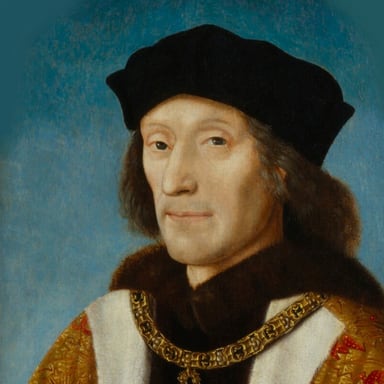
A crown won in battle. Henry Tudor defeats Richard III at Bosworth and marries Elizabeth of York, joining the two houses that fought the Wars of the Roses.
Born
28 January 1457, Pembroke Castle
Crowned
30 October 1485
Married
Elizabeth of York, 1486
Died
21 April 1509, Richmond
Heir
His second son, Henry
Source Polydore Vergil, Anglica Historia, book 26
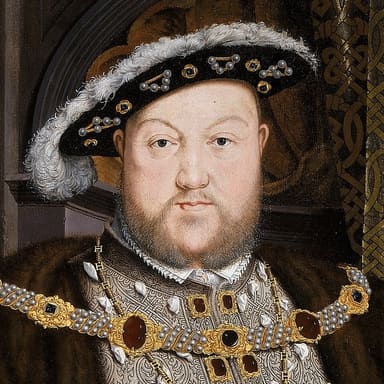
1509Henry VIIIreigned 1509 to 1547
Six marriages in thirty-eight years. Two wives are executed, two marriages are annulled, and each of three wives leaves one child who will reign.
Born
28 June 1491, Greenwich
Crowned
24 June 1509
Married
Six times, 1509 to 1543
Died
28 January 1547, Whitehall
Heir
His only son, Edward
Source Letters and Papers of Henry VIII, The National Archives
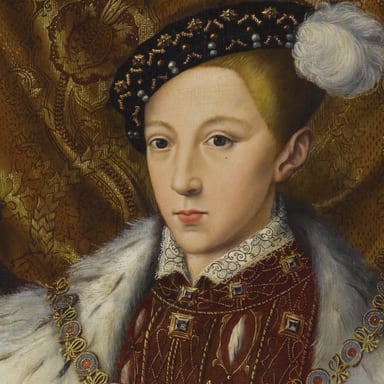
1547Edward VIreigned 1547 to 1553
The only son, crowned at nine. He rules through his uncles and dies at fifteen, naming Lady Jane Grey his heir.
Born
12 October 1537, Hampton Court
Crowned
20 February 1547
Married
Never
Died
6 July 1553, Greenwich
Heir
By his will, Jane Grey
Source The Chronicle of Edward VI
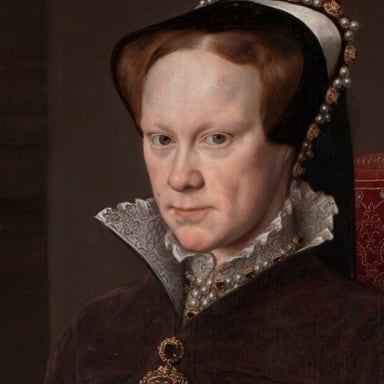
1553Mary Ireigned 1553 to 1558
Jane Grey holds the throne for nine days. Mary, daughter of Catherine of Aragon, takes it and marries Philip of Spain.
Born
18 February 1516, Greenwich
Crowned
1 October 1553
Married
Philip of Spain, 1554
Died
17 November 1558, St James’s
Heir
Her half-sister, Elizabeth
Source Calendar of State Papers, Spanish
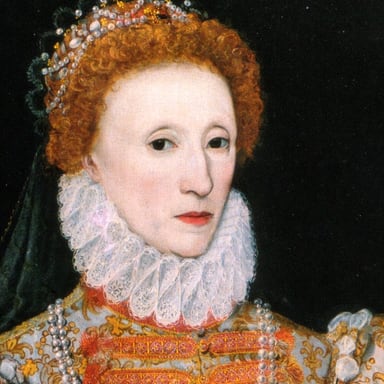
1558Elizabeth Ireigned 1558 to 1603
Anne Boleyn’s daughter reigns for forty-four years and never marries. With her the Tudor line ends.
One crown and three generations. The article sets out every reign with its dates, the six marriages of Henry VIII in one table, the three Acts of Succession, the nine days of Lady Jane Grey and the Scottish line that inherited in 1603, with a numbered source for every statement.
A regnal table of five monarchs and Queen Jane
All twenty-four people in a table you can filter by reign
Who the chart leaves out, two descent diagrams and a timeline
The catalogue lists every chart of the section. Search by the name of a family or of any person on a chart, or narrow the list by era and by kind. The house, the place and the years come from the chart itself.
Kind
Era
All 83 families are shown.
Dynasties and monarchs
Royal houses drawn reign by reign, with marriages between courts, heirs who did not live and the lines that ended.
No. 01
The Tudors
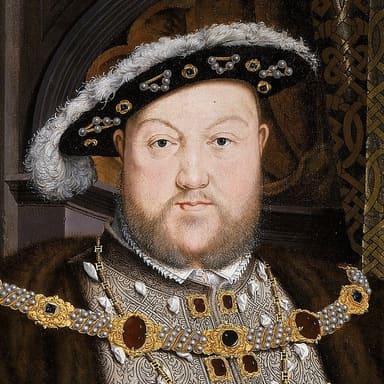
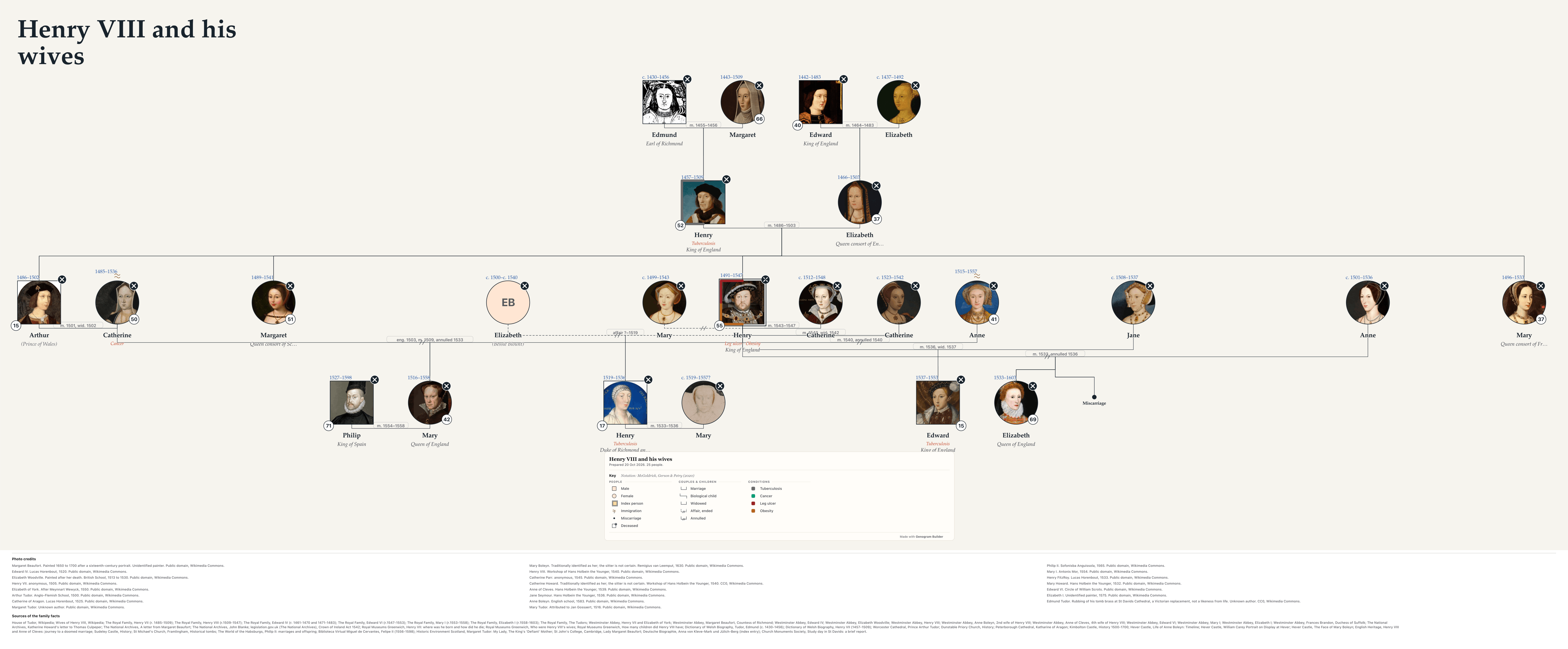
Henry VIII, his parents and grandparents, his six wives and two mistresses, and his children, drawn with the portraits that are free to use.
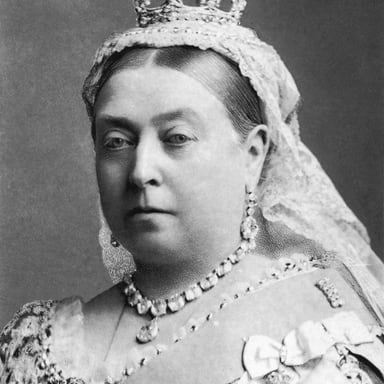
Queen Victoria, her parents and Prince Albert, their nine children and the grandchildren and great-grandchildren through whom haemophilia passed, every one with a portrait.
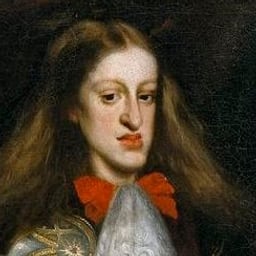
Philip I and Joanna of Castile to Charles II across six generations, every person with a public domain portrait, and the consanguineous marriages named in the notes.
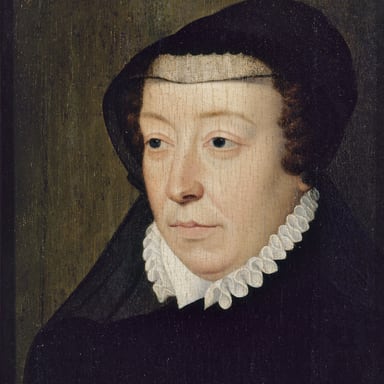
Giovanni di Bicci to Catherine de' Medici and her sons, the last Valois kings, with Popes Leo X and Clement VII and a public domain portrait for nearly everyone.
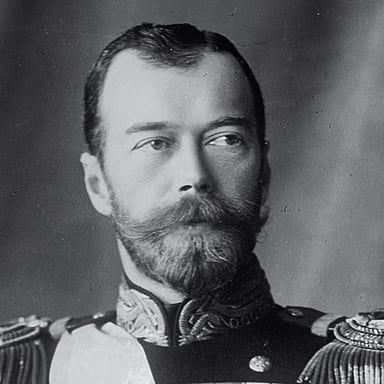
The last Russian imperial family and the Hessian family of the Empress, four generations from Queen Victoria, with a photograph or portrait of almost everyone.
William the Conqueror, his parents, Matilda of Flanders and their children, with the line through Henry I, Empress Matilda and King Stephen to Henry II.
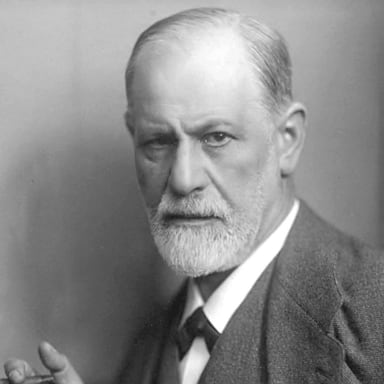
Sigmund Freud, his parents, his wife and her sister, his sister Adolfine and his children across four generations, with every photo that is free to use.
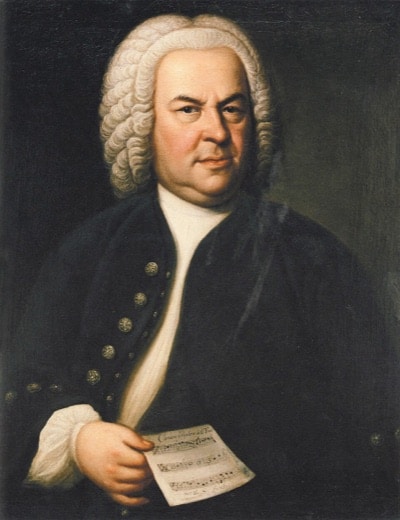
Johann Sebastian Bach with his parents, his two wives and the children who reached adulthood. Occupations show how music passed from father to sons in a family of professional musicians.
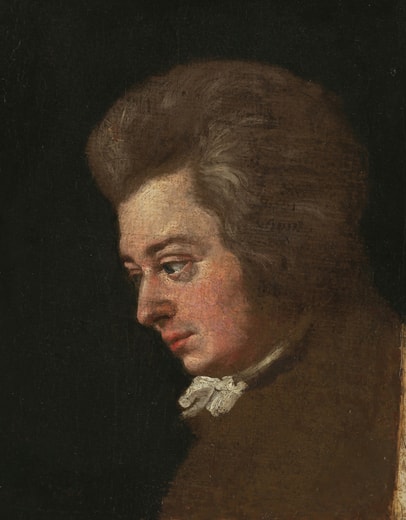
Leopold and Anna Maria Mozart, their children Nannerl and Wolfgang, and the six children of Wolfgang and Constanze. Four of those children died in infancy, and the line ended with the two surviving sons.
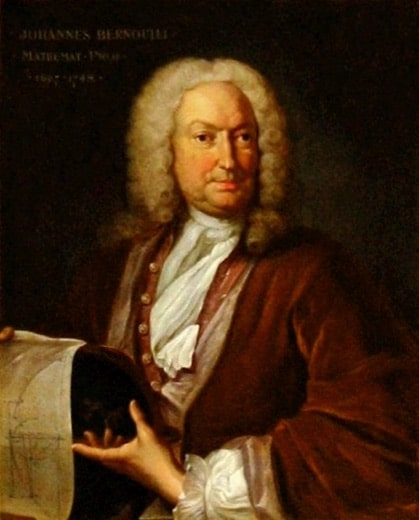
Four generations of the Bernoulli family of Basel, who produced eight notable mathematicians. Emotional lines mark the rivalry between the brothers Jacob and Johann and between Johann and his son Daniel.
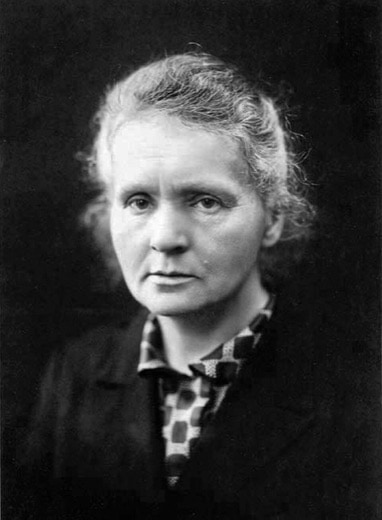
Marie and Pierre Curie with their parents, their daughters Irène and Ève, and the daughters’ husbands. The notes record the Nobel Prizes of 1903, 1911, 1935 and 1965 and the illnesses attributed to work with radiation.
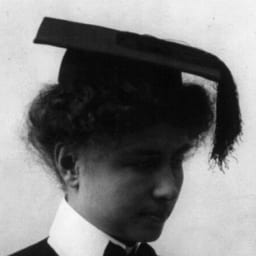
Helen Keller with her parents, half-brothers, sister and brother, and the teacher and companion who lived with her, with the portraits that are free to use.
Martin Luther King Jr. with the Williams and King ancestors of Georgia, his parents, his sister and brother, Coretta Scott King and their four children.
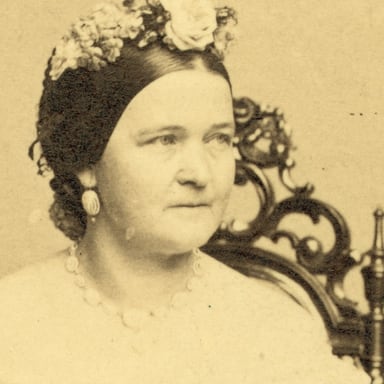
Mary Todd Lincoln, the Todds of Lexington, Abraham Lincoln, the four Lincoln sons and Robert Todd Lincoln's descendants, with a portrait or a silhouette for each.
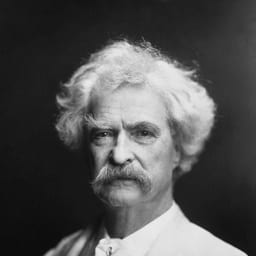
Samuel Clemens with his parents, his brothers and sisters, Olivia Langdon, their four children and Nina Gabrilowitsch, with the portraits that are free to use.
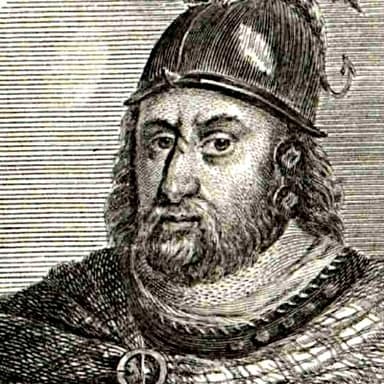
William Wallace, the father Alan named on his seal, the brothers Malcolm and John, and the wife and daughter that Blind Harry's poem gives him, marked as legendary.
The Prophet Muhammad and Khadija, their children, Fatima and Ali, Hasan and Husayn, and the Twelve Imams as Twelver Shia tradition counts them, drawn with plain name medallions.
Antipater the Idumaean, Herod the Great and five of his wives, Archelaus, Antipas and Philip, Herodias and Salome, and the kings Agrippa I and Agrippa II, as Josephus gives them.
Ibrahim with Hajar and Sarah, his sons Ismail and Ishaq, the line from Ismail to the Prophet Muhammad and the prophets of the Children of Israel, drawn with plain name medallions.
Judah and his sons, the twins Perez and Zerah born to Tamar, and the line of Perez through Nahshon, Boaz and Ruth, Obed and Jesse to David, as Ruth 4 and 1 Chronicles 2 give it.
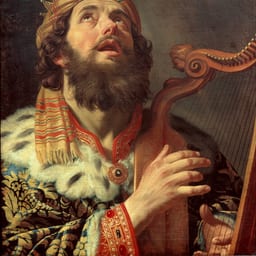
Jesse and his sons, King David with Michal, Abigail, Maacah, Bathsheba and his other wives, Absalom, Tamar, Adonijah and Solomon, and Solomon's son Rehoboam.
Levi and his three sons Gershon, Kohath and Merari with their sons, Amram and Jochebed, Aaron, Moses and Miriam, and the priests of Aaron down to Phinehas, as Exodus 6 and Numbers 3 give them.
Levi, Kohath, Amram and Jochebed, Moses with Aaron and Miriam, Pharaoh's daughter who raised him, Zipporah and Jethro, and the sons of Moses and of Aaron.
Genealogies as the old poets give them. Each chart follows one named text, since the sources do not agree with one another.
No. 17
The Olympian gods
Chaos, Earth and Heaven, the Titans Cronus and Rhea, their six children and the children of Zeus by Hera, Demeter, Leto, Maia, Semele and Alcmene. The genealogy follows the Theogony of Hesiod, with Apollodorus for the births it tells more fully.
The cursed family of Greek tragedy across five generations, from Tantalus to Orestes and Electra. Emotional lines record the killings within the family as the myth tells them.
The editor draws three kinds of chart on one notation. A chart opened from this page is a family history chart, which keeps every symbol of a genogram and adds what a dynasty needs.
Titles and reigns
A person carries titles with their years, and the chart can write the title and the reign under the name.
Houses
Each person can belong to a house, and the chart can fill people by house so that two lines are told apart.
Portraits
Each person can be drawn as a round portrait over a name plate, with the painter and licence kept in the credit.
History lines
A set of lines made for history stands beside the relationship lines of a genogram.
Typefaces
Twelve further typefaces, among them book and inscription faces, are offered to history and story charts.
Print and export
The chart exports as PNG and PDF with a free account, and it prints from the browser.
It shows who descended from whom, who married whom and in what order, with the years of each life. On these charts a square is a man, a circle is a woman, a line between two people is a union and a line that drops from it leads to a child.
Where the facts on the charts come from
The charts of the template library name their sources on their cards, the charts of myth name the text they follow, and the sources of a chart with its own article are numbered under the article. Where the record is uncertain the chart says so in a note and does not guess.
Whether the charts are free to use
Every chart opens on this page without an account. Opening a chart of the template library in the full editor, saving it and exporting it need a free account. The charts the editors publish in Community open in the full editor for everyone.
Why mythology is part of history here
A genealogy of gods is read and drawn in the same way as a dynasty, and it reaches us through named texts. Each chart of myth follows one text, such as the Theogony of Hesiod or the Prose Edda, because the texts differ.
How to add a family that is not listed
Open the editor, set the chart kind to family history in the Style panel and draw the family. A chart can be published to Community with a free account, where other people can open and copy it.
Portrait credits for this page
The portraits of the families with photos are credited with each family in the template library. The others are listed here, each with its file on Wikimedia Commons.
Johann Sebastian Bach. Elias Gottlob Haussmann, 1748. Public domain, Wikimedia Commons.