Career Genogram Template for Work and Education History
This career genogram template records the work and the education of three generations, so that the family patterns behind a career choice show on one page. Every symbol has a line for the name and a line for the occupation. Print the blank A4 sheet, edit it online or start from the worked example.
Blank sheet
Worked example, fictional family

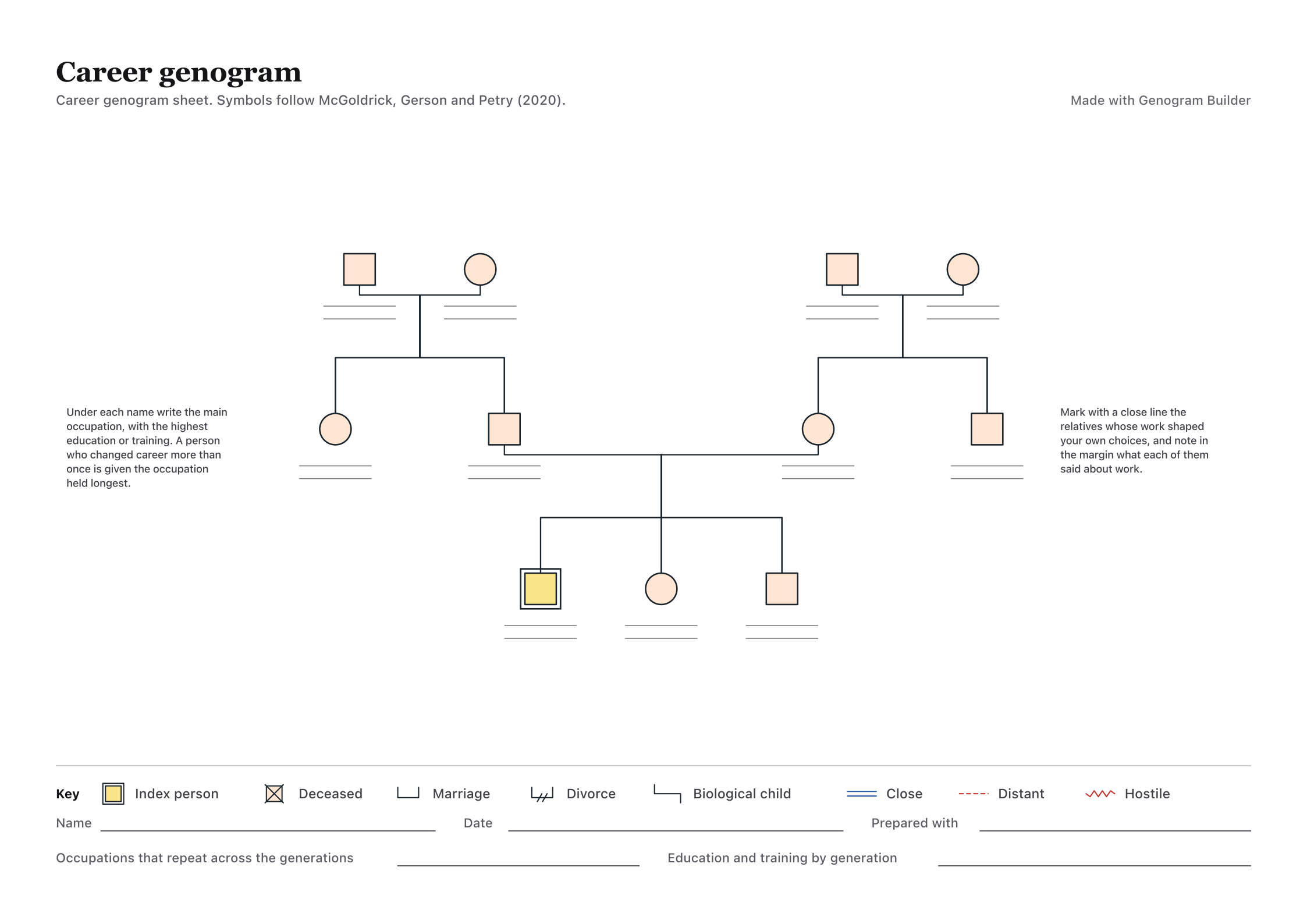
On the left is the blank sheet with a second line for each occupation. On the right is a worked example for the fictional Holm and Reyes families, with occupation and education under every name.
Edit the career genogram template online
Open the blank sheet to type your own family over the eleven placeholders, or open the worked example and change it. Either one starts a separate chart in this tab and leaves the family saved on the homepage alone.
Select a person to type the name, the years, the occupation and the education. The occupation appears under the name as it is typed, which is the second line of the printed sheet. Use Connect to draw a line of your own between two people, such as Mentor or Employed, and give it a name and a colour, and the key lists it under your lines.
Edits stay in this tab until you continue in the full editor, which keeps the chart. A visitor can edit without an account but cannot export. A free account exports a PNG, a PDF or a JSON project, with a watermark on the picture and the PDF, and Pro removes the watermark and adds SVG.
A career genogram maps the work of three generations
A career genogram is a family diagram that records what each relative did for a living, how far they went in education and how the family talked about work. It is drawn with the person whose career is in question, usually across three generations, so that the expectations, the examples and the refusals behind a choice of work can be seen together. Okiishi described the genogram as a tool for career counselling in 1987, and the exercise is still set in counselling and career development courses.
The chart is read for what repeats and for the relationships through which work was passed on. A profession that runs down one side of the family, a trade that skips a generation, a first university degree in the bottom row or a family business handed from parent to child are the patterns a careers adviser or a tutor will ask about.
The sheet gives every person a line for the name and a line for the work
The drawing has two sets of grandparents, the two parents with an aunt on one side and an uncle on the other, and three children with the index person outlined. The aunt and the uncle matter on a career genogram, because an aunt who became a doctor or an uncle who ran the family shop often shapes a choice as much as a parent does. Under each symbol the first line takes the name and the second takes the main occupation with the highest education or training.
The key names the index person, the cross for a death, the marriage and divorce lines, the line of a biological child and the close, distant and hostile lines. The fields at the foot take the name, the date, the person the sheet was prepared with, the occupations that repeat across the generations and the education and training of each generation.
Write the occupations held longest, then look for what repeats
Fill in the names and the years from the grandparents down, then the work.
- Occupations. On the second line write the occupation each person held longest. A retired person is written with the work they retired from, and a person who kept a home is written as a homemaker, which is work.
- Education. Add the highest education or training after the occupation, such as an apprenticeship, a diploma or a degree.
- Repeats. Read the sheet row by row and write in the fields what recurs, in a sentence each.
- Relationships. Draw a close line to the relative whose work the person admired, a distant line where a trade was refused and a hostile line where a choice caused a quarrel.
- Sayings about work. Note in the margin what each of those relatives said about work. It is often the most useful line on the page.
The career genogram example puts a nurse between teachers and pharmacists
The worked example follows twelve people of a fictional family. The index person is Maya Holm, born in 1998, a nurse with a BSc in Nursing who qualified in 2024 and is weighing a move into nurse education. On her father’s side, her grandfather Arne Holm was a shipyard welder for forty years, and her grandmother Astrid Holm, née Dahl, taught in one village school for thirty-four years. Their daughter Karin is an English teacher, and their son Lars, Maya’s father, is a marine engineer.
On her mother’s side, Samuel Reyes owned the pharmacy on the high street until he sold it in 2016, and Carmen Reyes, née Ortega, opened a dressmaking shop in 1982. Their daughter Elena, Maya’s mother, is a pharmacist, and their son Daniel took over the shop in 2014. Maya’s brother Jonas is an apprentice electrician, and her cousin Sofia studies fashion design.
Three lines of the chart’s own carry the story of how work was passed on. A dotted Mentor arrow runs from Astrid to Maya. An Employed arrow runs from Samuel to Elena for 1990 to 1996, the Saturdays she worked in his pharmacy, and a Took over the business arrow runs from Carmen to Daniel from 2014. A distant line between Arne and Lars marks the son who left the shipyard town for university, which his father took badly.
Read the finished chart for patterns, then ask the person
Read the occupations by row first. In the example, teaching runs down the father’s side and dispensing runs down the mother’s, and Maya’s choice of nursing sits between them. A trade skips a generation and returns, from Arne the welder to Jonas the electrician. Then read the lines, which show where a choice was encouraged, expected or resisted.
The chart does not answer the career question. It shows where to look, and each pattern becomes something to ask, such as what teaching meant to her grandmother or what her mother expects of her. Counselling students who draw their own chart for a course can find more on the assignment in genograms for counselling students.
Common questions
The career genogram template is free to print and edit
The blank PDF and PNG download without an account, and both the blank and the worked example can be edited online as a guest. Exporting an edited chart needs a free account, and the free export carries a watermark.
How many generations a career genogram needs
Start with three. That reaches the grandparents, whose work is often remembered as a family story. A fourth generation helps only when a business or a profession goes back that far.
How to show a family business
Write the business as the occupation of each person who worked in it, and draw a line of your own from the founder to the person who took it over. Name the line in the key, as the example does for the dressmaking shop.