Four-Generation Genogram Template with a Clear Key
This four-generation genogram template puts the great-grandparents, the grandparents, the parents and three children on one landscape sheet, seventeen people in all. Print the blank A4 worksheet, edit it online, or compare it with the same sheet filled in for a fictional family.
Blank sheet
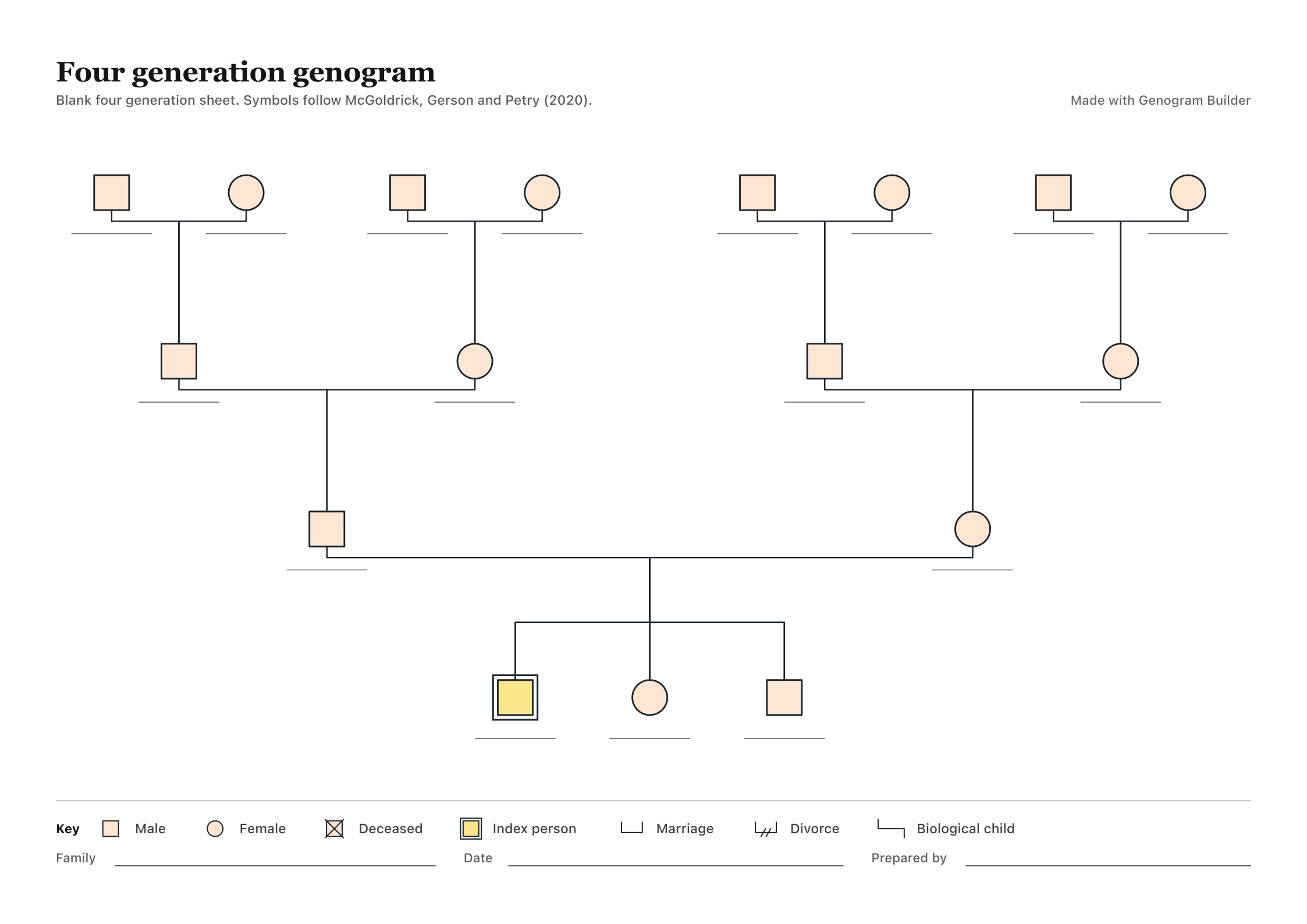
Filled in for a fictional family
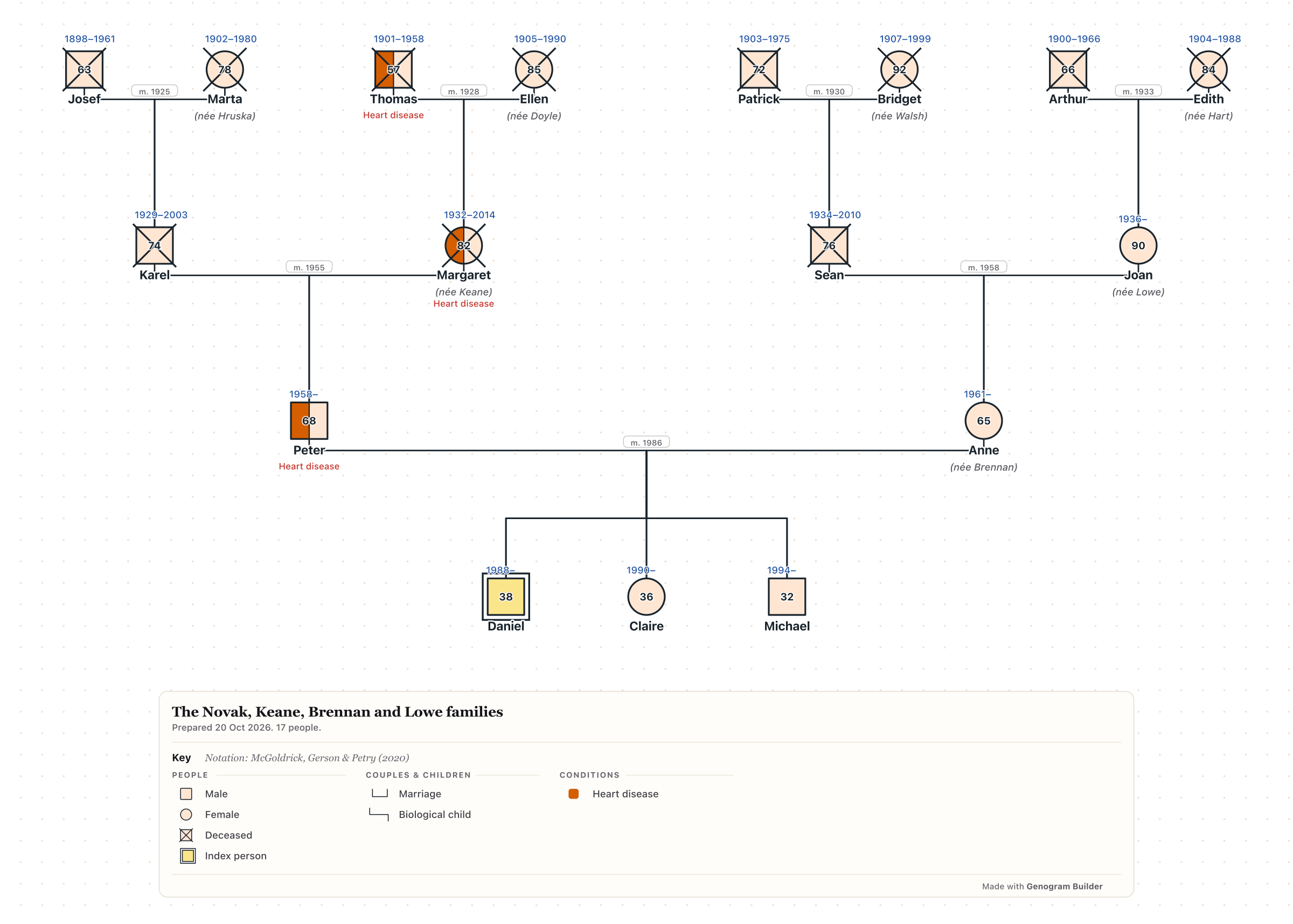
On the left is the blank A4 landscape sheet. On the right the same seventeen places are filled in for the fictional Novak family, with years, marriages and a heart condition on the father’s line.
Edit the four-generation genogram template online
Open the blank sheet to replace the placeholder names with your own family, or open the filled example to see how a finished chart behaves. Either one starts a separate chart in this tab and leaves the family saved on the homepage alone.
Select a person to type a name and the years of birth and death. Select a couple line to add the year of a marriage or to change it to a separation or a divorce. A great-grandparent who married twice gets a second partner from that person’s own controls, placed in the nearest free space on the row, and Arrange then spaces the row evenly again. A sibling or an aunt can be added to any row the same way, which is the main reason to use the editor rather than paper for a large family.
Edits stay in this tab until you continue in the full editor, which keeps the chart. A visitor can edit without an account but cannot export. A free account exports the chart as a PNG, a PDF or a JSON project, with a watermark on the picture and the PDF, and Pro removes the watermark and adds SVG.
The sheet adds four great-grandparent couples above the grandparents
The top row holds four couples, the parents of each of the four grandparents. The second row holds the two grandparent couples, each joined to its own great-grandparents. The third row holds the two parents, and the bottom row holds three children with the oldest on the left and the person the genogram is about outlined as the index person. Every symbol has a writing line under it for the name and room above it for the years.
The symbols are drawn a little smaller than on the three-generation template so that seventeen people and their writing lines fit one A4 landscape page. The key at the foot names the square, the circle, the cross for a death, the index person, the marriage and divorce lines and the line of a biological child. The fields below it take the family name, the date and the name of the person who prepared the sheet.
Fill in the great-grandparents first, even where little is known
Work from the top row down. The great-grandparents are usually the people about whom least is known, and that is a reason to begin with them while the relatives who remember them can still be asked. A name, a country and an approximate year are often all there is. Write a year that is an estimate with a tilde, such as ~1920, and leave a missing name as a short line with a note in the margin about whom to ask.
- Great-grandparents. Write each name under the symbol and the years above it. Draw an X through the symbol of anyone who has died and write the year of death after the year of birth.
- Grandparents. Follow each line down from a great-grandparent couple to their child on the second row. Write the year of each marriage on the couple line between the partners.
- Parents. Write the two parents on the third row and date their marriage. A former partner goes further out on the same row with a couple line of its own.
- Children. Write the children from the oldest on the left. The index person is already outlined, so move the outline if the chart is about someone else.
A fourth generation is often drawn to follow a condition. Shade the left half of each affected symbol, write the condition and the age at which it began under the name, and use the same shading for the same condition in every generation. A reader can then follow the shaded symbols down the page without reading every label.
The filled example follows a heart condition down the father’s line
The example fills the same seventeen places for a fictional family. On the father’s side, Thomas Keane, born in 1901, had heart disease from 1950 and died of a heart attack in 1958. His daughter Margaret Novak, née Keane, had heart disease from 1999 and died of heart failure in 2014. Her son Peter Novak, born in 1958, has had heart disease since 2019. The three affected symbols are half shaded, so the condition can be followed from the top row to the third without reading a word.
The rest of the chart gives the condition its context. Each of the seven couples carries the year of its marriage, from 1925 on the top row to 1986 for Peter and Anne. Every great-grandparent has died, and the number inside each symbol is the age at death or, for a living person, the age now. The index person is Daniel Novak, born in 1988, the oldest of three children.
Use the example as a check on your own sheet. Start at the index person and follow the line up through one parent and one grandparent to a great-grandparent couple. If every step can be read without guessing, the structure is clear enough to carry health or emotional information.
A fourth generation is worth drawing when a pattern reaches that far back
Many class assignments and intake forms ask for three generations, and the three-generation sheet is the one to use for them. A fourth row earns its place when a question reaches further back, such as a hereditary condition traced as far as the family remembers, a migration that began with the great-grandparents, or a family business founded two generations before the parents.
A genogram of four generations stops being readable if every sibling on every row is included. Draw the direct line and the relatives who bear on the question, and leave the others for a note. For charts of other shapes, the completed genogram examples show blended families, medical histories and clinical cases drawn with the same notation.
Choose the PDF, the PNG or the editor for the job
Use the PDF to fill the four-generation genogram template in by hand. It is one A4 landscape page, so check the print preview first, and on US Letter paper fit the whole page to the printable area so that the key and the bottom row are not clipped. Use the PNG to place the blank sheet in a slide, a handout or a report, and resize it by a corner so that it keeps its proportions.
Use the editor when the family does not fit the fixed layout. A great-grandparent with six children or a grandparent who married three times can be drawn on screen without crowding the page, and the export menu prints the chart on one sheet from A4 to A0 or on several pages to join.
Common questions
The four-generation genogram template is free to download and edit
The blank PDF and PNG download without an account, and the sheet can be edited online as a guest. Exporting an edited chart needs a free account, and the free export carries a watermark.
How many people fit on the sheet
Seventeen are drawn, and the margins take one or two more by hand. A larger family is better drawn in the editor, where Arrange spaces the rows evenly again as people are added.
How to show a great-grandparent nobody can name
Keep the symbol and leave its line blank or write unknown under it. A note in the margin can say what is missing and who might know, which is more useful to the next reader than an empty space.
Whether to add aunts and uncles to four generations
Add only the ones who bear on the question, such as a great-aunt with the condition being traced. Every sibling on every row would double the number of people, and the chart would read as a family tree rather than a genogram.