Adoption Genogram Template with a Filled Example
This adoption genogram template puts a birth family and an adoptive family on one sheet and joins the adopted child to both. A solid line runs to the birth parents, and a solid and a dotted line run to the adoptive parents, as the standard notation draws them. Print the blank A4 sheet, edit it online or open the filled example.
Blank sheet
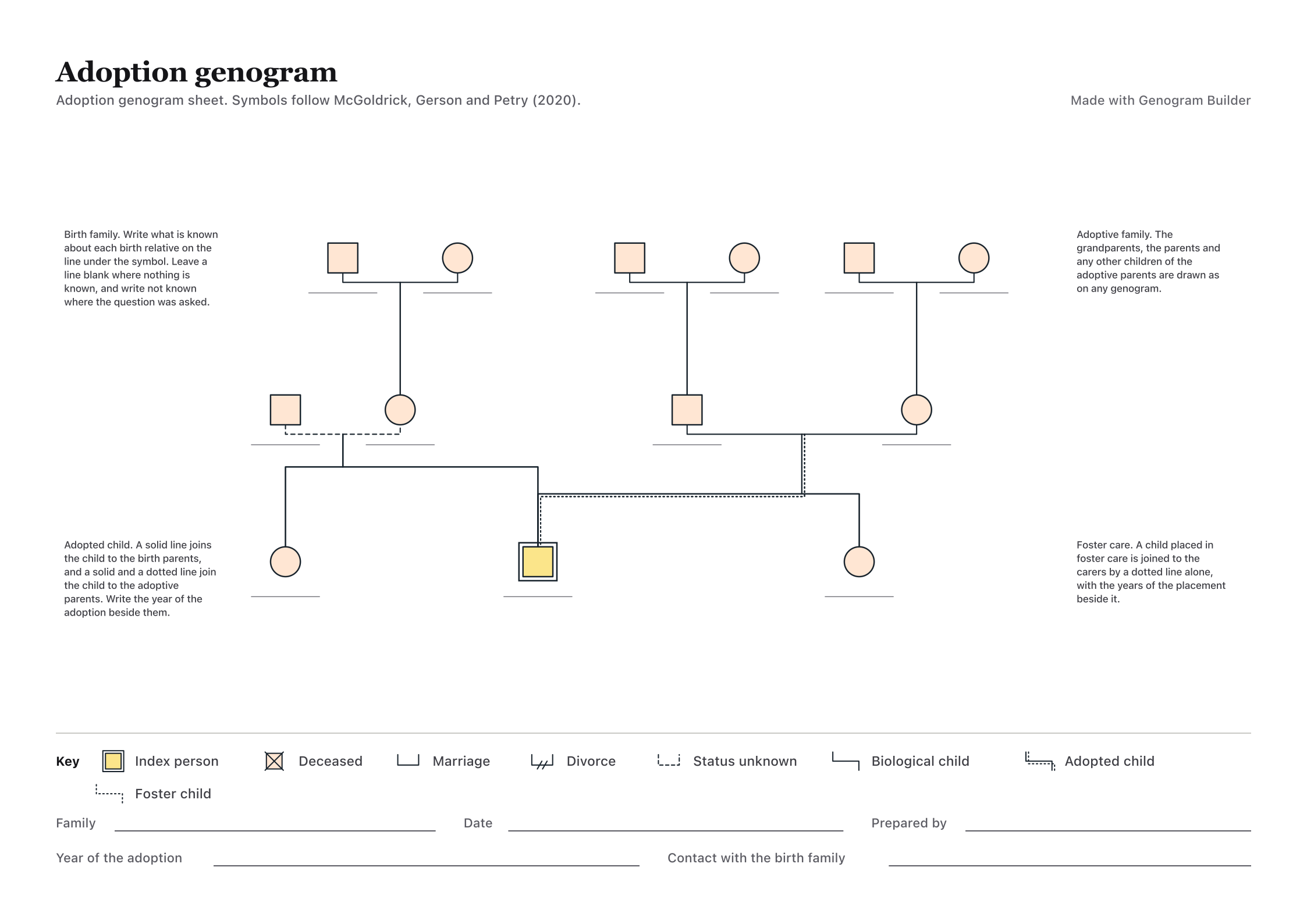
Filled in for a fictional family
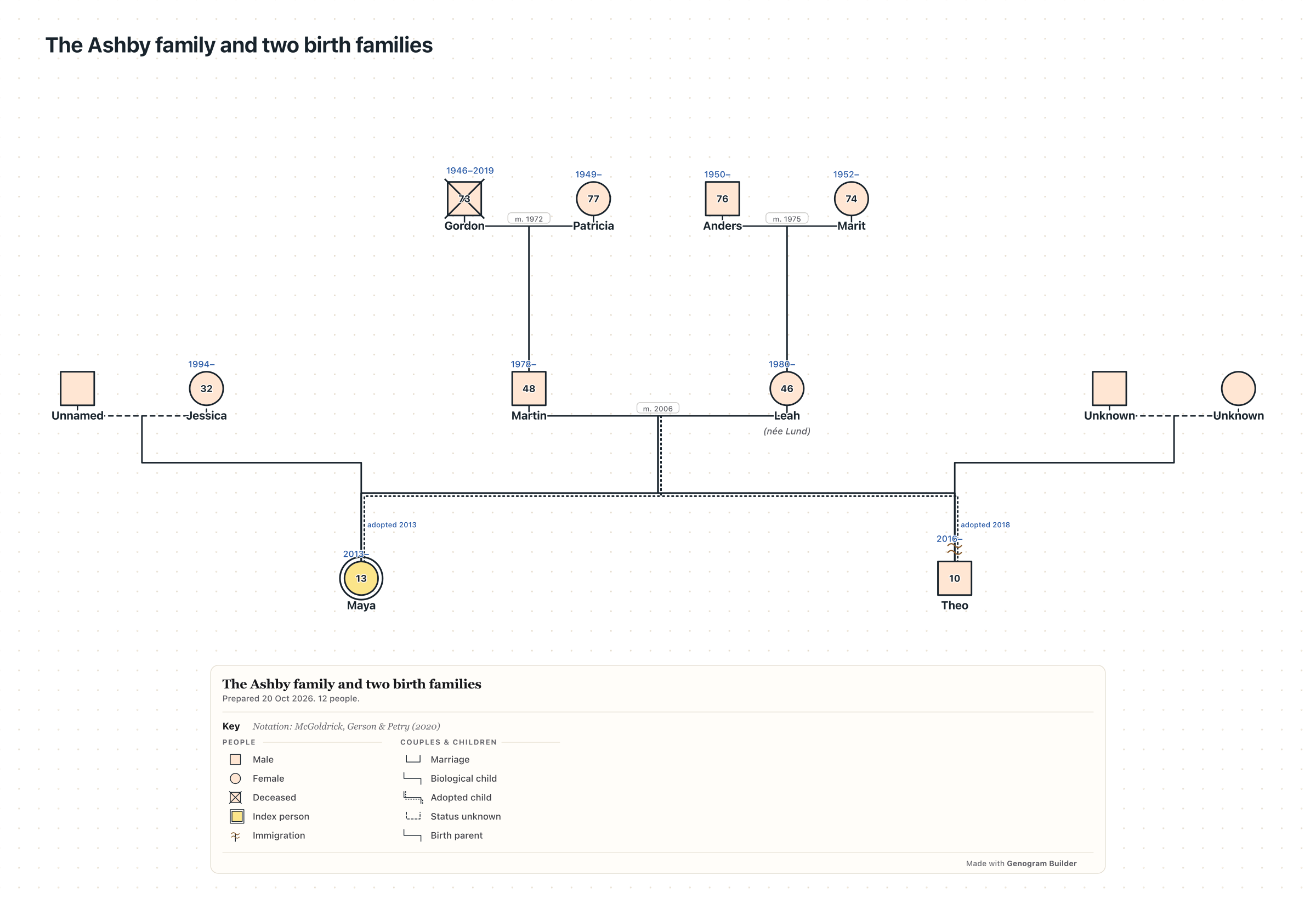
On the left is the blank sheet. On the right is the fictional Ashby family, with one child from an open adoption and one child adopted from Colombia whose birth parents are not known.
Edit the adoption genogram template online
Open the blank sheet to type over the thirteen placeholder names, or open the Ashby family and change it. Either one starts a separate chart in this tab and leaves the family saved on the homepage alone.
The child lines are already set. To change one, click the line from a parent down to the child and pick Adoptive parent, Foster parent or Birth parent in Parent type, then type the year in Adopted, or the years of a placement in Lived with from and Until. Each parent has a line of their own, so set the type for both adoptive parents. The guide to showing adoption or fostering goes through every option.
Edits stay in this tab until you continue in the full editor, which keeps the chart. A visitor can edit without an account but cannot export. A free account exports a PNG, a PDF or a JSON project, with a watermark on the picture and the PDF, and Pro removes the watermark and adds SVG.
The sheet holds a birth family and an adoptive family together
On the left are the birth parents, with the birth mother’s parents above them and a birth sibling below. On the right are the adoptive parents, each with their own parents, and a second child of the adoptive family. The adopted child stands between the two families and is outlined as the index person, because an adoption genogram is usually drawn around that child.
The couple line of the birth parents is dashed, the notation for a relationship whose status is not known. The birth family’s sibling bar sits a little higher than the adoptive family’s, so the two never read as one row of brothers and sisters. The key at the foot names every line on the sheet, and the fields take the year of the adoption and the contact the child has with the birth family.
Adoption, fostering and birth lines are drawn differently
The lines follow McGoldrick, Gerson and Petry (2020), the notation most courses and agencies teach. Draw the line that matches the arrangement the child lives in, and write the year beside it.
| Arrangement | How the line is drawn | What to write beside it |
|---|---|---|
| Birth parent of an adopted child | A solid line, as for any biological child | Nothing, since the years of the parent sit above the symbol |
| Adoptive parent | A solid and a dotted line in parallel | The year of the adoption |
| Foster carer | A dotted line alone | The years the child lived with the carer |
| Relative caring for the child | A dotted line from the relative, as for foster care | The years of the arrangement |
| Step-parent | A dashed line from the step-parent | The year the household formed |
Fostering is temporary and adoption is permanent, which is why the notation keeps a solid line for adoption and a dotted line alone for fostering. When a foster placement becomes an adoption, change the line and its year rather than drawing a second line beside it.
Record what is known about the birth family and nothing more
Many adopted people know part of their birth family and not the rest. In an open adoption the birth mother may be named and in touch while the birth father is not named. After an intercountry or a closed adoption nothing may be known at all. The sheet is built for both, and the example shows each case.
- A relative who is known. Write the name and the year of birth, and note the kind of contact, such as letters twice a year or a visit each summer.
- A relative who is not named. Keep the symbol, write Unnamed under it and add a note that the record gives no name. The child line still runs to the symbol, because the person exists.
- A relative who is not known. Keep the symbol with Unknown under it and no year, and leave the couple line dashed, since its status cannot be known.
- A birth sibling. Hang a brother or sister from the same birth parents, or from the one parent the two children share, and note whether they have met.
- Anything never asked. Leave the line blank. Write not known only where the question was asked and nobody had the answer.
Never fill in a birth relative from a guess, a surname or a country of birth. A blank line on an adoption genogram is accurate, and a guess can mislead the person the chart is about.
The fictional Ashby family shows both kinds of birth family
Martin and Leah Ashby married in 2006 and adopted two children. Maya, the index person, was born in 2013 and adopted at five months in an open adoption. Her birth mother, Jessica Rourke, born in 1994, writes twice a year and visits each summer. Her birth father is not named on the adoption record, so his symbol carries the name Unnamed.
Theo was born in 2016 in Medellín, Colombia, and adopted from there at two years old in 2018. The immigration mark sits above his symbol. The adoption file records no names for his birth parents, so both are drawn as Unknown with a dashed couple line between them. Martin’s parents and Leah’s parents complete the chart, with Gordon Ashby crossed through for his death in 2019.
Maya drew the chart with her parents for a life story project at school, which is one of the most common reasons for an adoption genogram. Open it in the editor above to see how each line is set. More completed charts are collected in the genogram examples.
Draw the chart with the adopted person, not about them
Ask the adopted person, or the adoptive parents of a young child, what they want on the chart before you add the birth family. Some people want both families drawn in full, and some want the birth family as one named parent. Both are valid adoption genograms, and the sheet leaves room for either.
Social workers who draw the chart for a case file note the source of each fact, such as the adoption record, a birth parent or the child. Students drawing their own family for a course can leave out a birth relative they do not wish to name and say on the page that the chart is partial. The guide to genograms for social workers covers assessment, and the genogram symbols reference shows each line on its own.
Common questions
The adoption genogram template is free to print and edit
The blank PDF and PNG download without an account, and the sheet can be edited online as a guest. Exporting an edited chart needs a free account, and the free export carries a watermark.
Where the birth parents go on an adoption genogram
Put them on the same row as the adoptive parents, to one side, with the birth grandparents above them where they are known. The adopted child sits between the two families, joined to each by its own lines.
How to show an adoption by a relative
Draw the child once, hanging from the birth parents, and join the child to the relative who adopted with the solid and dotted lines of adoption. The relative keeps their own place in the family, such as an aunt beside the birth mother.
How to show a foster placement on the same chart
Join the child to the foster carers with a dotted line and write the years of the placement beside it. The foster carers stand beside the family as people of their own, outside the birth family and the adoptive family.