Cultural Genogram Template with Questions and an Example
This cultural genogram template gives every person two writing lines, one for the name and one for where they were born and the cultures they identify with. It covers three generations with an aunt and an uncle, and its fields record origins, languages, faith and migrations. Print the blank A4 sheet or edit it online.
Blank sheet
Filled in for a fictional family
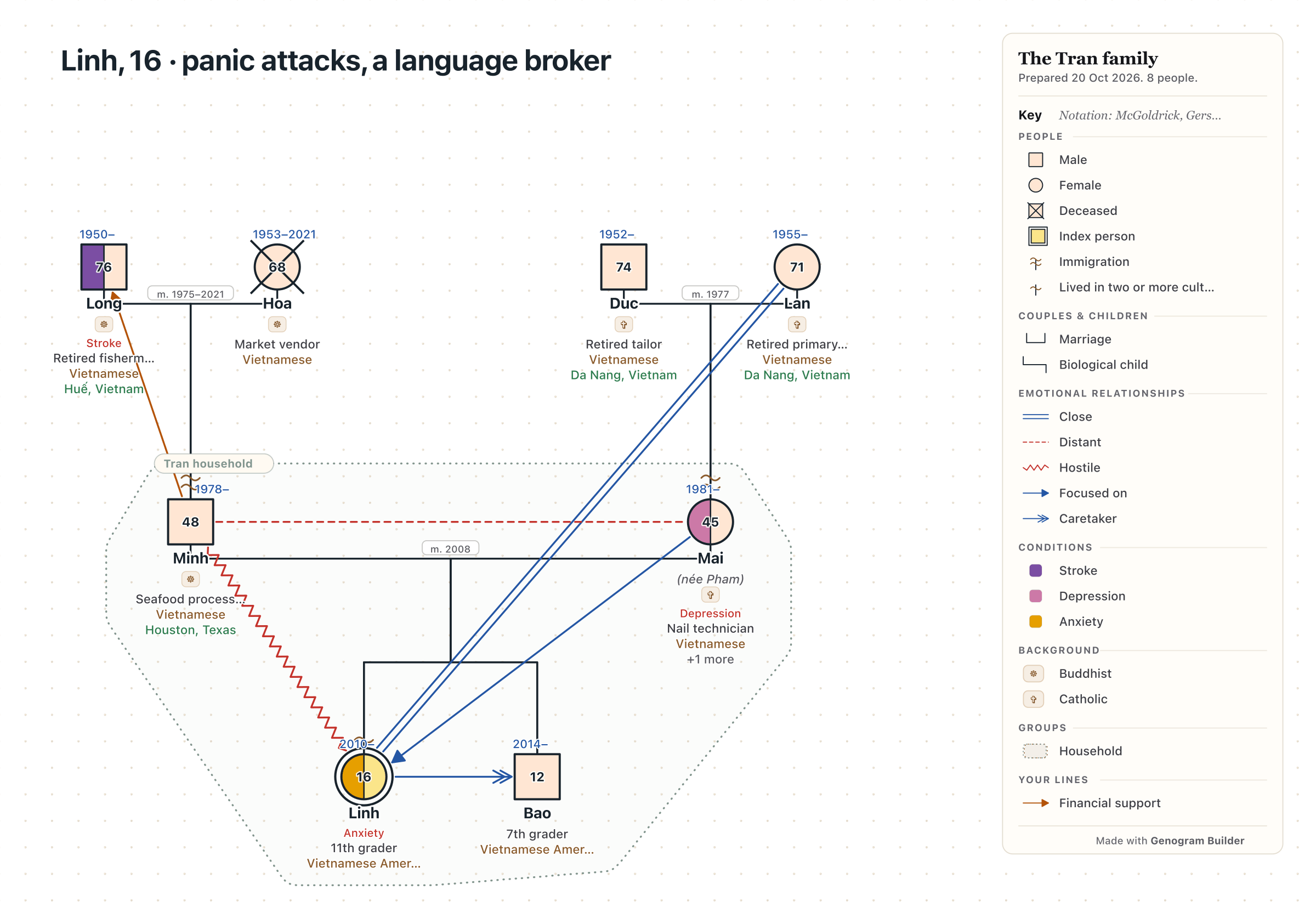
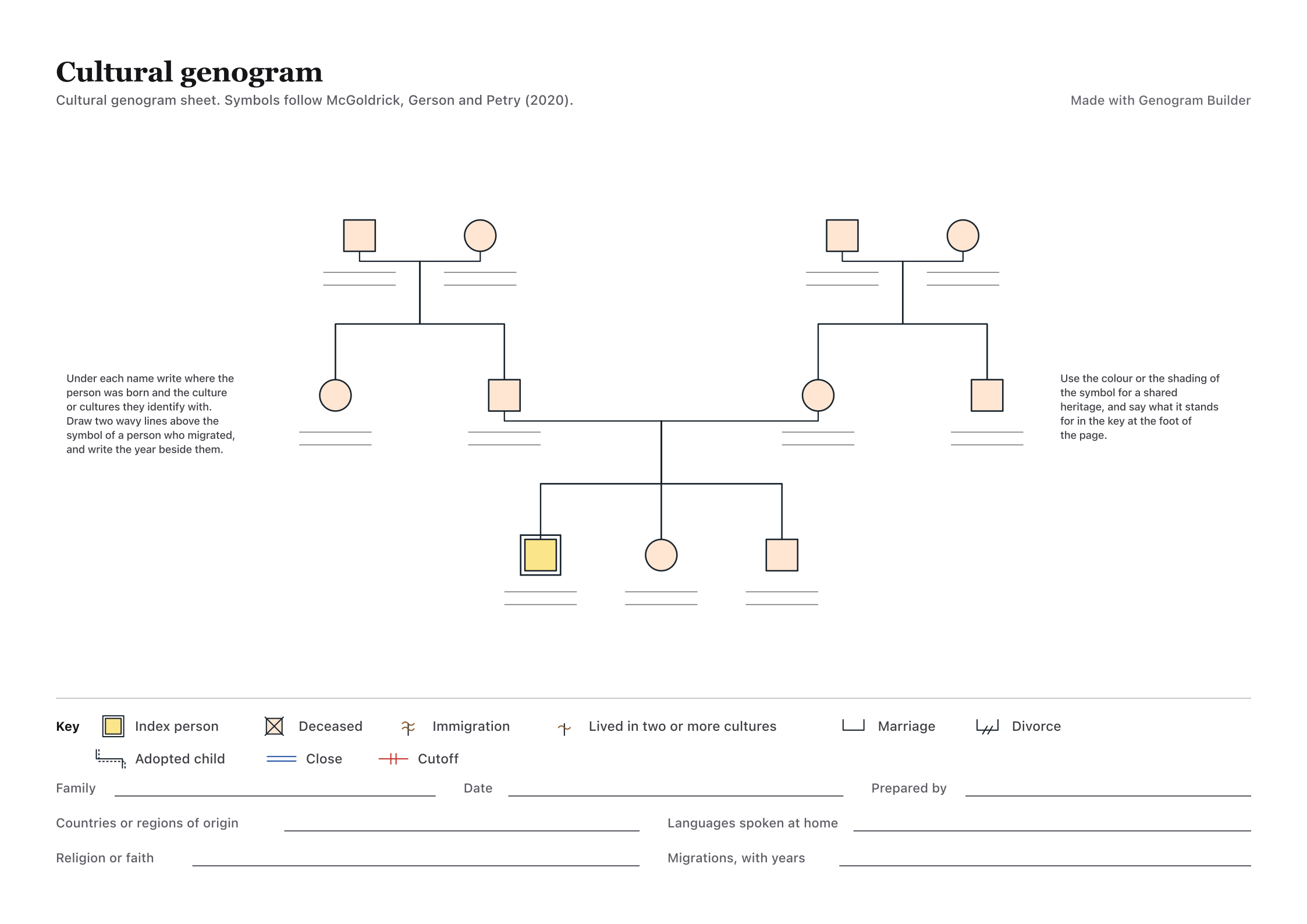
On the left is the blank sheet. On the right is the fictional Tran family from the template library, with the migration marks, heritage, faith and places filled in.
Edit the cultural genogram template online
Open the blank sheet to type over the eleven placeholder names. It starts a separate chart in this tab and leaves the family saved on the homepage alone.
Select a person to type the name and the years, then open the person’s background to record heritage, religion and whether it is practised, and the place of birth. Heritage and place can be shown under the name, as the second line of the printed sheet would be, and a religion from the list is drawn as a small mark at the symbol and named in the key. Set a migration on a person and the editor draws the mark above the symbol and adds it to the key.
Edits stay in this tab until you continue in the full editor, which keeps the chart. A visitor can edit without an account but cannot export. A free account exports a watermarked PNG or PDF, or a JSON project, and Pro removes the watermark and adds SVG.
The sheet gives every person a second line for heritage
The drawing has two sets of grandparents, the two parents with an aunt on one side and an uncle on the other, and three children with the person the genogram is about outlined as the index person. Under each symbol the first line takes the name and the second takes the place of birth and the culture or cultures the person names as their own. A note beside the drawing says where to draw the mark for a person who migrated and where to write the year of the move.
The key names the index person, the cross for a death, the mark for immigration, the two-cultures mark for a person who has lived in two or more cultures, the marriage and divorce lines, the line of an adopted child and the close and cutoff lines. The fields at the foot take the countries or regions of origin, the languages spoken at home, the religion or faith and the migrations with their years.
Cultural genogram questions to ask in each generation
A cultural genogram is filled in from what people say about themselves, so the questions matter more than the drawing. Ask them of the person the chart is about, and of a parent or grandparent where that is possible. Write each answer in the words it was given, such as Punjabi Sikh or Irish and Italian American, and never fill a line from a surname, a photograph or a place of birth.
| Topic | What to ask | Where the answer goes |
|---|---|---|
| Origins | Where each person was born and where they grew up | The second line under the symbol and the field for origins |
| Identity | Which cultures, communities or heritages the person names as their own | The second line under the symbol |
| Language | Which languages each generation spoke at home, and which were kept or lost | The field for languages |
| Migration | Who moved between countries or regions, in what year and with whom | The mark above the symbol with the year, and the field for migrations |
| Faith | Which religion or tradition each person names, and whether they practise it | The field for faith, or a note where it changed |
| Relationships | Which relationships a move, a language or a faith drew closer or apart | A close or cutoff line between the two people |
Faith passed down, changed or left between generations has a guide of its own on drawing a spiritual genogram. For the wider interview, the genogram interview questions cover each person, each couple, the relationships and the family’s health and events.
Fill in origins and migrations before the relationships
Work from the grandparents down, as on any genogram, and leave the relationships until the facts are in place.
- Names and years. Write each name on the first line and the years above the symbol, with an X through the symbol of anyone who has died.
- Heritage. On the second line write where the person was born and the cultures they identify with. Write both places for a person born in one country and raised in another.
- Migrations. Draw the immigration mark above each person who migrated and write the year beside it. Use the two-cultures mark for a person who has lived in two or more cultures, such as a child raised abroad for some years, and keep the immigration mark for a person who settled in a new country.
- The fields. Fill in the origins, the languages at home in each generation, the faith of each generation and each migration with its year.
- Relationships. Draw the close and cutoff lines that a shared language, a move or a change of faith created, and explain any colour you used in the key.
The fictional Tran family shows the marks and fields in use
The Tran family is a fictional case from the template library. Linh Tran, born in 2010 in Houston, Texas, is the index person, and she and her brother Bao describe themselves as Vietnamese American. Their father Minh was born in Huế, came to Houston in 2004 and is a Buddhist who does not practise. Their mother Mai, née Pham, was born in Da Nang, came in 2006 and is a practising Catholic. Both parents carry the immigration mark above their symbols.
Both sets of grandparents stayed in Vietnam. Long Tran is a practising Buddhist in Huế, and Minh sends him money every month, drawn as a line of its own named Financial support. Hoa Tran died of COVID-19 in 2021, and no one from Houston could travel to the funeral. Duc and Lan Pham are practising Catholics in Da Nang, and Lan raised Linh there from 2012 to 2016, which is why Linh carries the two-cultures mark.
The relationships carry the cultural story. Linh has interpreted for her parents since she was ten, and the chart draws a focused-on line from Mai to Linh, a caretaker line from Linh to Bao, a hostile line between Linh and Minh and a close line between Linh and her grandmother Lan, who video-call every Sunday. More completed charts are collected in the genogram examples.
Record culture as the family describes it, never as a guess
Hardy and Laszloffy described the cultural genogram in 1995 as an exercise for training family therapists. Read the assignment before adding sensitive detail. It may ask for heritage and migration without asking for exact dates, full names or religion.
When a relative does not know or does not want to say, leave the line blank and note that it was asked. A blank line is accurate, and a guess drawn from a surname or a country of birth is not. Keep your notes in a working copy apart from the version you submit.
Common questions
The cultural genogram template is free to print and edit
The blank PDF and PNG download without an account, and the sheet can be edited online as a guest. Exporting an edited chart needs a free account, and the free export carries a watermark.
How to show a person with two cultures
Write both on the second line under the symbol. Draw the two-cultures mark above it only if the person has lived in both cultures. In the editor the heritage of a person takes more than one entry.
Whether to record religion on a cultural genogram
Record it where the person regards it as part of their culture, with whether they practise it, since a change between generations is often what the chart is drawn to show. Leave it blank where it is not relevant or not wanted on paper.
What the cultural sheet leaves out
It has no printed fields for class, income or immigration status, which some versions of the exercise ask for. Add them in the margin only where the assignment asks for them and the person agrees.