A spiritual genogram records faith as each person describes it
The drawing is an ordinary genogram, with the same symbols for people, couples and children. What changes is the information written beside each person. Instead of an occupation or a diagnosis, you record the faith or tradition the person names, whether they practise it, and when that changed. A person who has no religion is recorded too, because a gap between generations is often the pattern the chart is drawn to show.
David Hodge described the spiritual genogram in the journal Families in Society in 2001 as a generational approach to assessing spirituality. It is used in social work and counselling, and you can draw one for yourself to see how your beliefs relate to those of your parents and grandparents.
The chart is not about any one religion, and it never decides what a person believes. Do not work out a faith from a surname, a country of birth or a culture. Write what the person tells you, and leave the line empty when you have not asked. The cultural genogram template covers origin, language and migration, and this page goes further into faith and practice.
Genogram Builder
Draw a spiritual genogram in the editor
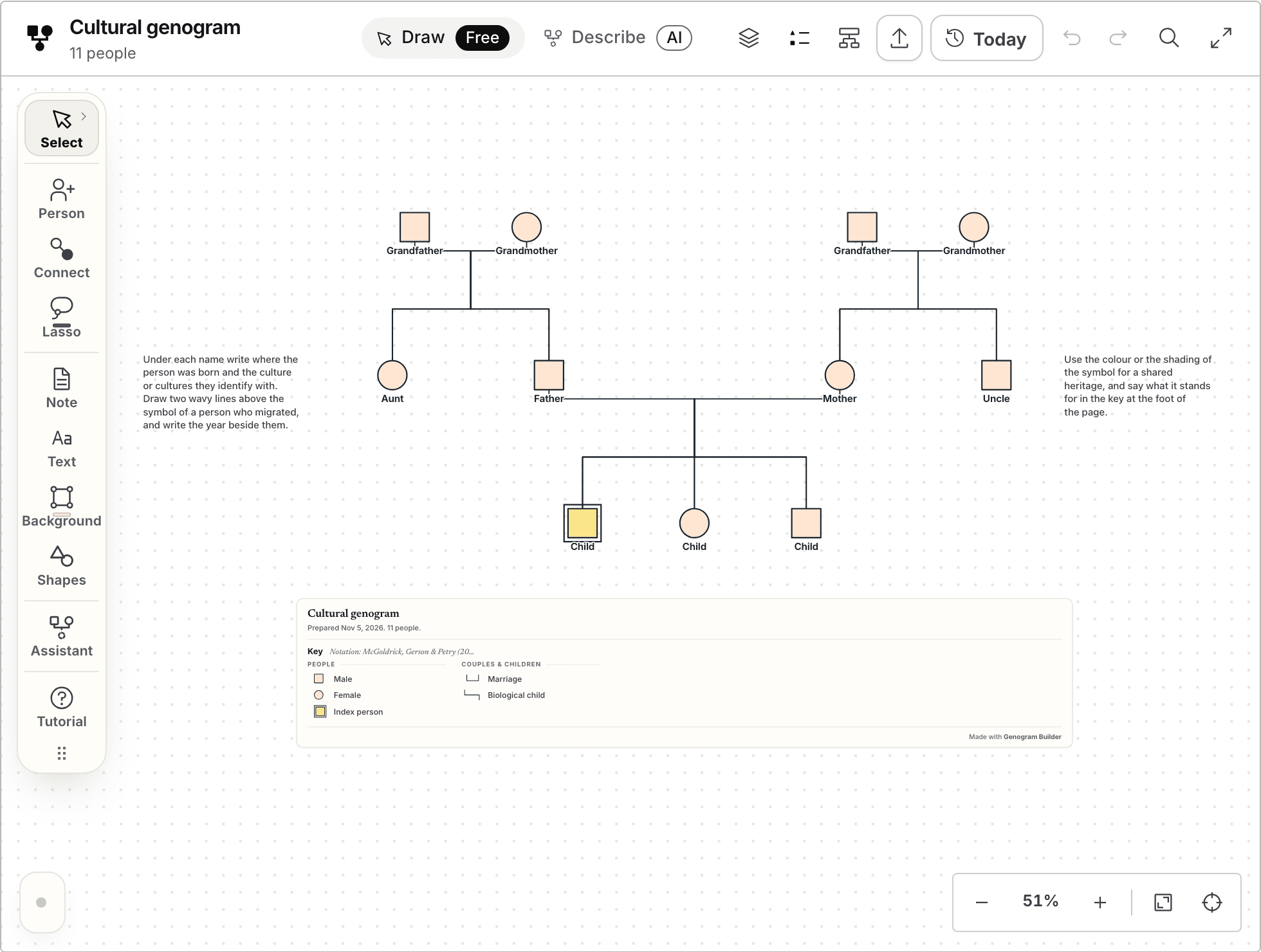
Open the blank cultural sheet, then give each person a religion in their own words and mark whether they practise it.
- Opens without an account
- A religion field and a practice choice for each person
- PNG and PDF export with a free account
Record five things for every person on the chart
Keep the same five fields for every person, including those who describe no faith. Short answers fit under a symbol, and the longer account goes in the notes. Ask the person how they would like their faith written, and use that form on every copy of the chart.
| Field | What to write | From the worked example |
|---|---|---|
| Faith or tradition | The name the person uses, or no religion | Anglican, Lutheran, Pentecostal, Quaker and no religion |
| Practice | Practising, not practising or not known | Ruth still attends the church where she married |
| Changes, with years | A new community, a conversion or a lapse, and the year it happened | David began attending Quaker meeting in 2001 |
| Who shares it | The relatives who share the faith or the practice | David and Samuel are both practising Quakers |
| What it means to them | A short phrase in their own words, kept in the notes | Ruth says her faith carried her after Joseph died |
A fictional family shows faith changing across three generations
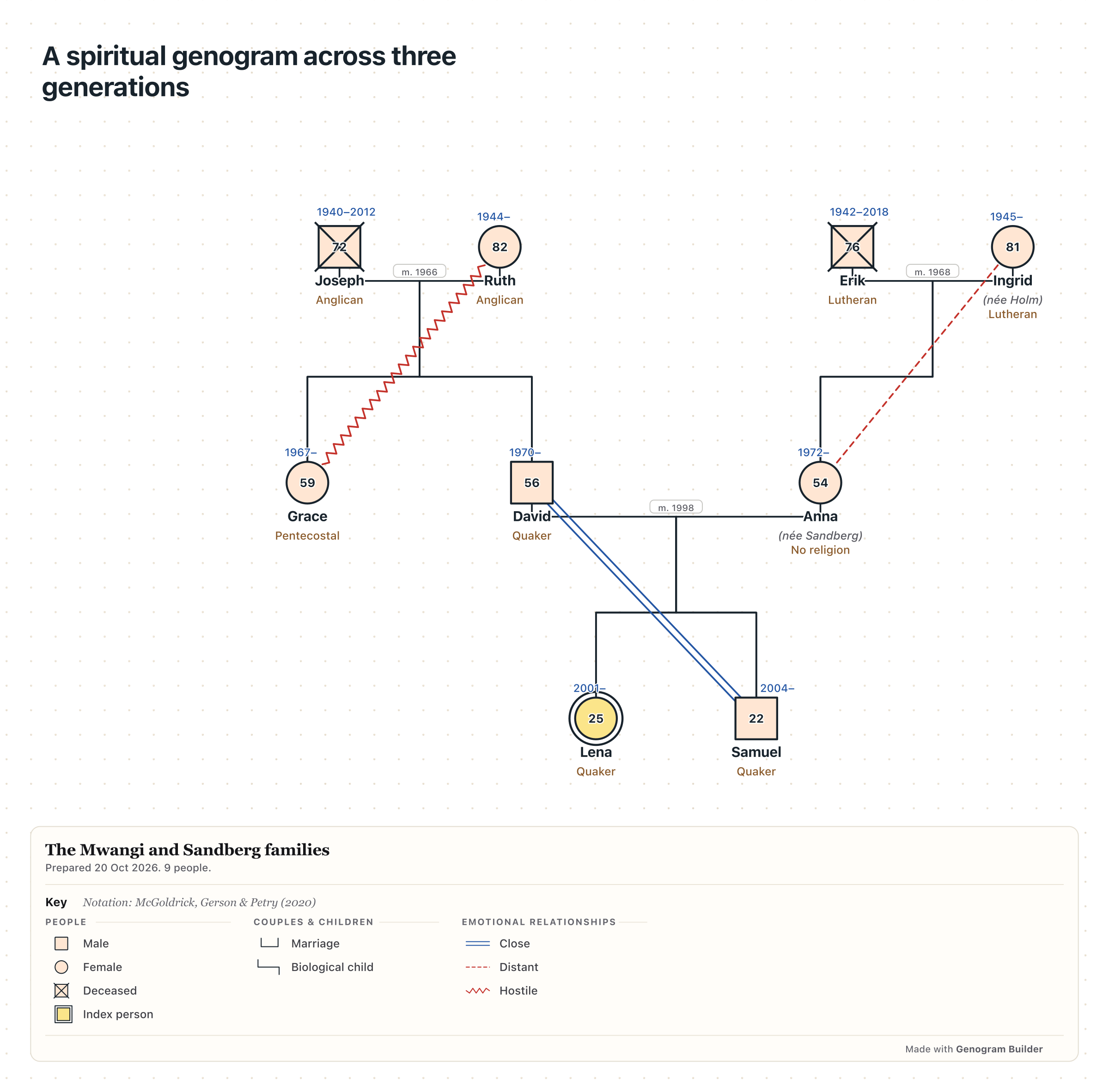
The Mwangi and Sandberg families below are fictional. Joseph and Ruth Mwangi, both practising Anglicans, married in 1966. Joseph was a churchwarden for twenty years and died in 2012. Erik and Ingrid Sandberg married in 1968 and are both recorded as Lutheran. Erik was confirmed as a boy and stopped attending in his twenties, while Ingrid sings in the parish choir.
In the middle generation the traditions divide. David Mwangi was raised Anglican, began attending Quaker meeting in 2001 and became a member in 2005. His older sister Grace joined a Pentecostal church in 1993, and her note records that her mother saw it as leaving the family church. The chart draws a hostile line between Ruth and Grace. Anna Sandberg, who married David in 1998, was raised Lutheran and describes herself as spiritual but not religious. A distant line joins her to her mother, with no reason recorded.
Their children are Lena, born in 2001, and Samuel, born in 2004. Lena is the person the genogram is about. She goes to meeting with her father at Easter and calls her faith private. Samuel attends every week, and a close line joins him to his father. The chart records these lines as the family described them and does not claim that faith caused them.
Ask neutral questions and write the answers in their words
Come to faith once the people are on the page. Ask each question the same way for every relative, so that no tradition is treated as the normal one. A person may decline, and that is recorded as not asked rather than guessed. The genogram interview questions cover the rest of the family history.
Faith and practice
- How would you describe your faith or spiritual life, in your own words?
- Do you practise it now, and what does practice look like for you?
- How did each of your parents and grandparents describe their faith?
- Who in the family practised most, and who least?
Change across the generations
- Has anyone in the family changed their faith, joined a new community or stopped practising, and in what year?
- How did the rest of the family respond to that change?
- Which beliefs or customs were handed down, and which were dropped?
Meaning and community
- What part has faith played in hard times, such as an illness or a death?
- Which relatives share your faith or practice, and how does that affect your relationship with them?
- Is there a faith community the family relies on, and since when?
- Is there anything about faith in your family that you would rather leave off the chart?
Draw the spiritual genogram on paper or in the editor
On paper, use the cultural genogram sheet. It has two writing lines under every symbol, the first for the name and the second for birthplace and culture, where the faith can be written too, and a field at the foot for religion or faith. Write the year of any change beside the person.
In the editor, open the same sheet and select a person. The Religion field takes a tradition from its list or the words you type. Once a religion is set, a Practice choice reads Practising, Not or Unknown. The notes hold what the faith means to the person. A visitor can draw without an account but cannot export. A free account exports a PNG or a PDF with a watermark, or a JSON project, and Pro removes the watermark.
This guide writes the faith under each name rather than using special symbols. If you colour the symbols by tradition, say in the key what each colour means.
Common questions
What a spiritual genogram is used for
It helps a counsellor or a social worker see where faith supports a family and where it has divided one. Students also draw their own as a reflective exercise.
How it differs from a cultural genogram
A cultural genogram records origin, language, migration and the cultures a person identifies with, and faith is one field among them. A spiritual genogram makes faith and practice the subject, with the changes and the years written in.
Whether to include relatives with no religion
Yes. Write no religion, or the words the person uses, such as spiritual but not religious. A blank line should mean that you did not ask, so the reader can tell the difference.
Whether the spiritual genogram template is free
The cultural sheet downloads as a PDF or PNG without an account, and it opens in the editor without one. Exporting your edited chart needs a free account, and that export carries a watermark.
Sources and methodology
We make Genogram Builder. We used the references below for this guide. Last checked on 5 November 2026.
Fill in the cultural sheet for your own family, one tradition and one practice at a time. The editor opens without an account.
Open the cultural sheet in the editor