The questions follow the order in which a chart is drawn
Each group of genogram interview questions fills one layer of the chart. The first gives the symbols and the years, and the second gives the couple lines and the children. The third gives the emotional lines, the fourth the shading and the dates of events, and the last the schools, services and people around the family.
Ask the first two groups about everyone on the chart, and choose from the rest according to what the genogram is for. A focused chart, such as a sexual genogram, adds its own questions once these are answered.
Each person on the chart
- What is this person’s full name, and what are they called in the family?
- When were they born, and where?
- If they have died, when did they die, how old were they, and what was the cause?
- What work did they do for most of their life, and how far did they go in school?
- Where do they live now, and who lives with them?
Couples and parents
- When did this couple meet, and when did they marry or begin living together?
- Did the relationship end, and if so when, and was it a separation or a divorce?
- Were there earlier marriages or partnerships, and were there children from them?
- Which children were born to this couple, in what order, and were any adopted, fostered or lost before birth?
- Are there children who grew up in this house who are not the couple’s own?
The relationships between people
- Who in the family is this person closest to, and who are they most distant from?
- Is there anyone in the family this person no longer speaks to, and since when?
- Who takes care of whom, and who worries most about whom?
- When there is a disagreement in the family, who takes whose side?
- Which relationships in the family would you describe as tense or hostile?
Health, habits and events
- Has anyone in the family had a long illness, a mental health condition or a disability, and at what age did it begin?
- Has anyone had a problem with alcohol, drugs or gambling, and are they in recovery?
- What were the big events in the family, such as a move, a loss, a job lost or a house bought, and in what year?
- Did anyone in the family emigrate, and from where, and in what year?
- Which anniversaries or dates are still hard for the family?
The family in its community
- Which schools, clinics, churches, agencies or groups does the family rely on, and for how long?
- Who outside the family would you call first in a crisis?
- Is there anyone outside the family who is a source of pressure rather than support?
- Which supports did the family have in the past that it no longer has?
- What would you want someone reading this chart to understand about your family that the lines do not show?
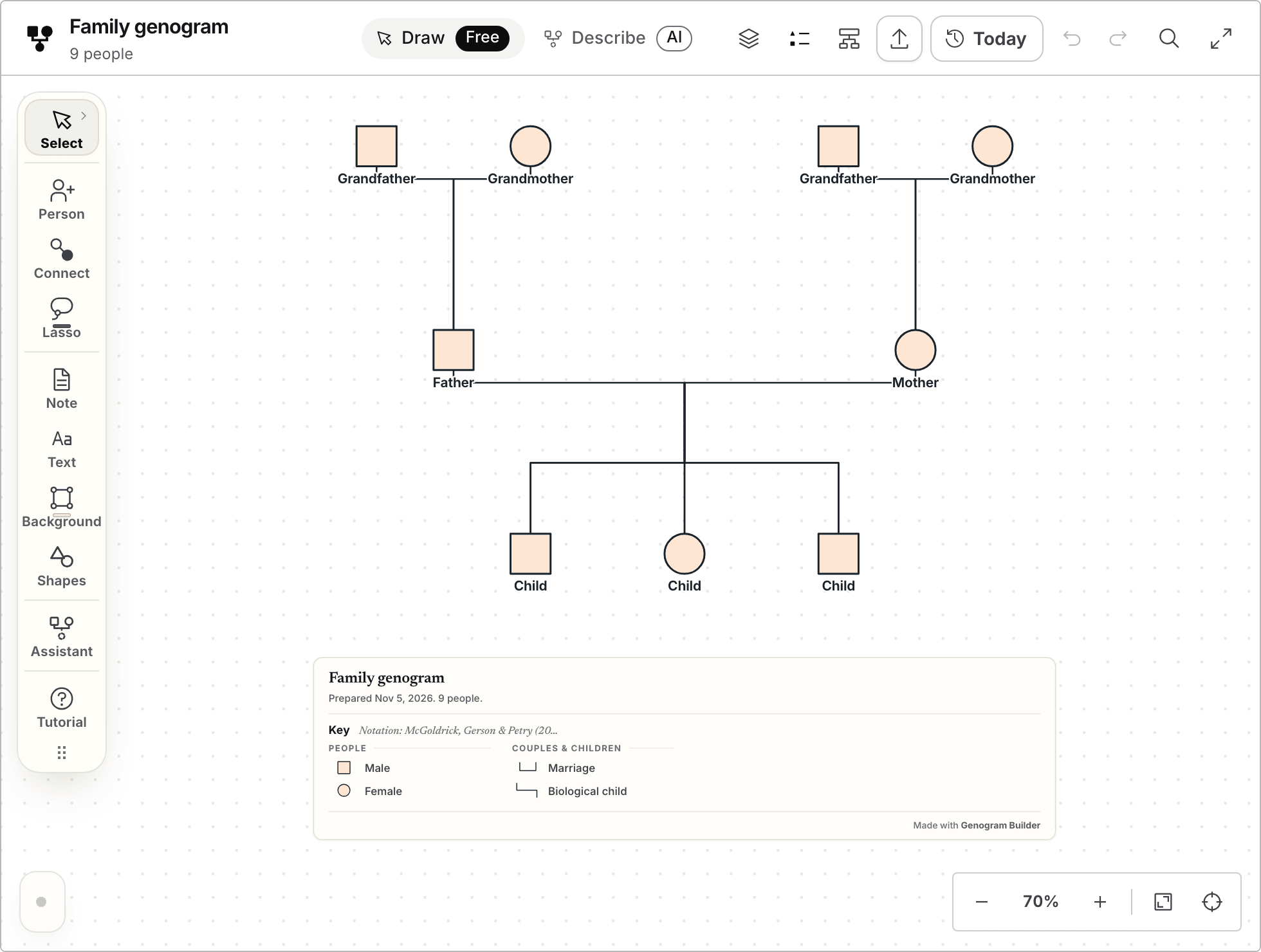
Genogram Builder
Draw the answers as they are given
The blank sheet opens in the editor. Each answer becomes a person, a couple line or a mark, and the key is drawn for you.
- Opens without an account
- Continue in the full editor to keep the chart
- PNG and PDF export with a free account, with a watermark
Each answer becomes one mark on the chart
Writing an answer in the form it will take on the chart keeps the interview and the drawing in step. The table shows common answers beside the mark each one becomes. A line drawn from a single remark should wait until the person confirms it.
| What the person says | What goes on the chart | Where it goes |
|---|---|---|
| Grandmother Rose was born in 1938 and died in 2011 | A circle with an X through it and 1938–2011 above it | The top row, on her side of the family |
| My parents married in 1985 and divorced in 1999 | A couple line with two slashes, and the years on the line | Between the two parents |
| I have a half brother from my father’s first marriage | A second couple line for the father, with the brother below it | Beside the father, further out |
| My mother and my aunt have not spoken since 2015 | A cut-off line between the two sisters, with the year | The middle row |
| My father has had diabetes since he was forty | Shading in his symbol and the condition under his name | The father’s symbol |
| We moved from Manila to Toronto in 2004 | Two wavy lines above each person who moved, with the year | Above the symbols of those who migrated |
| I do not know when my grandfather was born | An empty year with a note of whom to ask | His line, left open until it is checked |
Begin with easy facts and move to feelings later
Names, dates and places are easy to give and usually accurate, so begin with them. They put the structure on the page early and show the person what the drawing is for. Leave a blank where an answer is not known, and note who might know it. With a young child, a family play genogram asks about the same people through small figures.
Ask about closeness, conflict and cut-offs once the structure is drawn, in the person’s own words. Record whether a line is something you were told or something you concluded.
Questions about illness, addiction and loss need consent and care
The health group asks about illness, mental health, alcohol, drugs and the dates that are still hard for the family. Say why you are asking, let the person decline, and record only what they agree to have written down.
A genogram of a real family holds facts about relatives who were never asked, so keep it confidential. These genogram interview questions gather facts for a chart and make no assessment of anyone. Genograms in social work and genograms in family therapy describe how practitioners use the answers.
Draw the answers in the editor while you listen
The editor opens a blank sheet with two sets of grandparents, two parents and three children, each named by role. Replace each role with a name as the answers come. The guide to making a genogram covers the drawing in more depth, and the counseling genogram template is a worksheet for writing the answers down on paper.
Select a person and type the name, the symbol, the status and the year of birth into the details on the right.
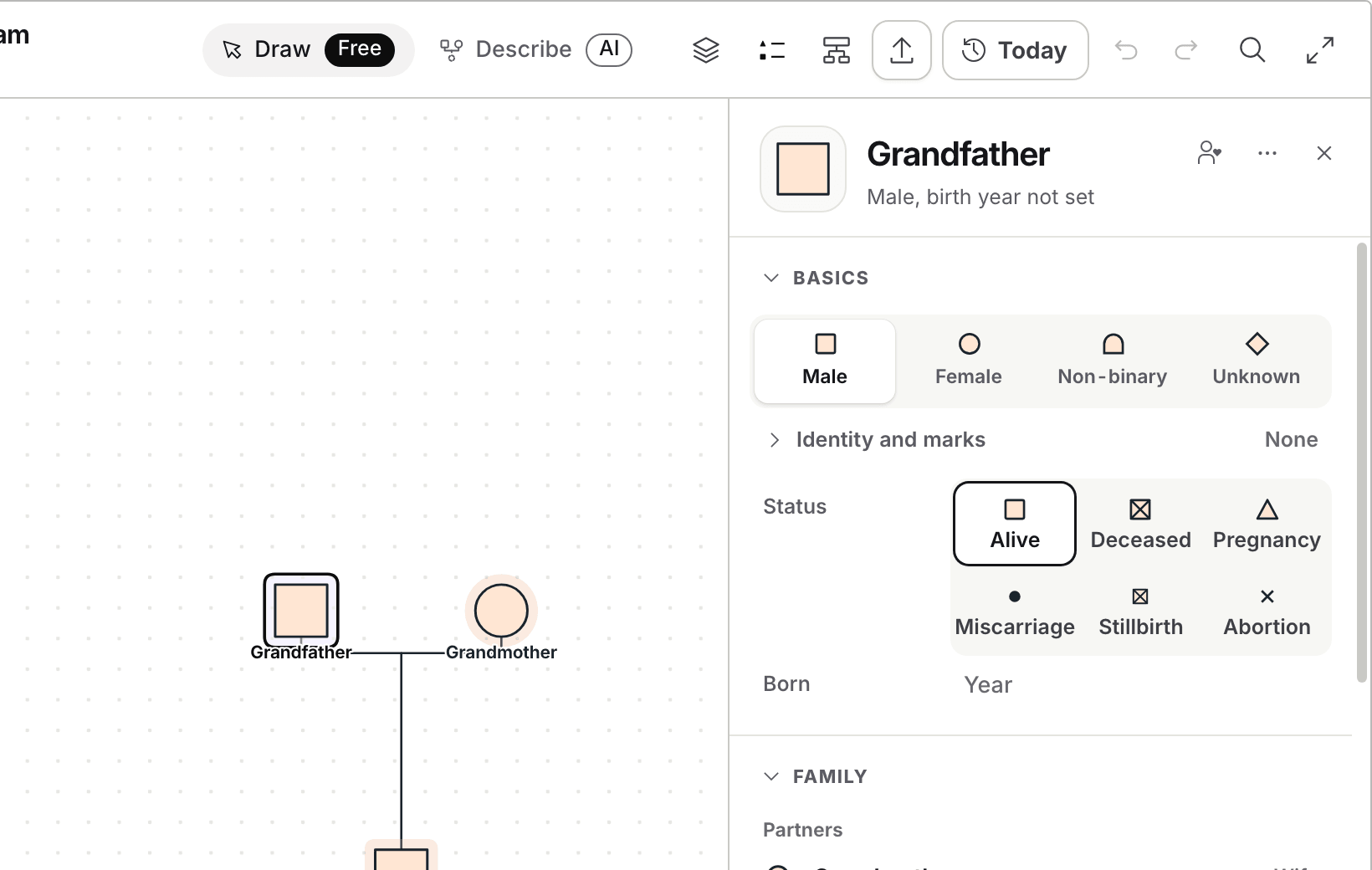
Add a relative the person names with the Person tool, or from the controls of someone already on the chart.
When the interview ends, choose Export. A free account saves the chart as a PNG or a PDF with a watermark.

Common questions
How long a genogram interview takes
The facts about each person and the couples can often be gathered in one meeting. The relationships and the health questions often take a second, once trust is built.
Whether to ask every question
No. The list of genogram interview questions is a menu. A medical family history needs the health group in full, while a therapy intake leans on the relationships.
Using the questions for a class assignment
The questions are free to copy and print for a student interviewing a relative. The guide on how to write a genogram paper explains what to do with the answers.
What to do when nobody knows an answer
Leave the space empty and write who might know. If you enter an estimated year, say so in the person’s notes, because the chart prints the year exactly as it is typed.
Draw each answer on the blank sheet as it is given. No account is needed to begin.
Start drawing the answers