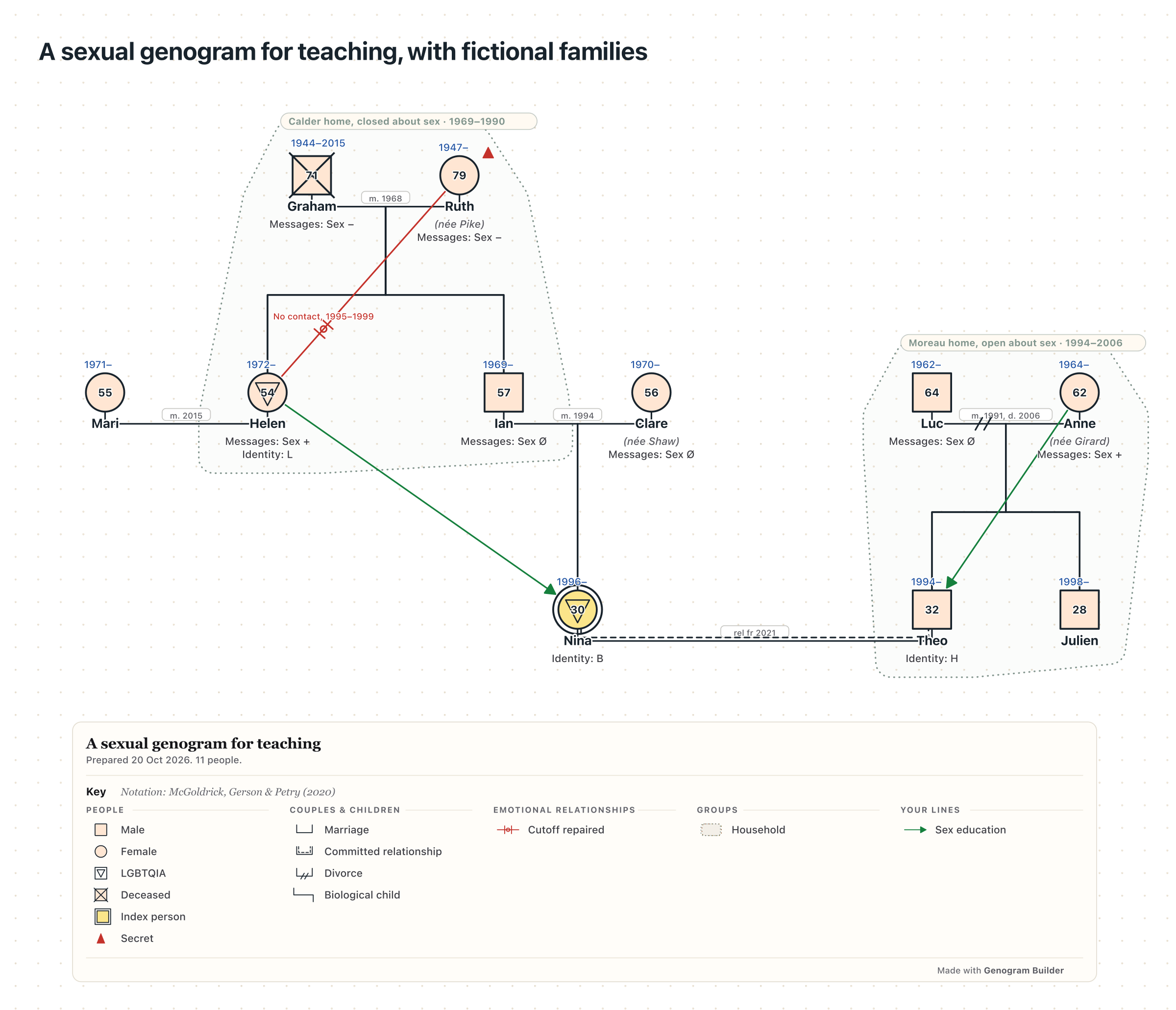
A sexual genogram adds messages about sex to a family genogram
The drawing is an ordinary genogram. Belous and colleagues, who revisited the method in 2012, describe it as structurally no different from a traditional genogram, with a further layer about sex and sexuality. That layer records what each person was told, what was never said, how affection was shown and how each person describes their gender and attraction.
Hof and Berman wrote for therapists treating couples. Belous and colleagues extended the method to individual clients, and their paper appears as course material on a sexuality counselling course at East Carolina University.
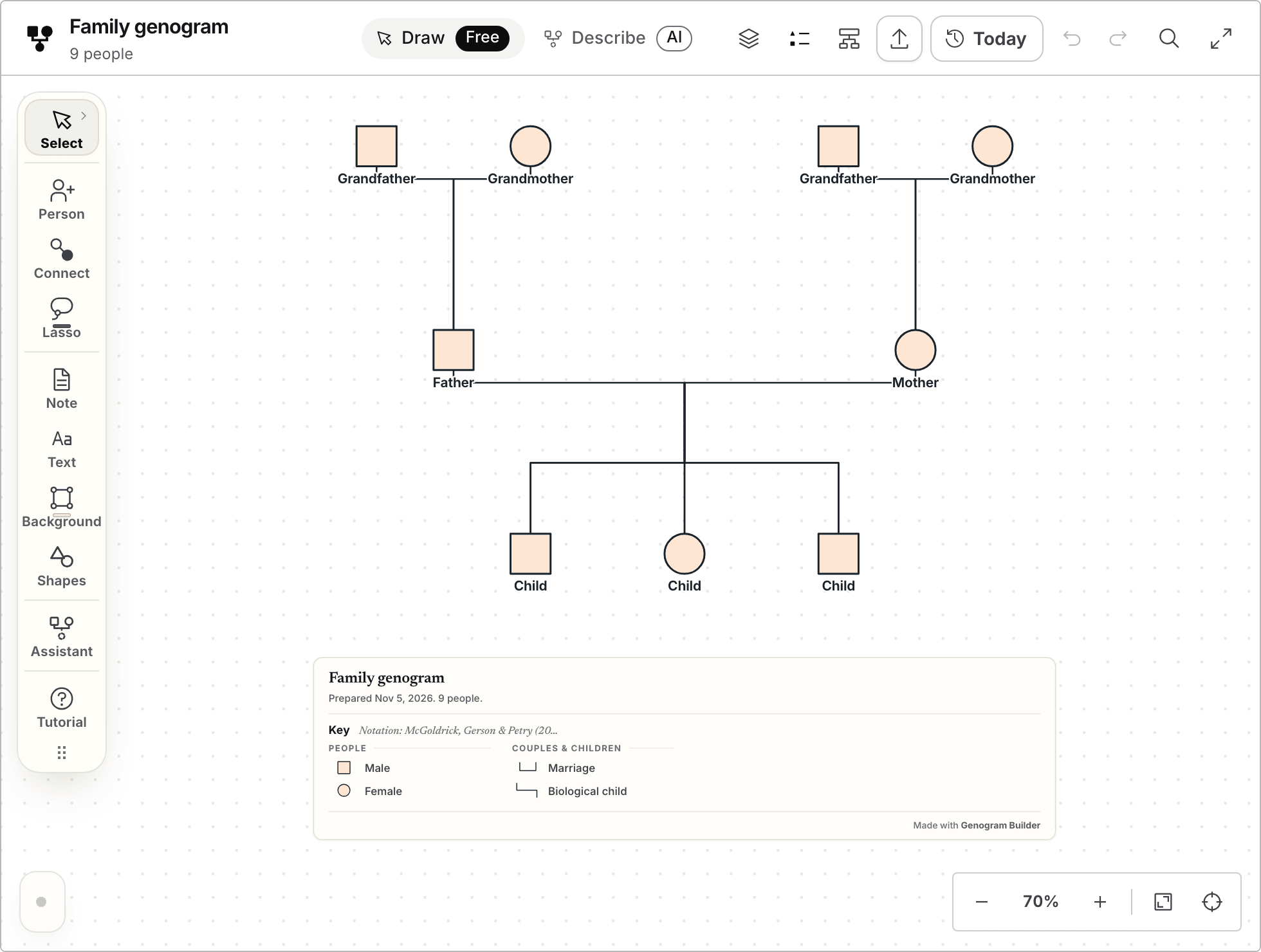
Genogram Builder
Draw the chart with identity marks and fields of your own
Record identity in the person’s own words, and turn on Clinical mode before you export.
- Opens without an account
- LGBTQIA, transgender and secret marks
- Clinical mode replaces names with numbers in exports
Hof and Berman build the chart in five steps
Belous and colleagues summarise the original method in five steps. The questions of the third step can be answered at home or in the session, and the genogram interview questions cover the family history of the first two.
- Introduce the genogram
Explain to the client or couple what a genogram is.
- Draw the family
Draw the standard genogram and talk through what it shows.
- Add the sexual layer
Ask the questions on sex and intimacy for each generation.
- Discuss the chart
Talk about the patterns the finished chart displays.
- Plan the treatment
Bring what the chart shows into the plan for the therapy.
Six areas of questions decide what goes on the chart
The third step asks about six areas, each linking what the family passed down with what the client or couple brings now. That link is why the chart records these things and leaves the rest out.
| Area | What it asks about | On the teaching chart |
|---|---|---|
| Messages | What each generation said or implied about sex, intimacy and being a man or a woman | Sex +, Sex − or Sex Ø under a name |
| Communication | How the family talked about sex and showed affection | Green arrows from the adults who answered questions |
| Secrets | What the family kept quiet | The red triangle beside Ruth |
| Missing information | What is unknown and how it might be found out | No identity for Mari, who was not asked |
| The partner’s view | What each partner notices in the other’s chart | The Moreau side, drawn by Theo |
| Wishes for change | What the person or couple want to change | Kept in the notes |
The 2012 update records identity in the person’s own words
Belous and colleagues give every person an orientation or attraction, written as a letter the person chose, such as L for lesbian, G for gay, B for bisexual, P for pansexual, Q for queer or questioning, A for asexual and H for heterosexual. The letters record how people describe themselves, never what the therapist assumes.
The editor draws the inverted triangle of McGoldrick, Gerson and Petry (2020) instead, and the teaching chart shows both. Mari, Helen’s wife, has neither, because she was not asked, and a partner’s gender does not answer the question.
| Term | What it means | On the teaching chart |
|---|---|---|
| Sex + | Open and accurate information at the right age | Helen and Anne |
| Sex − | Fear based messages and little information | Graham and Ruth |
| Sex Ø | The subject never came up | Ian, Clare and Luc |
| Family boundary | A dashed circle around an open family and a solid one around a closed family | Two households named for how each home talked about sex |
| Committed relationship | A solid line for any relationship the couple calls committed | Nina and Theo, on the editor’s committed line |
| Sexual history timeline | The events that shaped the person, on a line under the chart | Not drawn, because the client decides whether to share it |
The teaching chart follows two fictional families
Nina Calder, the index person, and Theo Moreau are in couple therapy because they find it hard to talk about intimacy. Nina’s grandparents treated sex as a risk to avoid until marriage. Ruth was pregnant with Ian when she married Graham in 1968, a secret the family kept, and she stopped speaking to Helen for four years after Helen came out in 1995.
Ian and Clare left the subject to a book, and Nina’s aunt Helen answered her questions. On Theo’s side, Anne answered questions as they came and Luc left the room. Each partner brings a different family habit to the same difficulty, which is the comparison the fifth area of questions invites.
Consent and anonymity come before the first line is drawn
A sexual genogram holds private facts about the person and about relatives who never agreed to appear on it. These rules apply in therapy, in supervision and in a class.
| Rule | Why |
|---|---|
| Let the person decide what is shared | Students may decide what to share or withhold in class, under F.8.c of the ACA Code of Ethics |
| Offer a fictional or volunteer family | A University of Texas course allows a volunteer family to avoid coercive disclosure, and only the instructor reads the work |
| Write identity only as the person states it | Belous and colleagues warn that an assumption can be wrong in many ways |
| Hide the family’s identity outside the session | Case material may be presented only with agreement or when changed enough to hide identity, under G.5.a |
| Remove names and notes before export | Clinical mode replaces names with numbers and leaves notes and custom fields out of PNG, SVG and PDF files |
| Never share the JSON project of a real family | The project file keeps the real names even in Clinical mode |
Draw a sexual genogram in the editor with marks and fields
Draw the family first. Then select a person, open Identity and marks, type the person’s own words in Gender identity, and switch on LGBTQIA or Secret where they apply.
For the sexual layer, click Add a field under Notes and name it Messages or Identity, so that the value is written under the name. A custom line records who answered a child’s questions, and the Clinical switch in the bottom strip replaces the names with numbers.
Common questions
Whether a sexual genogram is explicit
It need not be. It records messages, identities and secrets, and the detail of any experience stays in the conversation.
Whether students must draw their own family
No. Under the ACA code, students decide what they share in class, and a course can accept a fictional or volunteer family. Ask the instructor before you start.
Who may see the finished chart
Only the people the person has agreed to show it to. In a course that is usually the instructor alone.
Sources and methodology
We make Genogram Builder. We used the references below for this guide. Last checked on 9 November 2026.
- Hof and Berman 1986, The sexual genogram, Journal of Marital and Family Therapy, 12, 39–47
- Belous, Timm, Chee and Whitehead 2012, Revisiting the sexual genogram, The American Journal of Family Therapy, 40, 281–296
- American Counseling Association 2014, ACA Code of Ethics
- Valdez 2019, SW 393R3 syllabus, The University of Texas at Austin
- East Carolina University, COAD 7404 course site
- The Center for Growth, A tool for exploring sexuality
Draw the family first, then add the sexual layer one person at a time, in each person’s own words. No account is needed to begin.
Open the blank three generation sheet