Blended Family Genogram Template with Step and Half Siblings
This blended family genogram template draws a mother and a father who married after earlier partnerships, with the children of each couple hanging from their own line. Former partners stand on the far side, so no couple line crosses another, and an outline shows who lives together. Print the blank A4 sheet, edit it online or read the filled example.
Blank sheet
Filled in for a fictional family
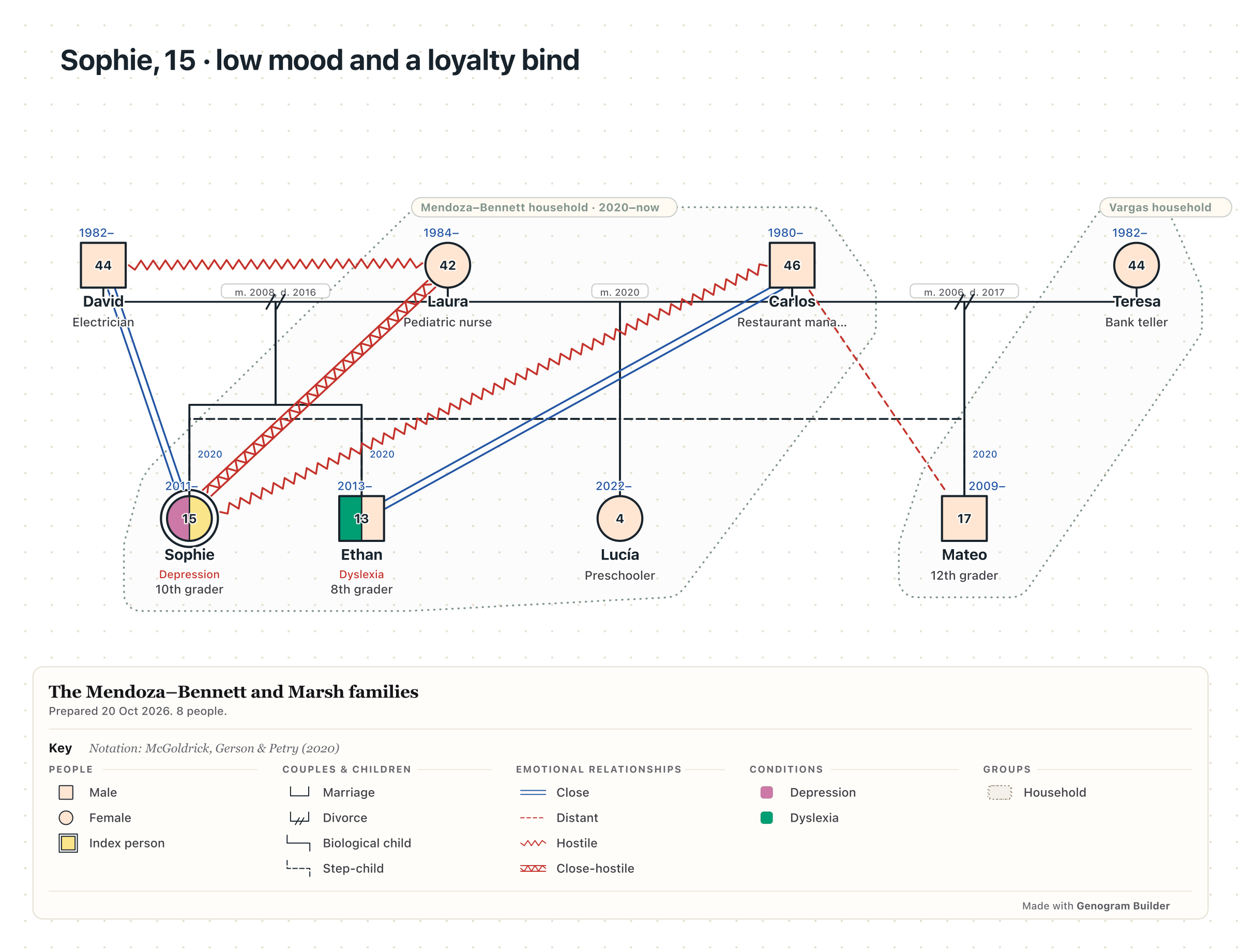
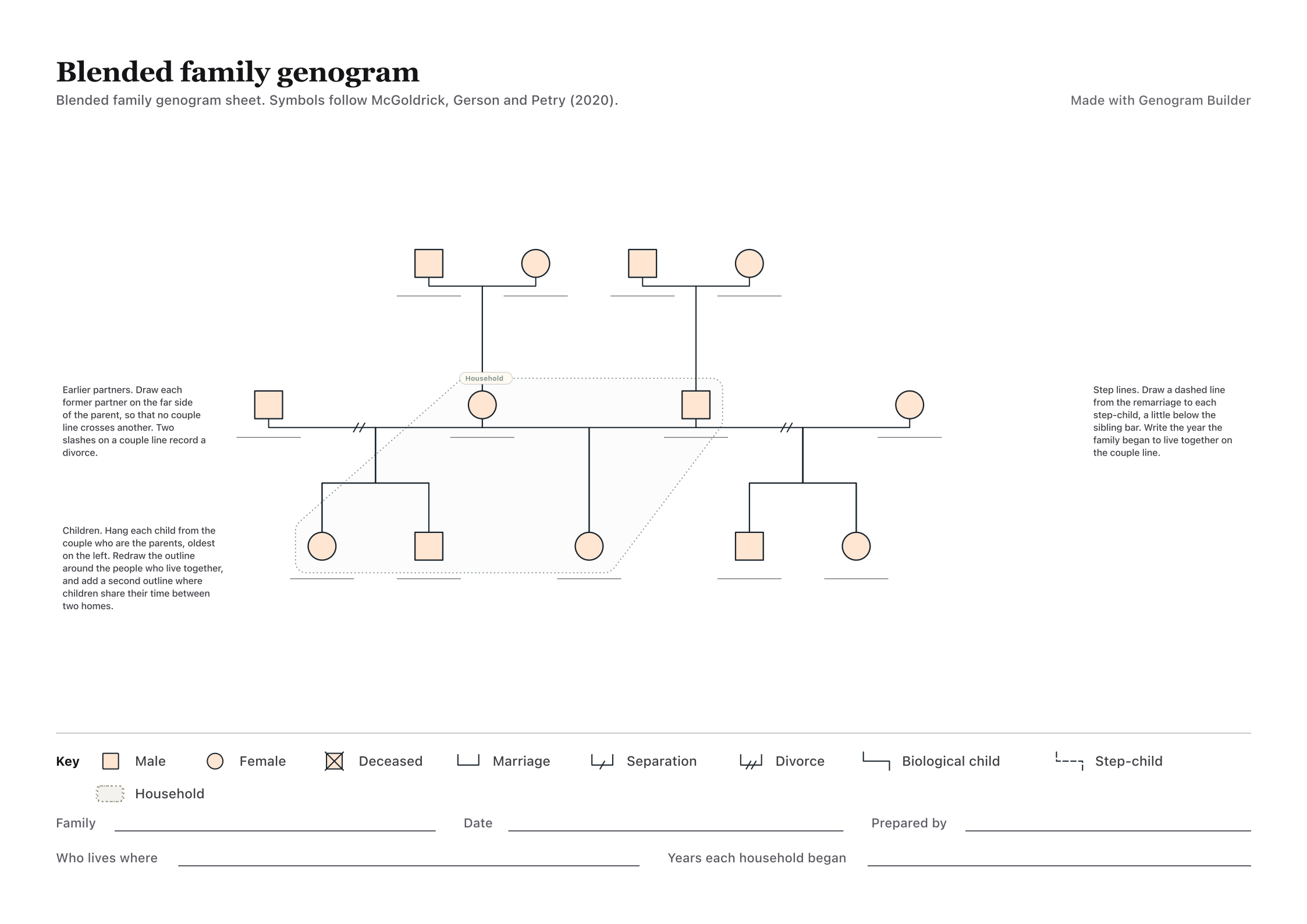
On the left is the blank sheet. On the right is a fictional case from the template library, with two divorces, a remarriage, step lines, a half-sister and two households.
Edit the blended family genogram template online
Open the blank sheet to type over the thirteen placeholder names. It starts a separate chart in this tab and leaves the family saved on the homepage alone.
Click a couple line to set its status, such as Divorced, and its years in From and Until. To add a partner, select the person and click Add a partner in the side panel, and to add a child of one couple, select either partner of that couple and click Add a child. A step-parent is joined by pressing C, clicking the step-parent and then the child, and choosing Step-parent in Parent type. The household outline is drawn with the Lasso around the people who live together. The guide to showing a remarriage or step-family goes through each step.
Edits stay in this tab until you continue in the full editor, which keeps the chart. A visitor can edit without an account but cannot export. A free account exports a PNG, a PDF or a JSON project, with a watermark on the picture and the PDF, and Pro removes the watermark and adds SVG.
The sheet keeps each set of children under its own couple
The mother stands left of centre with her former partner on her left, and the father stands right of centre with his former partner on his right. Each earlier couple has two children, the remarriage has one, and the parents of the mother and of the father sit above them. Every child hangs from the couple who are that child’s parents, which is the one rule that keeps a blended family readable.
Both earlier couple lines carry the two slashes of a divorce, and the household outline encloses the mother, the father, the mother’s two children and the child they share. The key also shows the dashed step line, which you draw in where it applies, and the fields record who lives where and the year each household began.
Divorce, remarriage and step lines each mean something different
A blended family genogram combines lines that a first family rarely needs. The table lists them as McGoldrick, Gerson and Petry (2020) draw them, with the step line, which this editor adds and explains in its key.
| What happened | How it is drawn | What to write |
|---|---|---|
| Marriage | A solid couple line | The year of the marriage |
| Separation | One slash across the couple line | The year of the separation |
| Divorce | Two slashes across the couple line | The years of the marriage and of the divorce |
| Living together without marriage | A dashed couple line | The year the couple moved in together |
| Step-parent and step-child | A dashed line from the step-parent to the child | The year the household formed |
| Half siblings | Children under two couple lines that share one parent | Nothing more, since the lines show it |
| Household | A dotted outline around the people who live together | A second outline for a second home |
Brothers and sisters who share one parent are half siblings, and the guide on how to show half siblings on a genogram explains how they read on the chart. Stepsiblings share no parent and are joined only through the couple line of the remarriage.
Fill in the partnerships in the order of their dates
Work along the row of partnerships from left to right, and place every child before you add any step line.
- The first partnerships. Write each former partner’s name and years, then the years of the marriage and of the divorce on the couple line. Draw a single slash for a couple who separated but never divorced.
- The remarriage. Write the year the couple married, or the year they began to live together, on the line between them.
- The children. Hang each child from the couple who are the parents, oldest on the left within each couple. A child of the remarriage goes under its line, between the two families.
- The step lines. Draw a dashed line from a step-parent to each step-child who lives with them or has a parent’s place in their life, a little below the sibling bar.
- The households. Redraw the outline around the people who live together now, and add a second outline for the other home of a child who moves between two.
A former partner who has remarried in turn can be given a new partner further out on the same side, so the chart grows outward without any line crossing another.
A fictional blended family shows the lines in use
Sophie Marsh, aged fifteen, is the index person in a fictional case from the template library. Her mother Laura Bennett married David Marsh in 2008, and they divorced in 2016. Sophie and her brother Ethan are their children. Laura married Carlos Mendoza in 2020, and their daughter Lucía was born in 2022, which makes her a half-sister to Sophie and Ethan.
Carlos was married to Teresa Vargas from 2006 until their divorce in 2017, and their son Mateo lives with his mother. Dashed step lines join Carlos to Sophie and Ethan, and Laura to Mateo. Two household outlines show where everyone lives, one around the Mendoza–Bennett home and one around Teresa and Mateo.
The relationship lines carry the case. Sophie is close to her father and hostile with Carlos, her relationship with her mother is close but hostile, and Ethan has grown close to his stepfather. The chart shows the loyalty bind that brought Sophie to counseling without a paragraph of explanation.
A blended family genogram shows where a child is caught
Children in blended families often move between two homes with two sets of rules, and a genogram drawn with them shows the shape of that life on one page. Family therapists use the chart to see where a child is caught between households, and students drawing their own family for a course use it to explain a remarriage without long paragraphs.
Ask each person whom they count as family before you draw the step lines, since a step-parent who joined late may not hold that place for the child. Draw a relationship line only where the person it concerns has described the relationship. The guide to genograms and family therapy covers using the chart across sessions.
Common questions
The blended family genogram template is free to print and edit
The blank PDF and PNG download without an account, and the sheet can be edited online as a guest. Exporting an edited chart needs a free account, and the free export carries a watermark.
Where a former spouse goes on a genogram
On the far side of the person they were married to, away from the current partner, so that no couple line crosses another. The couple line keeps the years of the marriage and of the divorce.
How to show children who live in two homes
Draw an outline around each home and put the child inside the outline of the home where they spend most nights. Where the time is shared equally, write it in a note beside the child.
How to show a stepfamily without a marriage
Draw the couple line dashed for partners who live together without marrying, and write the year they moved in together. Step lines and half siblings are drawn as for a married couple.