How to show half siblings on a genogram in four steps
Before drawing, write down the biological parents of each child and any known partnership dates. A half-brother or half-sister shares exactly one biological parent with the other child. Sharing a home, surname or step-parent does not establish that relationship.
Use the person symbols and couple-line conventions required by your course or workplace. The example uses squares for males, circles for females, solid marriage lines and two slashes for divorce. The half-sibling relationship comes from the parent connections, regardless of the person symbols used.
- Draw the shared parent once
Place the parent shared by both children in the parent generation. Leave space on either side for the other parents.
- Draw a line for each couple
Connect the shared parent to each other parent separately. Record marriage, separation or divorce only when those facts are known.
- Attach each child correctly
Draw a descent line from each parental couple to its own child or sibling group. Give children with the same two parents a shared sibling bar.
- Check the parent connections
Trace each child upward. Half-siblings should lead to one common biological parent and two different other biological parents.
Full siblings, half-siblings and step-siblings have different parent connections
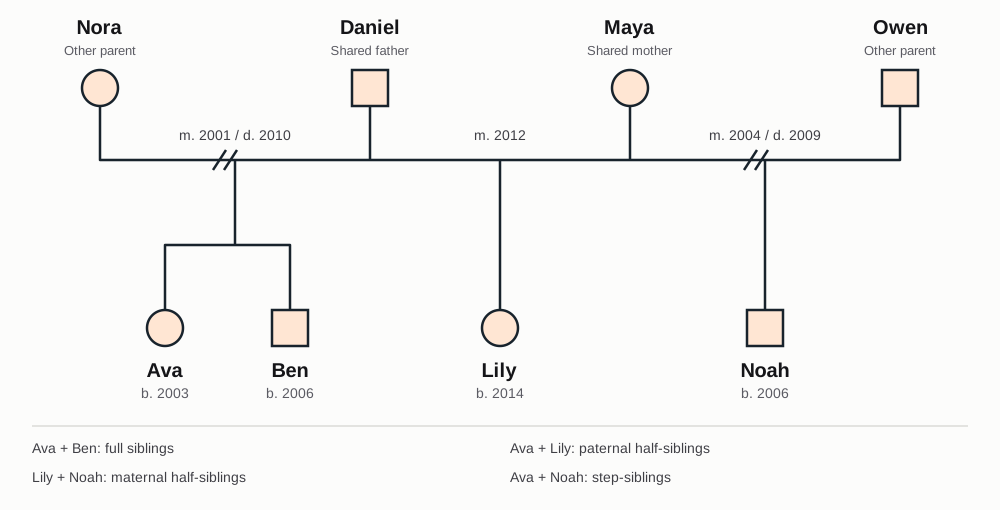
Full siblings share both biological parents, as Ava and Ben do. Half-siblings share one biological parent, as Ava and Lily do through Daniel, and Lily and Noah do through Maya. Step-siblings share no biological parent and are connected through the partnership of their parents, as Ava and Noah are through the marriage of Daniel and Maya.
Keep Noah on the Maya and Owen branch. Attaching him to the Daniel and Maya branch with ordinary biological descent lines would incorrectly identify Daniel as his biological father. A household outline can show who lives together without changing any of these parent connections. GenoPro’s family reference illustrates the different sibling types.
Some software also offers an explicit step-parent line. In Genogram Builder, that optional dashed line is an editor convention identified in the key. It should not replace the biological parent links or be used as a special line between half-siblings. Explain any added convention in the legend of the chart you submit.
The blended family genogram template prints this arrangement on one sheet. Twins who share both parents hang from one point on the sibling line instead, as the twins genogram template shows.
Keep birth order within each parental sibling group
Place children who share a parental couple from oldest to youngest, left to right within that group, following GenoPro’s birth order guidance. Ava, born in 2003, sits to the left of Ben, born in 2006. Lily belongs under Daniel and Maya even though Noah, shown farther to the right under Maya and Owen, is older than she is.
Do not move a child onto the wrong parental branch to make every child on the page follow one left-to-right timeline. Write birth years beside the symbols so readers can compare ages across branches. If birth order is known but dates are uncertain, preserve the order and leave the dates unspecified.
Record unknown parents and partnership status without guessing
When the other biological parent is known to exist but their name is unknown, use an unnamed or unknown-parent symbol and explain it in the key. Keep that person separate from the known other parent on the first branch. An unknown name is not a reason to attach the child to a different couple.
Half-siblings do not imply a divorce or even a marriage. Use a marriage line only for a known marriage, and use the notation required for an unmarried relationship when appropriate. Add separation or divorce marks only when confirmed. Two divorce slashes describe the parental relationship, not the relationship between the children.
Check each child after adding another partner in the editor
In Genogram Builder, start with the shared parent and one partner, then add the children of that partnership. Add the other partner from the shared parent and create the children belonging to that second couple. Click each child line to check which parent and child it connects.
The Child action on the person ring uses that person’s most recent partnership. Adding every child from the shared parent after creating both couples can therefore put an older child under the newer couple. Creating the first branch before adding the next partner reduces this mistake. The guides to adding siblings and showing a remarriage explain how to inspect and correct family links.
For a worked example, open the blended-family template. It includes full siblings Sophie and Ethan, their maternal half-sister Lucía, and Mateo, who is Lucía’s paternal half-brother. The template has additional emotional and step-parent lines, so read its key alongside the simpler biological-parent diagram above.
Trace the parents before calling the diagram complete
The final check for how to show half siblings on a genogram is to trace the descent lines. Each child should reach their own parents, each half-sibling pair should share one biological parent, and every parental couple should keep its own branch. Check birth order within each group and explain any optional lines in the key before exporting the chart.
Common questions
Which symbol represents half-siblings on a genogram
There is no separate half-sibling symbol in the notation shown here. Use the usual person symbols and biological child lines. The relationship is visible because the children descend from different parental couples that have one biological parent in common.
How to show a half-brother or half-sister
Place the half-brother or half-sister under the couple line of their own biological parents. Draw the shared parent once and connect that parent to both partners. The child symbol follows the notation used for that person, while the parent connections establish the half-sibling relationship.
Whether half-siblings need a line between them
No additional line is needed between the children. Their parent links already show that they are half-siblings. An emotional relationship line may be added if closeness, conflict or another relationship is relevant, but it records that emotional relationship rather than biological kinship.
How to show half-siblings when the parents never married
Use the appropriate couple line for the known relationship between each pair of parents. Connect each child to their own parents and keep the shared parent in both parental couples. A marriage is not required for two children to be half-siblings.
Whether half-siblings and step-siblings are the same
Half-siblings share one biological parent. Step-siblings share no biological parent and are connected through the partnership of their parents. A child can have both kinds of sibling relationship in the same blended family, as Lily, Ava and Noah illustrate in the diagram.
Draw your own family in the editor or open the fictional blended-family template to inspect the parent links. The template library identifies which examples need a free account.
Open the blended-family template