Counseling Genogram Template for Interviews and Practice
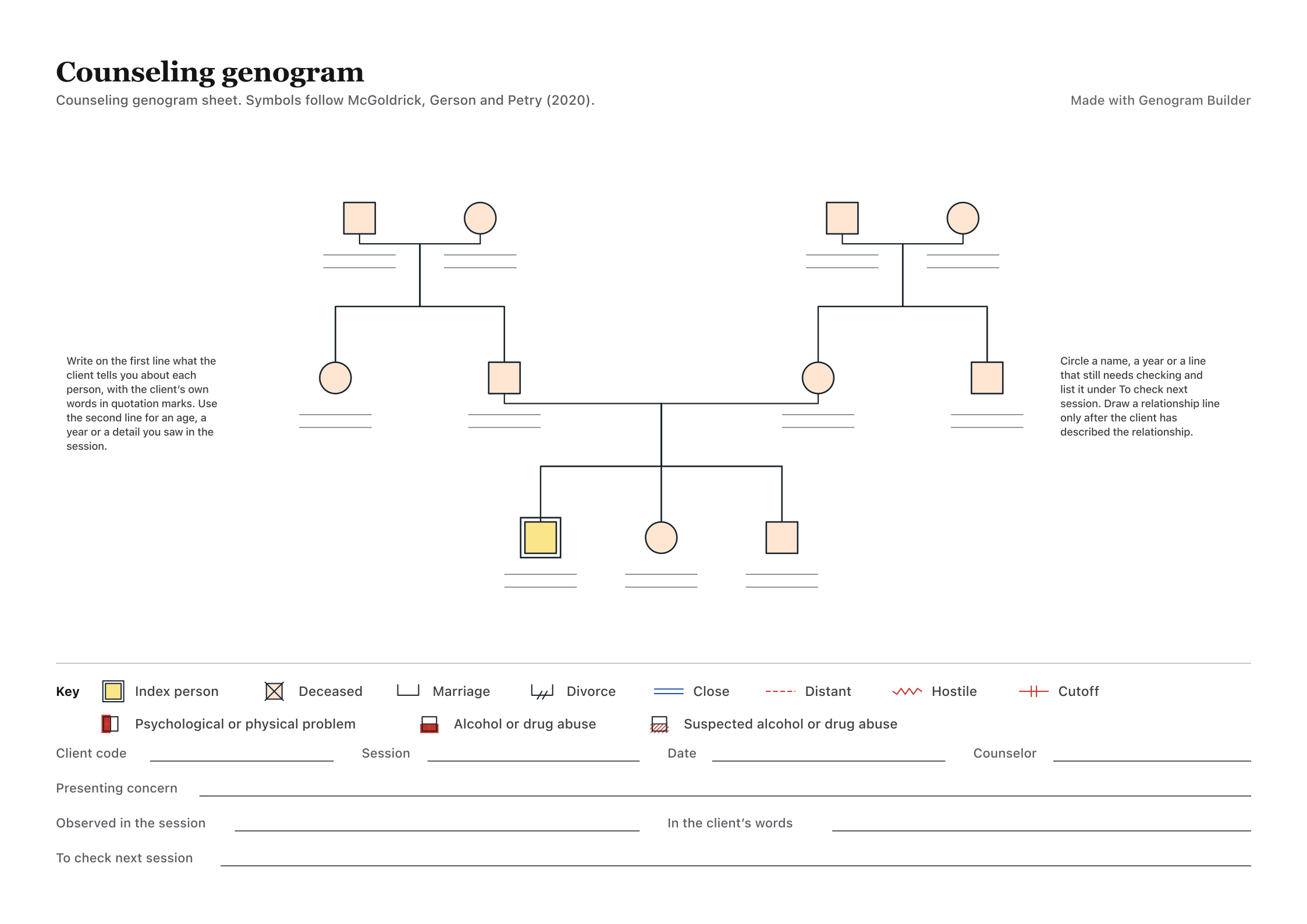
This counseling genogram template is a worksheet to fill in during an interview. Every symbol has two writing lines, and the fields at the foot keep what you observed, what the client said in their own words and what still needs checking apart. Print the blank A4 sheet, edit it online or open the practice example.
Blank worksheet
Practice example, fictional client
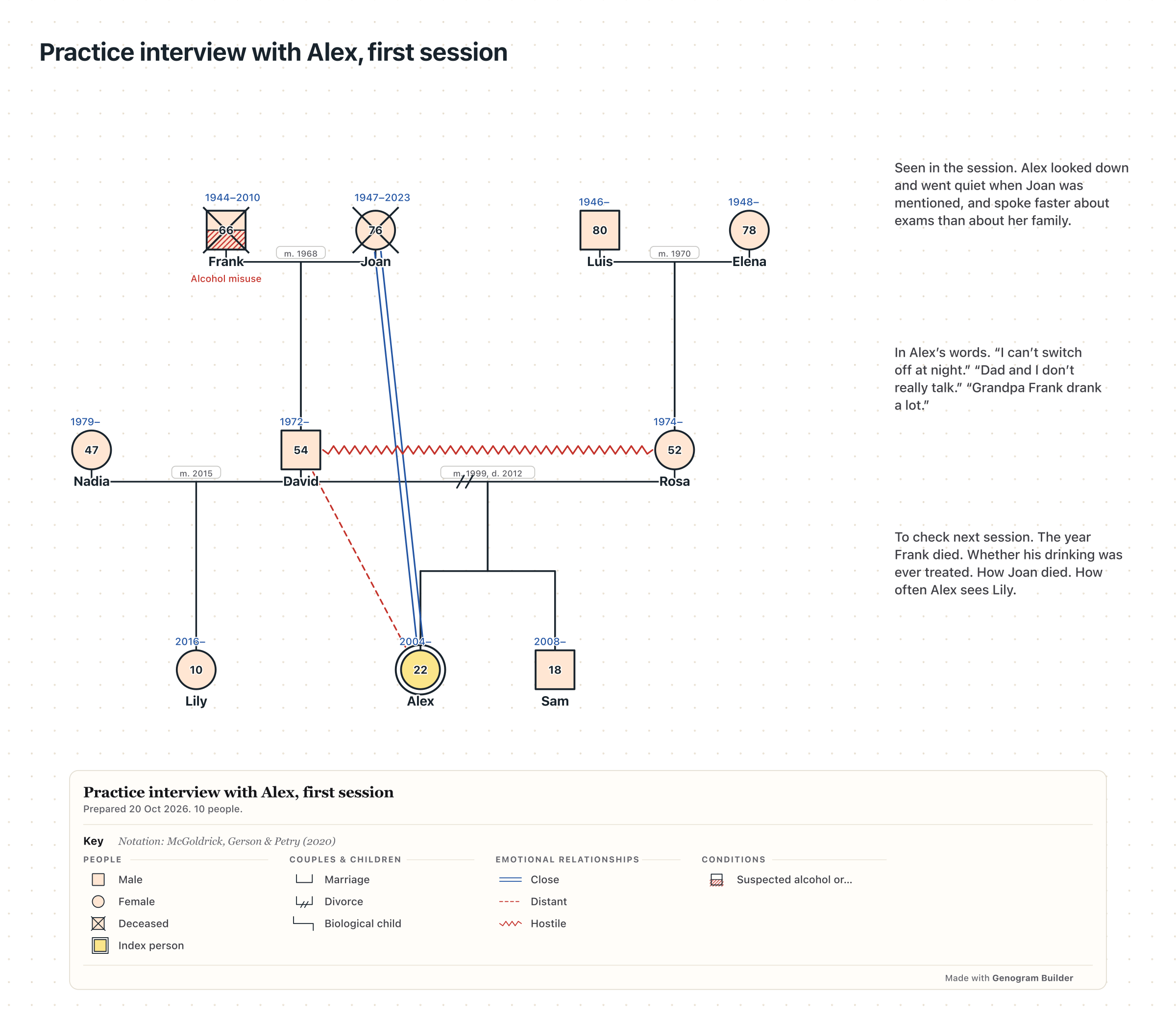
On the left is the blank worksheet. On the right is a first practice interview with a fictional student, Alex, with the facts on the chart and three notes beside it.
Edit the counseling genogram template online
Open the blank worksheet to type over the eleven placeholder names, or open the practice interview with Alex and change it. Either one starts a separate chart in this tab and leaves the family saved on the homepage alone.
Select a person to type the name and the years. Under Health, add a condition, and where the client reports drinking or drug use that nobody has confirmed, set its status to Suspected, which hatches the lower half of the symbol instead of filling it. Press C and click two people to draw a relationship line, and use the Note tool to add the observations and the open questions beside the chart.
Edits stay in this tab until you continue in the full editor, which keeps the chart. A visitor can edit without an account but cannot export. A free account exports a PNG, a PDF or a JSON project, with a watermark on the picture and the PDF, and Pro removes the watermark and adds SVG.
The worksheet keeps facts, words and questions apart
The drawing covers three generations with an aunt and an uncle, and the client is outlined as the index person in the children’s row. Under each symbol the first line takes what the client tells you about the person, and the second takes an age, a year or a detail you noticed. A note beside the drawing asks you to circle anything that still needs checking.
The fields at the foot hold a client code instead of a name, the session and the date, the presenting concern, what you observed in the session, the client’s own words and the points to check next time. The key covers the lines and the health marks that a first interview most often needs.
Fill in the counseling genogram in the order you ask
Most first interviews move from the household outward. The order below fills the sheet from the client’s own generation up to the grandparents and leaves the relationships until the structure is clear.
- The client and the household. Start with the people the client lives with, and write names and ages under the symbols of the children’s row.
- Parents and their partnerships. Ask about each parent, any separation or divorce and any new partner, and draw each child under the right couple.
- Grandparents, aunts and uncles. Fill in the generation above, with deaths, the years they happened and the causes as the client gives them.
- Health and substance use. Ask about illness, mental health and drinking or drug use in each generation, and hatch the lower half where the client suspects a problem that nobody has confirmed.
- Relationships. Ask whom the client is close to, whom they rarely see and where there is conflict, and draw a line only for a relationship the client has described.
The genogram interview questions list the questions for each of these steps, grouped so you can copy them into your notes before a session.
Observations, quotations and open questions belong in different places
A genogram drawn in a session mixes several kinds of information, and mixing them on the chart is a common mistake in practice work. Keep each kind in its own place, as the table shows.
| Kind of information | An example | Where it goes |
|---|---|---|
| What you observed | Looked down and went quiet when her grandmother was mentioned | The field for observations, and never a line on the chart |
| What the client said | “Dad and I don’t really talk.” | The field for the client’s words, in quotation marks |
| A fact the client stated | Her parents divorced in 2012 | The chart itself, as a couple line with two slashes and the years |
| A fact the client was unsure of | Her grandfather died around 2010 | The chart, with the year circled and listed to check |
| Something to check | Whether her grandfather’s drinking was ever treated | The field for points to check next session |
A practice interview with Alex shows the worksheet in use
Alex is a fictional student, aged twenty-two, who came to a first session in 2026 with trouble sleeping and worry before exams since March. Her parents, David and Rosa, married in 1999 and divorced in 2012. David married Nadia in 2015, and their daughter Lily is Alex’s half-sister. Alex’s brother Sam was born in 2008.
Her paternal grandmother Joan died in 2023, and Alex described her as the person she was closest to, so a close line joins them. Her grandfather Frank died in 2010, as far as Alex knows. She said that he drank a lot, and since nobody has confirmed it, the lower half of his symbol is hatched for suspected drinking rather than filled.
The three notes beside the chart do the work of the fields on the worksheet. One records what was seen in the session, one quotes Alex, and one lists four points to check next time, starting with the year Frank died.
Keep a counseling genogram anonymous and provisional
Write a client code or initials on any genogram that leaves the room, and keep the key to the code with the case record. In training, use a role play, a fictional client like Alex, or your own family with the agreement of anyone you name.
Treat the first chart as a draft. Clients correct dates, add relatives they forgot and see a relationship differently once it is drawn, so date each version and keep the earlier ones. The guide to genograms and family therapy covers returning to the chart over later sessions.
Common questions
The counseling genogram template is free to print and edit
The blank PDF and PNG download without an account, and the sheet can be edited online as a guest. Exporting an edited chart needs a free account, and the free export carries a watermark.
Whether to fill in the genogram during the session
Many counselors sketch it during the session with the client watching, since the client can correct it there and then. Others take notes and draw it afterwards. The worksheet works either way, and its fields keep the notes apart from the drawing.
How much a first counseling genogram needs
Three generations, the household, the major losses and the relationships the client raises are enough for a first session. Add more as the client brings it, rather than asking every question at once.
Whether the template suits a psychology assignment
Yes. The same worksheet fits a psychology or counseling course that asks for a genogram from an interview. Check the key your course gives, and add any line it asks for that the sheet leaves out.