The outline gives a genogram paper seven parts
Learning how to write a genogram paper starts with its parts. The outline below gives seven, in the order in which a written analysis builds from the chart to the reflection. Check it against your own brief, which may rename a part or leave the reflection out, and replace each line with a paragraph of your own.
Introduction
- State whose genogram this is, how many generations it covers and when the information was gathered.
- Say how the facts were collected, for example from interviews with named relatives, from documents or from memory.
- Name the question the paper answers, such as a pattern you expected to find or a relationship you wanted to understand.
The genogram and its key
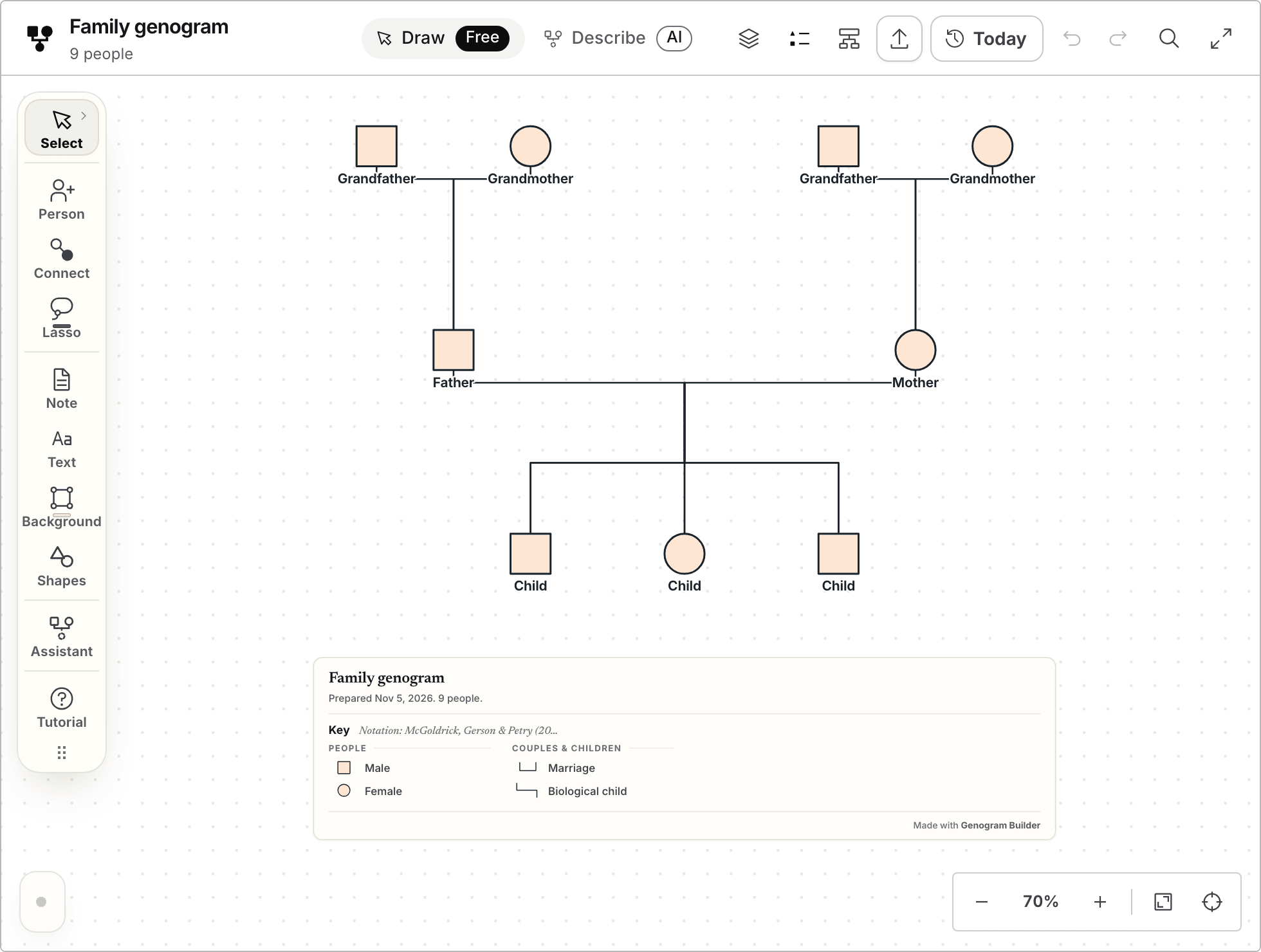
- Place the genogram as a figure with a number and a caption, and refer to it by that number in the text.
- State that the symbols follow McGoldrick, Gerson and Petry, and include the key with the figure.
- Explain any line or colour of your own that the standard notation does not provide.
The structure of the family
- Describe the family generation by generation, beginning with the oldest, with names, dates and places.
- Note the marriages, separations and divorces, the children of each union and any adoption, fostering or loss.
- Describe the households and who lives in each one today.
Patterns across the generations
- Describe what repeats, such as an illness, an occupation, an age at marriage, a migration or a kind of relationship.
- Describe the emotional relationships and where closeness, distance, conflict and cut-offs cluster.
- Describe the triangles, the roles people fill and the events that fall in the same years.
Analysis
- Connect the patterns to the ideas of the course, with a citation for each idea you use.
- Separate what the family told you from what you concluded, and say which is which.
- Consider what the chart leaves out and whose account of the family is missing.
Reflection and conclusion
- Say what drawing the genogram changed in your understanding of the family, or of yourself.
- Say how you would use a genogram in your own practice, and what you would do differently next time.
- Return to the question you asked in the introduction and answer it in a paragraph.
References and appendix
- List every source in the style your course requires, with the notation reference among them.
- Add the interview notes, the consent you obtained and any earlier draft of the chart as an appendix.
Genogram Builder
Draw the figure for your paper
Each person goes on a blank three generation sheet in the editor, and the chart exports with its key to place as Figure 1.
- Opens without an account
- The key follows McGoldrick, Gerson and Petry
- PNG and PDF export with a free account, with a watermark
The chart goes in as a numbered figure with its key
Place the figure after the paragraph that first mentions it, and refer to it by its number wherever the text discusses it. In APA Style the number sits above the title and the image, and figures are numbered in the order the text first mentions them. Keep the key with the figure, so a reader can check each line without turning the page.
For a chart drawn by hand, print a blank sheet from the three generation template and scan it once it is filled in. The genogram symbols guide explains each mark. Where your course names another style guide, follow it.
| Part of the figure | What to write | How APA Style sets it |
|---|---|---|
| Number | Figure 1 | In bold, above the title and the image |
| Title | The Hawkins Family Across Three Generations | In italic title case, one double-spaced line below the number |
| Image | The genogram with its key | Below the title |
| Note | Note. A fictional family. Symbols follow McGoldrick et al. (2020). | Below the image, only where the figure needs it |
Make the figure in the editor and export it
The editor draws the chart in the standard notation and writes the key for you, so the figure and its legend agree.
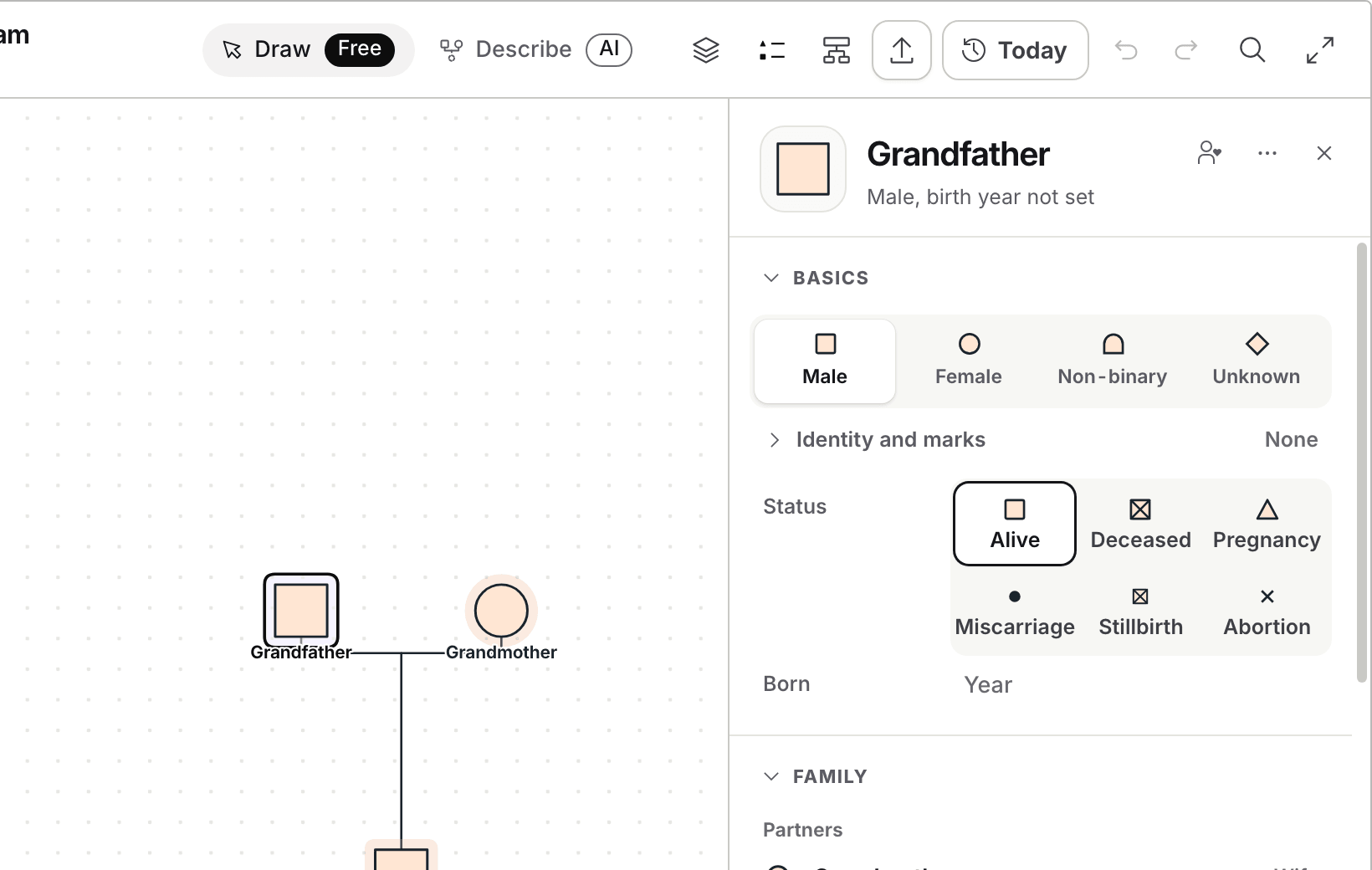
Open the blank sheet, select each person and type the name, the status and the years into the details.
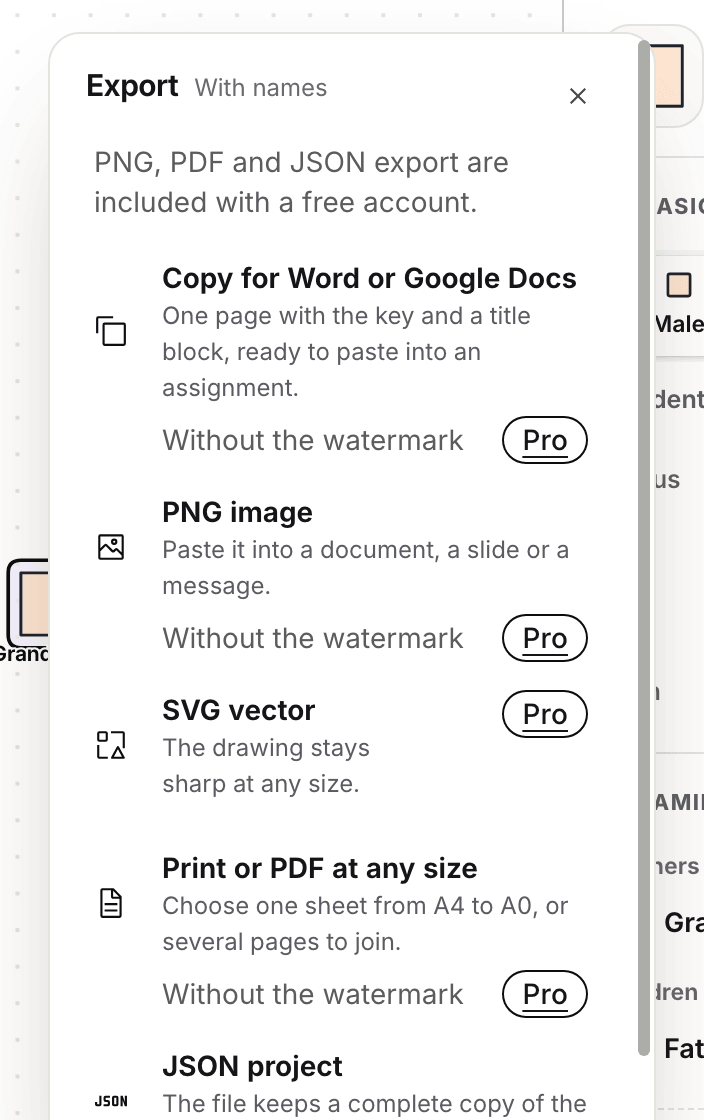
Choose Export, then Copy for Word or Google Docs to paste one page with the key, or save a PNG or a PDF. A free account adds a watermark.
Describe the structure before interpreting anything
The description states what the chart shows, generation by generation, with no interpretation. A passage about the fictional Hawkins family reads as follows. Walter and Joan Hawkins married in 1968, and Walter died in 2021. Their son Paul was married to Dawn Reilly from 1994 until their divorce in 1997, and he married Helen in 2003. Paul and Helen have two children, Jack and Ellie. Ellie, born in 2009, is the index person.
Name a pattern and point to the evidence
The patterns part says what repeats and points to the lines and dates that show it. An example reads as follows. Mental health and substance problems appear in all three generations. Walter and Joan were fused, and Joan has had depression since Walter died. Paul misused alcohol for many years and has been in recovery since 2019. Ellie has generalised anxiety disorder and has not attended school since March 2026.
The passage does not say that one event caused another. It names what the chart records and leaves the explanation to the analysis.
The analysis connects each pattern to the ideas of the course
Take each pattern and explain it with a concept the course has taught, such as differentiation, triangles or the family life cycle, with a citation for each. Keep what the family said apart from what you concluded, with phrases such as the family describes and the chart shows.
The reflection says what drawing the chart changed in your understanding and how you would use a genogram in practice. Put interview notes and consent in an appendix if the course allows it. The genogram interview questions help gather the facts before you write.
Common questions
Whether the example passages can be copied
No. They describe a fictional family to show the form of each part. A paper must describe the family of its own genogram in the student’s own words, and many courses check for this.
How long a genogram paper should be
The brief of the course sets the length and says whether the chart and the references count toward it. When it is silent, ask the tutor before you start.
Keeping a real family private in the paper
Use first names, initials or numbers, and say in the paper that you have done so. The editor has a Clinical mode that replaces names with numbers on the chart.
Whether to use AI to write the paper
Check the policy of the course first, since some courses do not allow it. Use the editor for the chart, and write the analysis in your own words.
Sources and methodology
We make Genogram Builder. We used the references below for this guide. Last checked on 5 November 2026.
Put the family on the blank sheet and export it with its key as the figure. No account is needed to begin.
Start the chart for your paper