Single Parent Genogram Template with Two Filled Examples
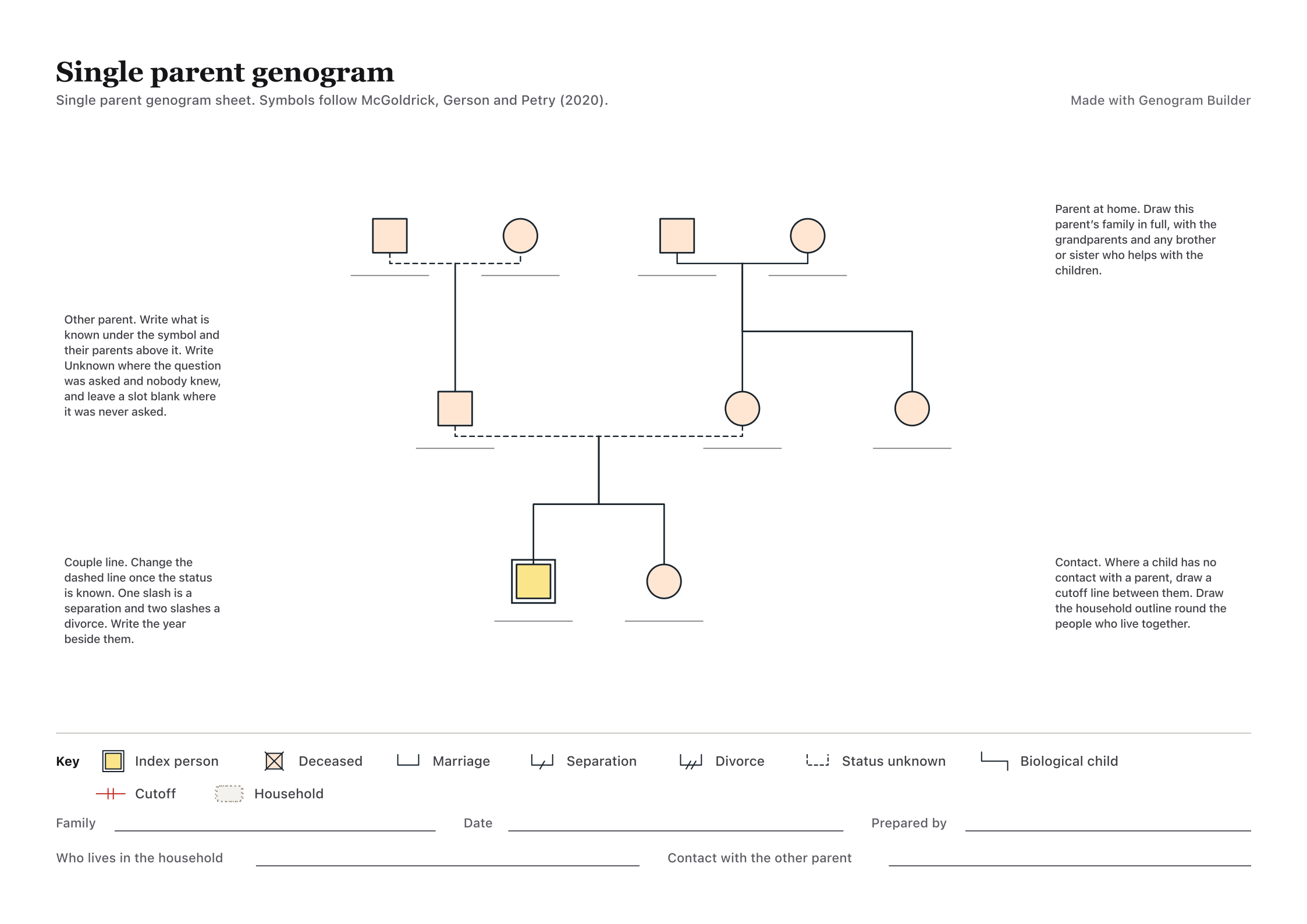
This single parent genogram template draws a parent raising children alone, with their own parents and a brother or sister, and keeps the other parent and their parents as slots whose details can stay open. A separation, a parent who is not known and a child with no contact are each drawn differently. Print the blank A4 sheet, edit it online or open one of the two filled examples.
Blank sheet
Filled in for a fictional family
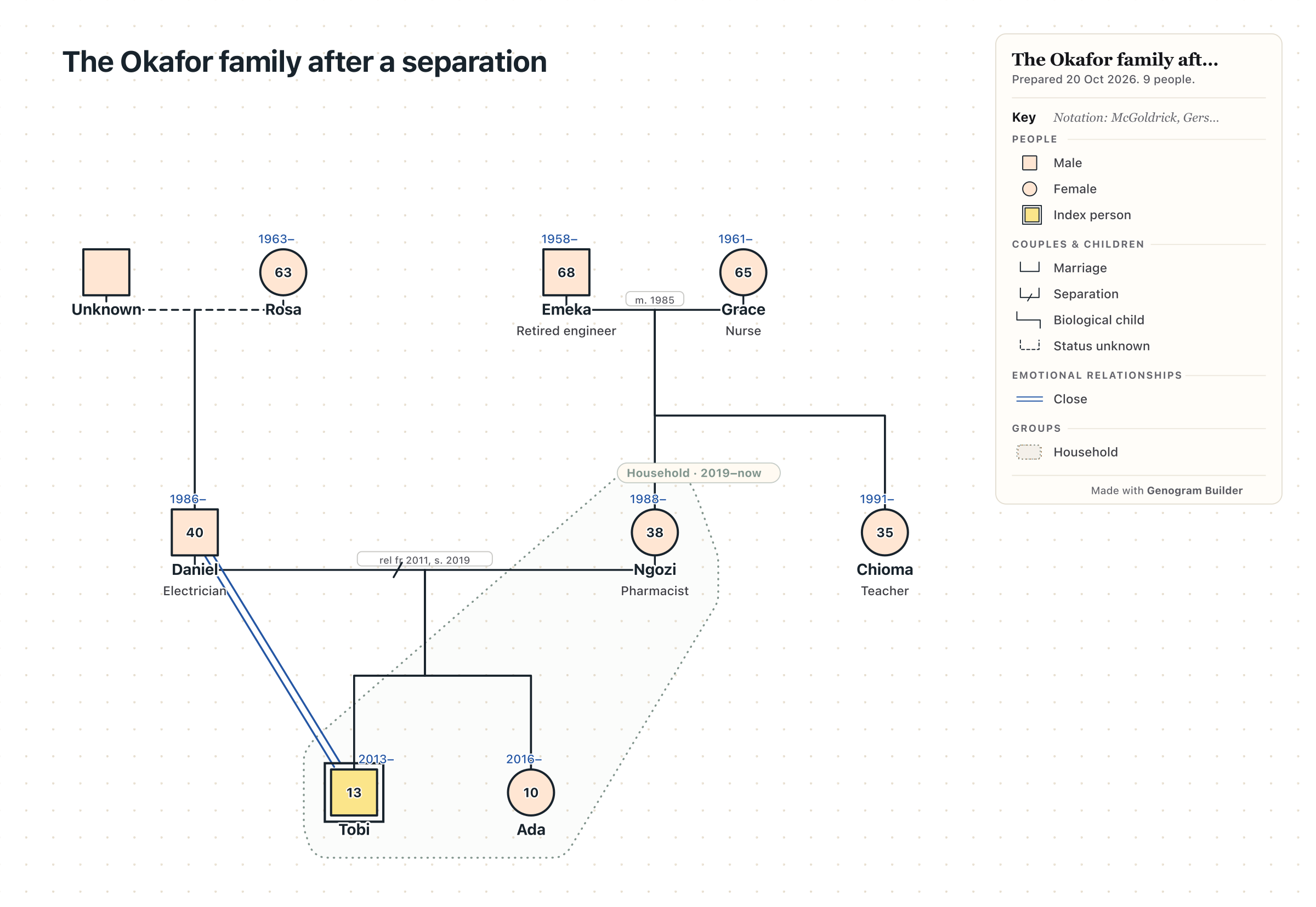
On the left is the blank sheet. On the right is the fictional Okafor family, where the parents separated in 2019 and the father still sees the children every other weekend.
Edit the single parent genogram template online
Open the blank sheet to type over the nine placeholder names, or open the Okafor or the Brennan family and change it. Each one starts a separate chart in this tab and leaves the family saved on the homepage alone.
To set the couple line, click it and pick Separated, Divorced or Unknown status in the side panel, then type the years. To record that a child has no contact with a parent, draw a Cutoff line between them with Connect. The guide to choosing the right line shows each relationship line.
Edits stay in this tab until you continue in the full editor, which keeps the chart. A visitor can edit without an account but cannot export. A free account exports a PNG, a PDF or a JSON project, with a watermark on the picture and the PDF, and Pro removes the watermark and adds SVG.
The sheet draws one parent in full and keeps the other open
The parent at home stands on the right with their own parents above and a brother or sister beside them, since grandparents and siblings are often the people who help most. The other parent stands to the left, joined by a dashed couple line, the notation for a relationship whose status is not yet recorded. The two children hang from both parents, with the first one outlined as the index person.
The other parent’s parents are slots on a dashed line. Fill them in where they are known and matter to the child, as the Okafor example does for one grandmother, and leave them blank where nothing is known. Never fill a slot from a guess, and delete the two slots where the other side is not known at all, as the Brennan example does.
Unknown, separated and no contact are drawn differently
A single parent family can mean a separation, a divorce, a parent who died, a parent who is not known or a child who has no contact with one parent. The standard notation of McGoldrick, Gerson and Petry (2020) gives each a different mark, so the chart says which one it is.
| What happened | How it is drawn | What to write beside it |
|---|---|---|
| The parents separated | One slash across the couple line | s. and the year |
| The parents divorced | Two slashes across the couple line | d. and the year |
| The status is not recorded | A dashed couple line | Nothing until it is known |
| The other parent died | An X through the symbol | The years of birth and death |
| A parent is not known | The symbol kept, with Unknown under it | Nothing else |
| A child has no contact with a parent | A cutoff line between them, broken by two short bars | The year the contact ended |
| A child conceived with a donor | The donor line from a donor symbol | Known donor or anonymous donor |
Keep the three kinds of gap apart. Unknown means the question was asked and nobody had the answer. A blank line means the question was never asked. A cutoff means the person is known and the contact has ended. Each one tells a reader something different about the family.
The Okafor family shows a separation with contact
Ngozi Okafor, born in 1988, and Daniel Reyes, born in 1986, lived together from 2011 and separated in 2019. Their children Tobi, the index person, and Ada live with Ngozi, and the household outline holds the three of them. Daniel has the children every other weekend, so a close line joins Tobi to his father.
Ngozi’s parents and her sister Chioma are drawn in full, because they collect the children from school and look after them on Saturdays. On Daniel’s side only his mother, Rosa Reyes, is known. His father is drawn as Unknown, on a dashed line, because Daniel has not shared anything about him.
The Brennan family shows a parent out of contact
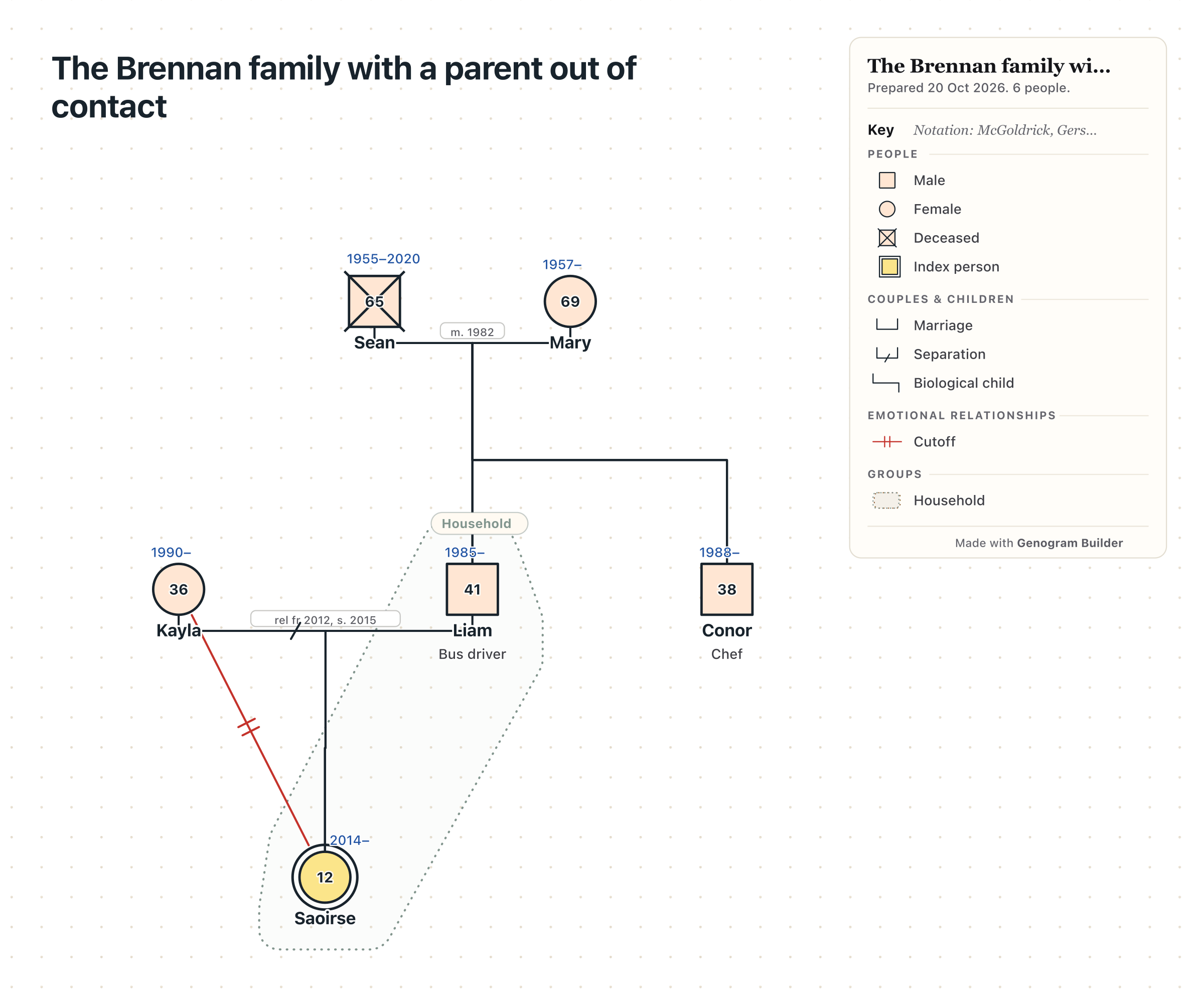
Liam Brennan, born in 1985, has raised his daughter Saoirse alone since 2015. Her mother, Kayla, is known only by her first name, and the year of birth on her symbol is an estimate. Saoirse has had no contact with her since 2016, which the red cutoff line between them records with its year.
Kayla’s family is not known, so nothing is drawn above her. Liam’s mother Mary lives nearby and does the school run, and his father Sean is crossed through for his death in 2020. Liam drew the chart with Saoirse for a meeting about her move to secondary school.
More completed charts are collected in the genogram examples, and every symbol and line on these sheets is explained in the genogram symbols guide.
Draw what the family knows and wants to share
Ask the parent which relatives belong on the chart before you start. Some parents want the other parent drawn with their family, and some want one symbol and nothing more. Both are honest single parent genograms, and the sheet leaves room for either.
A child who has no contact with a parent may still talk about them, and a cutoff line on a page can be hard to look at. Draw it with the parent, explain what the line means, and leave it off a copy that the child will see if the parent prefers. Social workers who add the chart to a case file note where each fact came from. The guide to genograms for social workers covers assessment.
Common questions
The single parent genogram template is free to print and edit
The blank PDF and PNG download without an account, and the sheet can be edited online as a guest. Exporting an edited chart needs a free account, and the free export carries a watermark.
How to show a parent who is not known
Keep the symbol in its place beside the other parent and write Unknown under it, with no year. Leave the couple line dashed, since its status cannot be recorded, and draw nothing above the symbol.
How to show a parent who died
Draw an X through the parent’s symbol and write the years of birth and death above it. The couple line stays as it was, ended by the death, and the household outline holds the parent and children who live together now.
How to show a new partner of the single parent
Join the new partner to the parent with a couple line of their own, set to the side away from the other parent. A child who lives with the new partner is joined to them by the dashed line of a step-parent, as on the blended family genogram template.