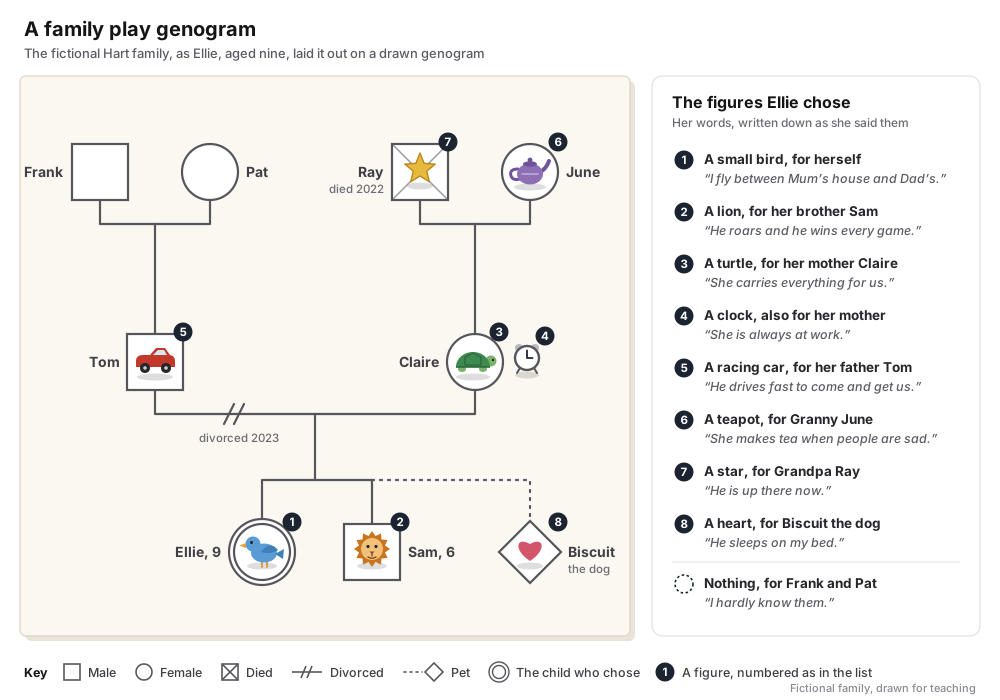
A play genogram adds chosen figures to a drawn genogram
The family play genogram starts as an ordinary genogram, drawn in the standard symbols on a sheet large enough for a small figure to stand on each person. Each participant then chooses a figure from a collection of miniatures for every person on the chart, including themselves, and places it on that person’s symbol.
The Multicultural Family Institute describes the method as a creative and metaphorical way for family members to explore their relationships and who they belong to. The figures often include friends and pets, and at times several items for one person show the best and the most difficult parts of a relationship.
Lowenstein and Post Sprunk credit the play genogram to Gil’s book on abused and traumatised children. Gil describes it at length in a chapter of Play in Family Therapy and in a chapter of Genograms by McGoldrick, Gerson and Petry (2020). Those chapters remain the reference for the full procedure.
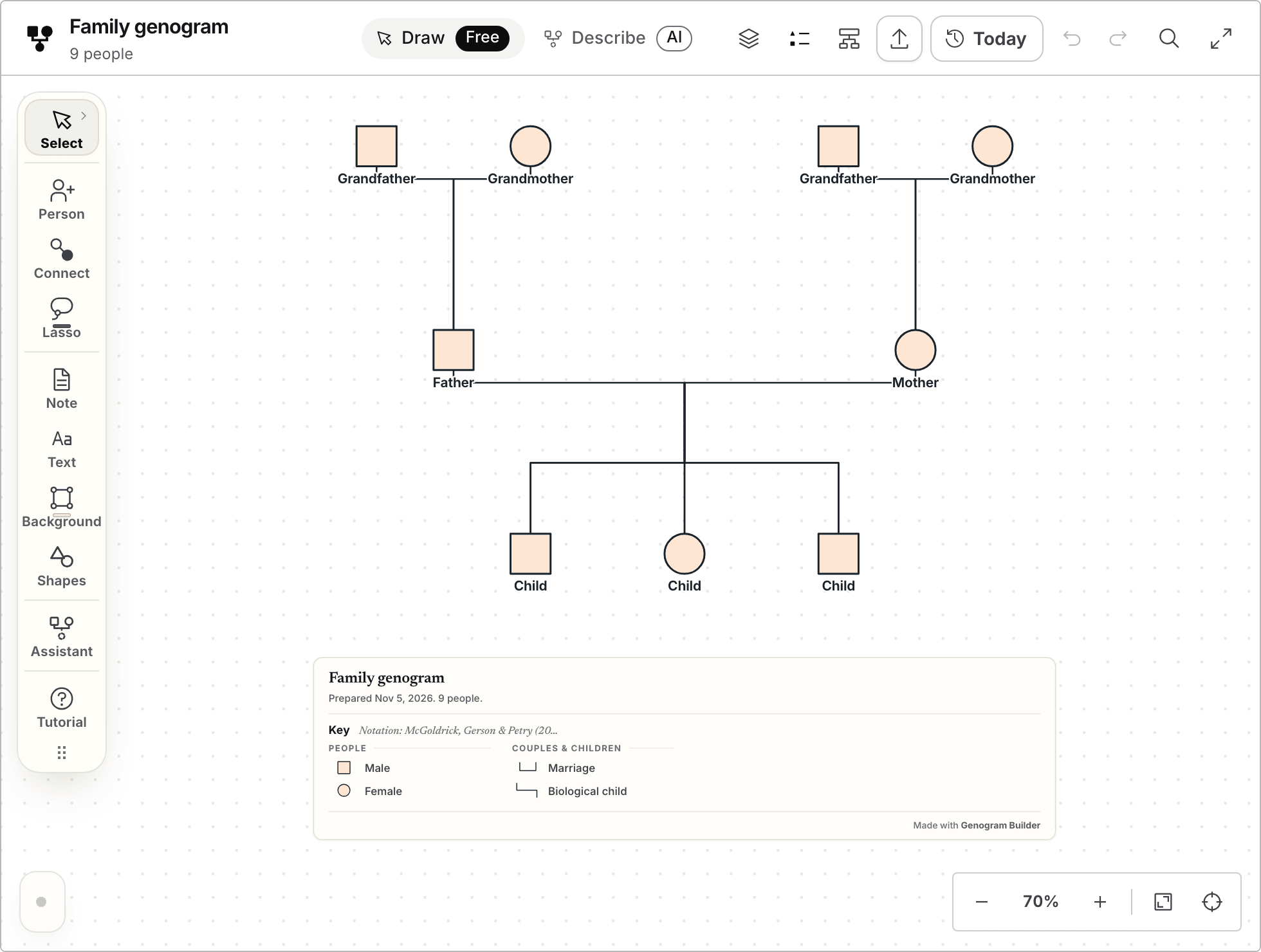
Genogram Builder
Draw the base genogram before the session
Name each person on the blank three generation sheet, then print it or copy it onto a large sheet.
- Opens without an account
- Standard symbols with the key drawn for you
- PNG and PDF export with a free account, with a watermark
Gather the materials before the family arrives
Most play therapy rooms already hold what the method needs.
| Material | What to prepare | Why it matters |
|---|---|---|
| Paper | A large sheet of flip chart or poster paper on a table or the floor | Each symbol must hold a figure |
| Markers | A dark marker for the genogram and a pencil for notes | The drawing stays legible in a photograph |
| Miniatures | People, animals, fantasy creatures, buildings, vehicles and everyday objects | A wide range lets each person find a figure that fits |
| Substitutes | Buttons, stones or pictures cut from magazines | A family without a collection can still take part |
| Recording sheet | A table with a row for each figure | The words are lost once the figures are put away |
| Camera | A phone or camera that your agency’s policy allows | A photograph keeps the layout |
Run and record the session in six steps
The instruction in the third step paraphrases the published descriptions. Adapt its wording to the youngest person in the room.
- Draw the genogram together
Draw three generations with the family and write each name beside its symbol.
- Show the collection
Let everyone look at the figures and say that any figure can be chosen for any reason.
- Ask for a figure for each person
Ask each participant to choose a figure for every person, themselves included, that shows what they think and feel about that person.
- Let each person explain
Ask what each figure is and why it was chosen, and write down the words without correcting them.
- Offer a second figure
Where a relationship has two sides, invite a second figure for the same person.
- Photograph and record
Photograph the paper from above before anything moves, then complete the recording sheet.
Write down the figure, the person and the words used
Record one row for each figure, with the person it stands for, the figure, where it was placed and the chooser’s own words. Note any person who received no figure, because a gap is also something the family showed.
Keep what was said apart from what you think it means. A child who chooses a lion for her brother has said something about him, and the meaning stays hers until she explains it. Write your own reading in a separate column marked as yours, and check it with the family.
| Person on the chart | Figure | Where it was placed | Ellie’s words |
|---|---|---|---|
| Ellie, herself | A small bird | On her own symbol | “I fly between Mum’s house and Dad’s.” |
| Claire, her mother | A turtle and a clock | The turtle on Claire and the clock beside her | “She carries everything for us. She is always at work.” |
| Ray, her grandfather, who died in 2022 | A star | On his symbol | “He is up there now.” |
| Frank and Pat, her father’s parents | None | Nothing placed | “I hardly know them.” |
Carry the facts back to the ordinary genogram
The ordinary genogram records births, deaths, marriages and divorces in a notation any reader can check. The figures record how one person saw another on one day, so the photograph and the recording sheet stay with the session notes.
Facts the figures bring out, such as a relative nobody had mentioned or a pet that matters, do belong on the ordinary chart. For the Hart family, the divorce, Ray’s death and Biscuit go on the genogram, and the turtle and the racing car stay in the record. Draw an emotional line only when the family has described the relationship in words.
Use the fictional Hart family as a teaching demonstration
The Hart family is fictional, so a class can use it freely. Students can draw the ordinary genogram from the drawing, write two questions they would ask Ellie in her own words, or role-play the session with a tray of everyday objects in place of miniatures.
For a recorded demonstration, the Multicultural Family Institute and Psychotherapy.net list Using Family Play Genograms in Psychotherapy, a 22 minute video in which Monica McGoldrick uses a play genogram with Denise, a single mother, and her 13-year-old daughter Kayla.
Use the method within your training and with care
A play genogram is a clinical technique for practitioners trained in family or play therapy, or for students under their supervision. Figures can bring up loss, conflict or harm a child has not put into words before, so plan how the session ends and who follows up.
Research in Practice notes that play genograms may suit some children less well, depending on how they communicate and whether they can place objects. It also asks practitioners to consider how a child might later read what was written about them, which is another reason to record the child’s own words.
This guide describes how the method is carried out and recorded, and makes no claim about its effect. Keep the record with your confidential files, and gather the facts for the ordinary chart with the genogram interview questions.
Common questions
Who developed the family play genogram
Eliana Gil, a family and play therapist, developed it. The Multicultural Family Institute describes it as a way of using genograms developed with her, and a chapter of her Play in Family Therapy is devoted to it.
Which ages the method suits
Published descriptions place it with families that include young children and teenagers. Adults take part too, because every member of the family chooses figures.
Whether the family must agree on one figure
No. Each person chooses their own figures, so one relative may carry several. The family strengths genogram, which Lowenstein and Post Sprunk describe as a modification of Gil’s method, asks the family to agree on one figure for each person.
Sources and methodology
We make Genogram Builder. We used the references below for this guide. Last checked on 9 November 2026.
- Multicultural Family Institute, Family play genograms
- Multicultural Family Institute, Using Family Play Genograms in Psychotherapy
- Psychotherapy.net, the same video with Monica McGoldrick
- Guilford Press, contents of Play in Family Therapy by Eliana Gil
- Lowenstein and Post Sprunk, Creative family therapy techniques
- Research in Practice, Using genograms in practice, 2021
Draw the family’s genogram before the session. No account is needed to begin.
Open the blank three generation sheet