At a glance
Who each one suits
A culturagram is the right chart when
The question is how culture shapes the life of this family now. Why it moved, which languages it speaks, what it believes about health, what it has lived through and what it values are answered in ten short boxes.
A genogram is the right chart when
The question is about the family as a structure. Who is related to whom, who has died, married or migrated, and which relationships are close or cut off are answered across three generations in a notation with a key.
The Villanueva family looks different on each chart
The Villanuevas are a fictional family in Jersey City, New Jersey. Liza came from the Philippines in 2006 to work as a nurse, and her husband Ramon followed in 2008. Their children Bea and Miguel were born in Jersey City, and Liza’s mother Corazon moved in with them in 2022, a year after her husband Arturo died.
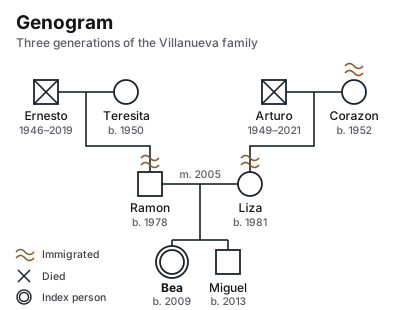
The genogram places each of them. It shows two families of origin, two grandfathers who have died, three people with the wavy lines of immigration and Bea as the person the chart is drawn around. It does not say why anyone moved, which languages they speak or what they expect of each other.
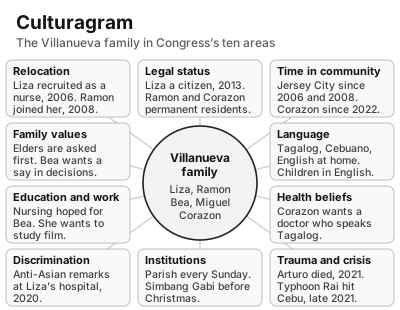
The culturagram leaves the generations out and puts the household in a circle, with a box for each area around it. Ramon grew up speaking Cebuano and Liza speaking Tagalog, so even the home language is not one thing. Liza is a citizen, while Ramon and Corazon are permanent residents.
The culturagram asks about ten areas of family life
Congress first published the culturagram in Families in Society in 1994 and revised it in later chapters. In an interview for the Social Work Podcast she lists ten areas and describes the drawing, with the family in the centre and a short narrative for any area that needs more room.
The table sets those areas beside the places a genogram can hold the same facts. Where the genogram has little to offer, the culturagram does work of its own.
| Culturagram area | On a genogram in Genogram Builder | On the cultural genogram sheet |
|---|---|---|
| Reasons for relocation | The wavy lines of immigration, with the reason in the notes | The field for migrations |
| Legal status | Nothing unless the family agrees and the case needs it | No field |
| Time in community | Lives in, and the year of the move in a field of your own | The year beside the wavy lines |
| Language spoken at home and in the community | A field of your own named Languages | The field for languages at home |
| Health beliefs | Conditions are drawn, and beliefs about them go in the notes | No field |
| Impact of trauma and crisis events | Deaths with their years, and other events as notes | Years and the cross for a death |
| Contact with cultural and religious institutions, holidays, food and clothing | Religion and practice, and a religious community joined to a person | The field for religion or faith |
| Oppression, discrimination, bias and racism | A note, only if the person wants it recorded | No field |
| Values about education and work | Occupation and education under the name | No field |
| Values about family structure, power, myths and rules | Close and cutoff lines, which show relationships but not rules | Close and cutoff lines |
Move between the charts when the question changes
A school counsellor meets the Villanuevas because Bea has missed eleven mornings of school since September. The genogram comes first. It shows that Corazon lives with the family and was widowed in 2021, but it cannot say why the mornings are missed.
The culturagram answers that. Corazon wants a doctor who speaks Tagalog, the family expects a relative to go with an elder to appointments, Liza works nights and Bea is the one free in the morning. The counsellor and the family can look for a clinic with a Tagalog interpreter and agree who goes with Corazon, without treating the family’s values as the problem.
- Start with the genogram
Place the household and the generations above it, with deaths and migrations.
- Ask about the ten areas
Fill in the culturagram in the family’s words, and leave blank any area they decline.
- Plan with what you learn
Plan the help from the areas that explain the problem, here language and health beliefs.
- Bring the facts back
Draw a caretaker line from Bea to Corazon and note the language Corazon wants, so that the two charts agree.
Draw the genogram in the editor and the culturagram on paper
Genogram Builder draws the genogram side of this page. Each person has Born in, Lives in, heritage, religion, occupation and education, and a Migration setting that draws the two wavy lines and adds them to the key. The Add a field button under Notes records anything else, such as the languages a person speaks.
Genogram Builder does not draw a culturagram. Draw it on paper or a whiteboard, with the family in a central circle and a box for each area, in the words the family used. The cultural genogram template has printed fields for origins, languages, faith and migrations, which carry four of the ten areas.
Ask about legal status and discrimination with care
Two of the areas can harm a family if the record travels. Ask about legal status only when it bears on the help the family needs, say who will read the record and accept a refusal. Write discrimination in the person’s own words and only with their agreement, and keep both off any genogram that will be printed or shared.
The culturagram was written against another harm, reading a family through a stereotype. Congress stresses that families from one country differ widely, and the Villanuevas show it inside one home, with two Philippine languages and two kinds of legal status.
Before you decide
Who developed the culturagram
Elaine P. Congress, a professor of social work at Fordham University, introduced it in Families in Society in 1994 for work with culturally diverse families, and revised it later.
How a culturagram differs from a cultural genogram
Hardy and Laszloffy described the cultural genogram in 1995 as a training tool, in which family therapists draw their own families to explore how culture shaped them. It keeps the generations and adds culture. A culturagram drops the generations and looks at one client family now.
How a culturagram differs from an ecomap
An ecomap draws the connections of a household with the systems around it. The culturagram also puts the family in the centre, but only its area on institutions overlaps with an ecomap.
Sources and methodology
We make Genogram Builder. We used the references below for this comparison. Last checked on 9 November 2026.
- Congress, The use of culturagrams to assess and empower culturally diverse families, 1994
- The Social Work Podcast, interview with Elaine Congress on the culturagram
- Fordham University, Elaine P. Congress and her culturagram publications
- Wurzweiler School of Social Work, the culturagram in practice
- Hardy and Laszloffy, The cultural genogram, 1995
Draw the family on the cultural genogram sheet, and keep the culturagram beside it on paper. No account is needed to begin.
Open the cultural genogram template