Extended Family Tree Diagram with Aunts, Uncles and Cousins
This extended family tree diagram gives the aunts, the uncles and the cousins their own branches. It has sixteen places, with the grandparents at the top, an aunt and an uncle with their partners beside the parents, and four cousins beside you. Print the blank A4 sheet and fill it in by hand, or edit it online and add every relative the sheet leaves out.
Blank sheet
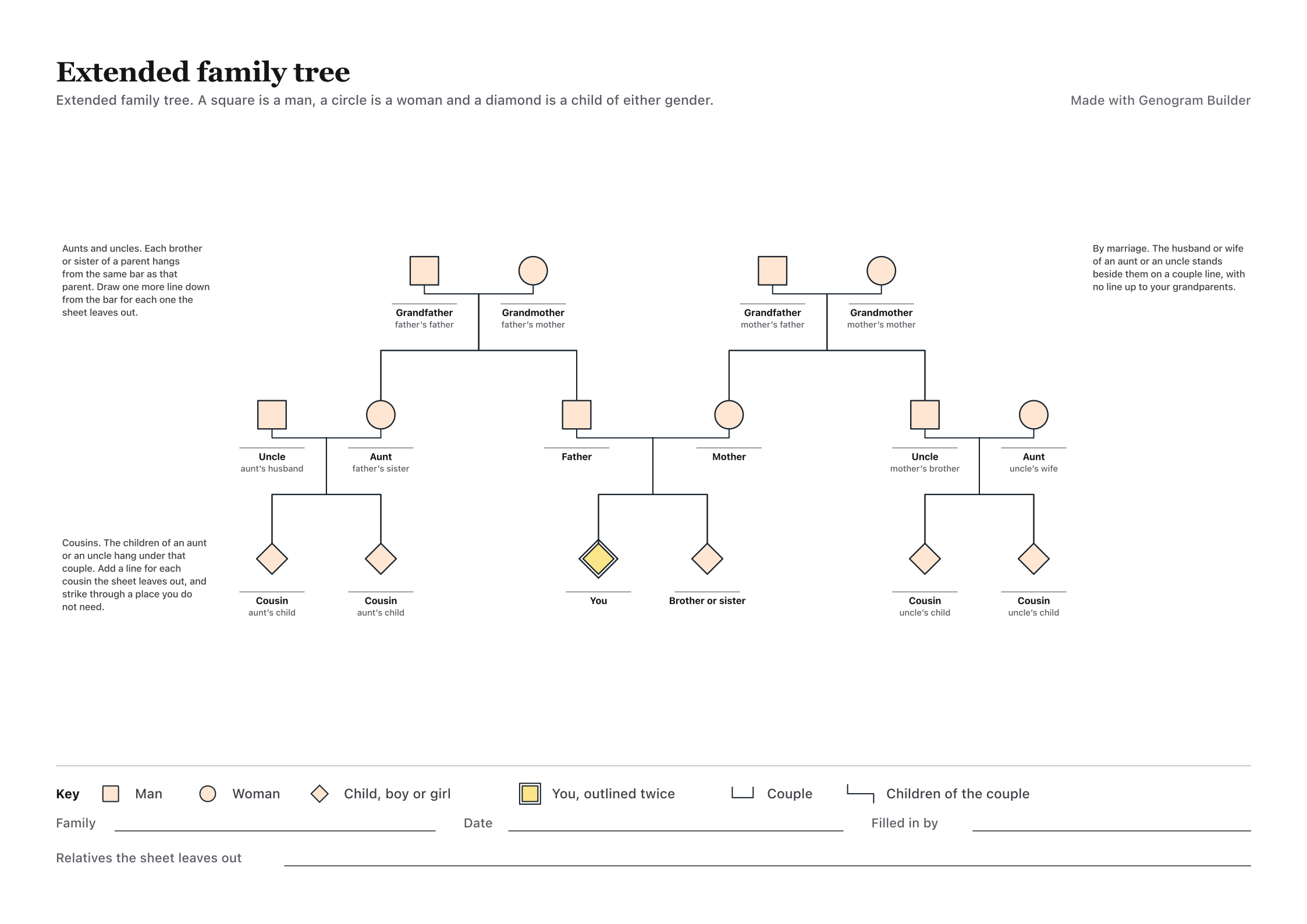
Filled in for a fictional family
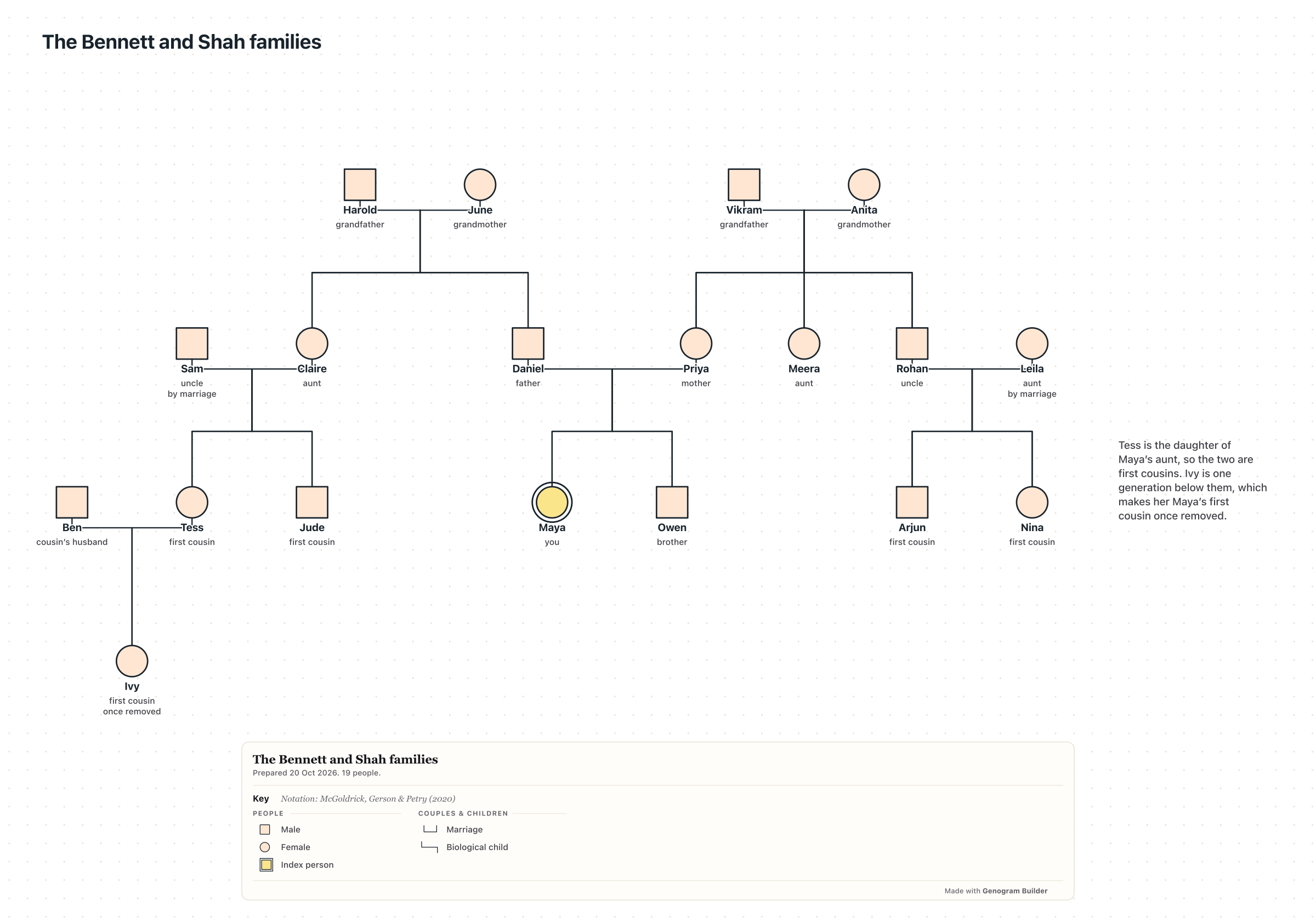
On the left is the blank sheet. On the right is the fictional Bennett and Shah family, with three relatives added that the sheet leaves out.
Edit the extended family tree diagram online
Open the blank sheet to type a name over each of the sixteen roles, or open the Bennett and Shah family and change it. Each one starts a separate chart in this tab and leaves the family saved on the homepage alone.
To add an aunt or an uncle, hover over the parent who is their brother or sister and click Sibling on the ring around the symbol. To add a cousin, hover over that aunt or uncle and click Child. Partner adds a husband or a wife. The guides to adding a sibling and adding a child show each move.
Edits stay in this tab until you continue in the full editor, which keeps the tree. A visitor can edit without an account but cannot export. A free account exports a PNG, a PDF or a JSON project, with a watermark on the picture and the PDF, and Pro removes the watermark and adds SVG.
The sheet gives every aunt, uncle and cousin a place
An extended family is the family beyond parents and their children. On this sheet it has three rows. The top row holds the two pairs of grandparents. The middle row holds your parents in the centre, your father’s sister with her husband on the left and your mother’s brother with his wife on the right. The bottom row holds you and a brother or sister, with two cousins under each aunt and uncle.
A square is a man and a circle is a woman. The bottom row is drawn in diamonds, which assume no gender, so the same sheet fits a family of sons, daughters or both. Under every symbol is a line for the name. Under the line is a printed role, such as Aunt, and a second line that says how the person is related, such as father’s sister.
The sheet is one arrangement among many. Your aunt may be your mother’s sister and your uncle your father’s brother, in which case write over the small print. The notes in the margin say how to add a branch.
Each branch starts from a brother or sister of a parent
Three kinds of line carry the whole diagram. A couple line runs under two partners. A line drops from the middle of the couple line to a horizontal bar, and every child of the couple hangs from that bar. Your aunts and uncles by birth hang from the same bar as your parent. Their husbands and wives stand beside them on a couple line and have no line up to your grandparents.
| Relative | Where they stand | How they are joined |
|---|---|---|
| Aunt or uncle by birth | Beside your parent, on the outside | Hangs from the same bar as your parent |
| Aunt or uncle by marriage | Beside their husband or wife | A couple line and no line upward |
| First cousin | Your own row, under their parents | Hangs from the couple line of an aunt and an uncle |
| Great-aunt or great-uncle | The row of your grandparents | A brother or sister of a grandparent |
| First cousin once removed | One row above or below yours | The child of your first cousin, or the first cousin of your parent |
| Second cousin | Your own row, further out | A grandchild of your great-aunt or great-uncle |
The blank sheet prints the first three rows of the table. The others are added by hand or online, and the filled example below adds a first cousin once removed.
The Bennett and Shah example adds three relatives
Maya Bennett is a fictional student, and every person on her tree is invented. On her father’s side are her grandparents Harold and June, her aunt Claire, Claire’s husband Sam Okoro and their children Tess and Jude. On her mother’s side are her grandparents Vikram and Anita Shah, her uncle Rohan, his wife Leila and their children Arjun and Nina. Owen is her brother.
Three people go beyond the blank sheet. Meera Shah, a younger sister of Maya’s mother, hangs from the bar of the Shah grandparents between her sister and her brother. Tess, the oldest cousin, has a husband, Ben Adler, and a daughter, Ivy, who starts a fourth row. Ivy is one generation below Maya and Tess, which makes her Maya’s first cousin once removed.
Under each name is the relationship to Maya, the person the tree is about. Put another person in the middle and every caption changes, which is why a family tree says whose tree it is.
Fill the sheet in from the middle outward
On paper the order matters, because the space beside each parent is fixed. Count the relatives before you write. Where one side of the family is much larger than the other, print a second sheet for that side.
- Start with yourself. Write your name on the line of the diamond with the double outline, and your brothers and sisters beside you from the oldest on the left.
- Add your parents and grandparents. Write your parents above you and their parents in the top row.
- Count the brothers and sisters of each parent. Each one is an aunt or an uncle. Where a parent has more than one, draw another line down from the bar of the grandparents.
- Hang the cousins. Write the children of each aunt and uncle under that couple, and strike through a place the family does not need.
- List who is left. Use the line at the foot of the page for relatives the sheet leaves out, such as a great-aunt or the child of a cousin.
The PDF is one A4 landscape page that also fits US Letter when the printer is set to fit the page. Leave a place blank where a name is not known, and write the question beside it for the next relative you talk to.
This sheet grows sideways and the generation sheets grow upward
The three-generation template and the four-generation template follow one line of descent from the grandparents or the great-grandparents down to the children, and they have no cousins. This sheet stops at the grandparents and spends its width on the brothers and sisters of the parents and on their children.
Choose a generation sheet to trace ancestors. Choose this one for a reunion, a school project about relatives or a first sketch before a wider family history. Both generation sheets are genogram sheets, with a key for the marks that this plain family tree leaves out. The guide to genograms for family history explains how a family tree becomes a genogram.
Common questions
The extended family tree diagram is free to print and edit
The blank PDF and PNG download without an account, and the sheet can be edited online as a guest. Exporting an edited tree needs a free account, and the free export carries a watermark.
Who counts as extended family
The extended family is every relative beyond your parents, brothers and sisters. It starts with grandparents, aunts, uncles and cousins, and goes on to great-aunts, great-uncles, second cousins and relatives by marriage.
How to show a half aunt or a step uncle
A half aunt shares one parent with your parent, so hang her from a second couple line of that grandparent. A step uncle is the son of a later partner of a grandparent, and he hangs from that partner alone.
How many relatives the online tree can hold
A guest can draw one tree of up to 50 people, which is enough for most extended families. A free account keeps two trees of that size.