A family tree works by giving each generation its own row
A family tree is a chart of who descends from whom. The oldest generation stands in the top row, their children stand in the row below, and the grandchildren stand below them. Everything else on the chart follows from that one rule, so a reader who finds the rows can read any tree.
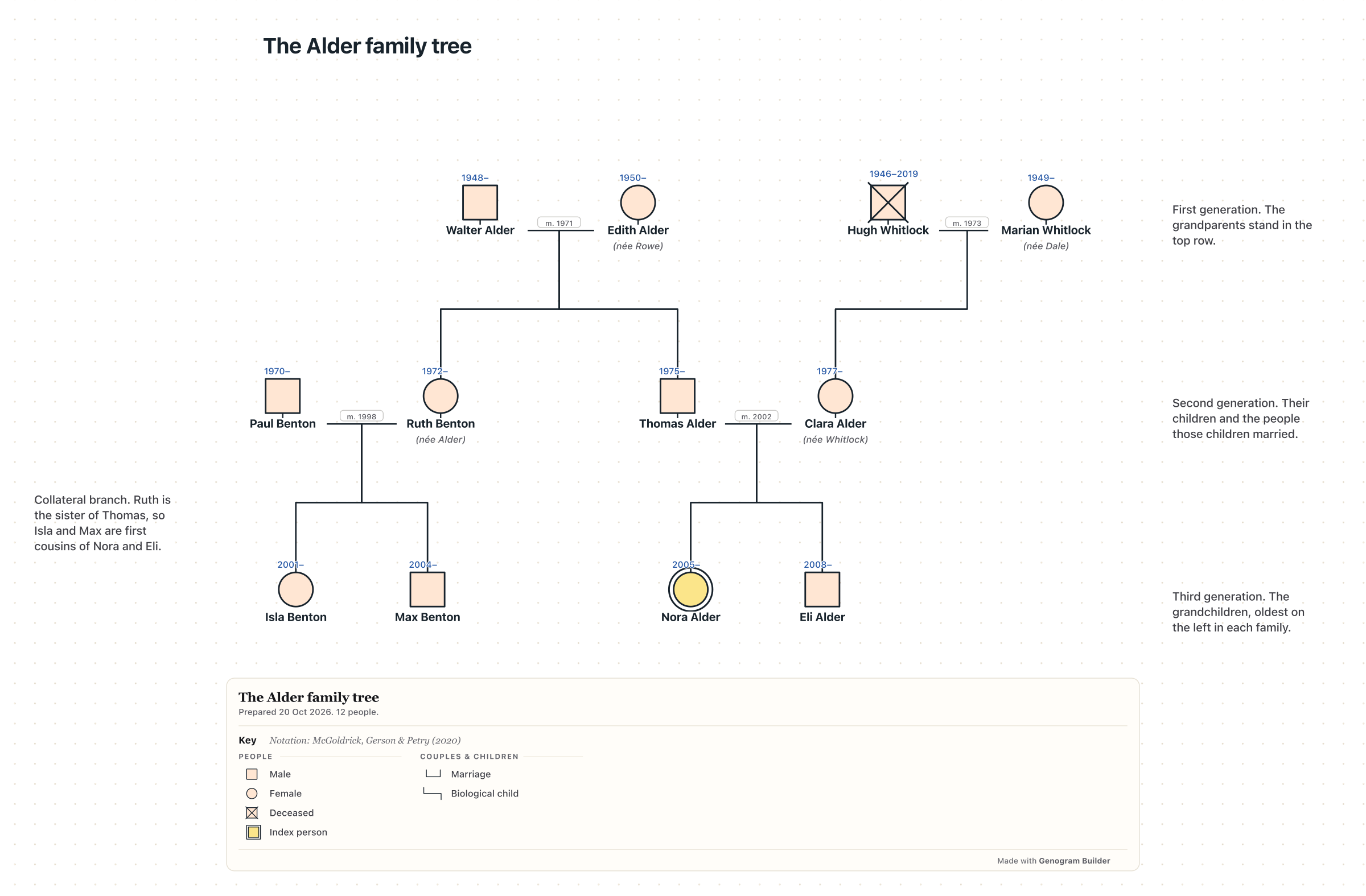
The Alder tree on this page holds twelve fictional people. Walter and Edith Alder and Hugh and Marian Whitlock are the grandparents. Their children Ruth, Thomas and Clara stand in the second row with Paul Benton, who married Ruth. The four grandchildren, Isla, Max, Nora and Eli, stand in the third row.
Genogram Builder
Keep the Alder tree or draw your own
Download the chart on this page, or draw the tree of your own family in the editor.
- Twelve fictional people in three generations
- Opens without an account
- PNG and PDF export with a free account, with a watermark
Read down the chart for descent and up the chart for ancestry
Direction is the first thing to settle. Reading down from Walter and Edith answers who their descendants are. Reading up from Nora answers who her ancestors are, which is the question most people bring to a tree. Nora carries a double outline on this chart because she is the person the tree starts from.
Within a row, the children of one couple are drawn in order of birth, with the oldest on the left. Isla, born in 2001, stands to the left of Max, born in 2004. Some trees run the other way and put the starting person at the bottom or at the left edge, with the ancestors spreading out from there. The rule of one generation to a row or a column still holds.
Two kinds of line carry most of the meaning
A horizontal line between two people joins a couple. A vertical line that drops from the couple line leads to their children, and a bar across the top of several children marks them as brothers and sisters. On the Alder tree the line between Thomas and Clara carries the year they married, 2002, and the line below it splits to reach Nora and Eli.
The small marks around a person add the facts. The table lists every mark on the Alder tree.
| Mark on the chart | What it tells you | Where it appears on the Alder tree |
|---|---|---|
| Horizontal line between two people | The two are a couple, and the label gives the year they married | Walter and Edith, married in 1971 |
| Vertical line below a couple | The people it reaches are the children of that couple | Ruth and Thomas below Walter and Edith |
| Bar above several children | Brothers and sisters, with the oldest on the left | Isla and Max |
| Years above a symbol | The year of birth, then the year of death for a person who has died | 1946–2019 above Hugh |
| Cross through a symbol | The person has died | Hugh Whitlock |
| Name after née | The surname a woman was born with | Edith Alder, née Rowe |
| Square or circle | A man or a woman on charts drawn by this editor | Thomas is a square and Clara is a circle |
| Double outline | The person the tree starts from | Nora Alder |
Count generations by rows and not by ages
A generation is one step from parent to child. Grandparents, parents and children make three generations, however many people stand in each row. Age is a poor guide, because in a large family an uncle can be younger than his niece. On the Alder tree Paul was born in 1970 and Clara in 1977, and both belong to the second generation because each married a child of the first.
The people directly above and below you form your direct line. For Nora that line runs through Thomas to Walter and Edith, and through Clara to Hugh and Marian. Genealogists call these relatives lineal. Every person has two parents, four grandparents and eight great-grandparents, so the direct line doubles with each row you climb.
A collateral branch starts from a brother or sister of an ancestor
Relatives who share an ancestor with you without being in your direct line are collateral. They sit on branches that leave the direct line at a brother or a sister. On the Alder tree the branch starts at Ruth, the sister of Thomas. Ruth married Paul Benton, and their children Isla and Max carry the Benton name.
To name a collateral relative, climb from yourself to the couple you share and come down the other side. Nora climbs two rows to Walter and Edith and comes down two rows to Isla, so the two are first cousins. Ruth is one row below the shared couple, so she is the aunt of Nora. The guide to family tree relationship terms places nieces, in-laws and cousins once removed on one chart.
Read any family tree in five steps
The same order works on a printed chart, a school project and a tree in a genealogy program.
- Find the starting person
Look for the person the tree was drawn for. On a chart from this editor that person has a double outline.
- Find the rows
Count the rows above and below the starting person. Each row is one generation.
- Climb the direct line
Follow the vertical line up to the parents, then up again from each parent to the grandparents.
- Follow the branches
At each couple, look along the bar for brothers and sisters, then down to their children.
- Read the marks
Check the years, the crosses and the key for what the lines alone do not say.
A genogram keeps the same rows and adds more about the people
A family tree records names, dates and descent. A genogram uses the same rows and lines and adds the kind of each relationship, health conditions and who lives together, which is why clinicians and students draw one. The comparison of a genogram and a family tree sets the two side by side and says when to choose each.
The chart on this page was drawn in Genogram Builder as a plain family tree, with no conditions and no relationship lines. To draw your own, follow Start a new genogram, then Add a partner and Add a child for each couple. Mark the index person gives the starting person the double outline.
Common questions
How many generations a family tree should show
Three generations fit one page and answer most school and family questions. Add a fourth row when you know the great-grandparents, and split a larger family into one chart for each branch so that every name stays readable.
Where half-brothers, half-sisters and step-parents go
A parent with two partners is drawn between them, with a couple line to each, and every child hangs from the couple who are its parents. The guide to half-siblings on a genogram shows the layout, which a family tree shares.
What to do when a relative is not known
Leave the place on the chart and write not known, so that a reader can tell a gap in the records from a person who was left out. The Alder tree would keep a symbol for a grandparent whose name was lost.
Add your grandparents, your parents and yourself, and read your own tree from the top row down. No account is needed to begin.