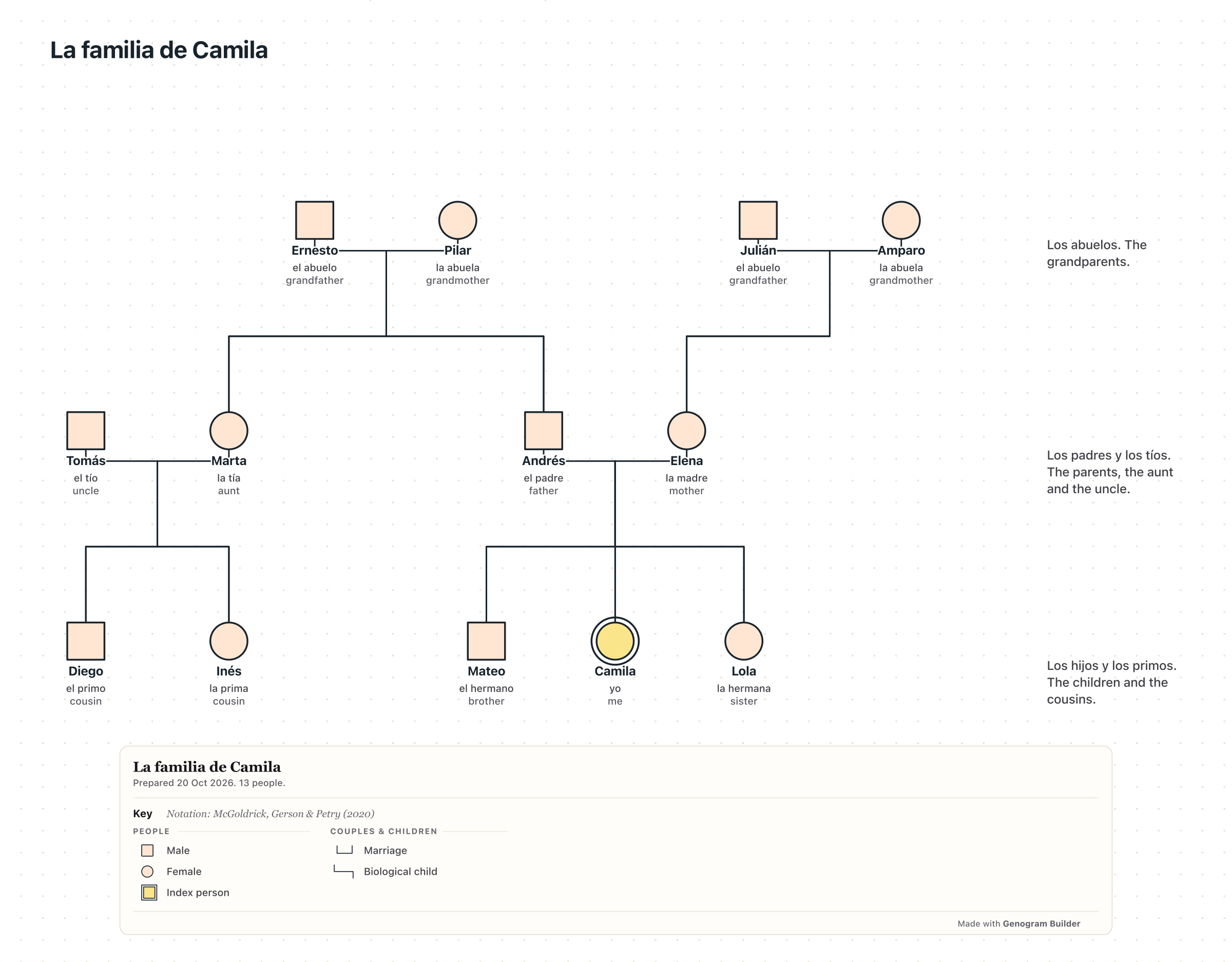
A Spanish family tree names each relative with an article and a noun
The Spanish for family tree is el árbol genealógico. Each person on the tree carries a kinship term with its article, el for a male relative and la for a female relative, so the chart teaches the gender of every noun together with the word.
The chart on this page belongs to Camila, a fictional student. Thirteen relatives stand in three rows, with the grandparents at the top, the parents, an aunt and an uncle in the middle, and Camila with her brother, her sister and two cousins at the bottom. The Spanish term stands under each name, with the English word under it.
Genogram Builder
Print the bilingual chart or draw your own
Download Camila’s chart for the classroom, or draw your own family in the editor and label it in Spanish.
- Thirteen fictional relatives in three generations
- Opens without an account
- PNG and PDF export with a free account, with a watermark
The kinship terms come in masculine and feminine pairs
Most kinship nouns change one letter between the masculine and the feminine form. El abuelo becomes la abuela, el primo becomes la prima and el hermano becomes la hermana. Padre and madre change the whole word, and so do el yerno, a son-in-law, and la nuera, a daughter-in-law.
| English | Masculine | Feminine | Plural for a mixed group |
|---|---|---|---|
| Grandfather, grandmother | el abuelo | la abuela | los abuelos |
| Father, mother | el padre | la madre | los padres |
| Son, daughter | el hijo | la hija | los hijos |
| Brother, sister | el hermano | la hermana | los hermanos |
| Uncle, aunt | el tío | la tía | los tíos |
| Cousin | el primo | la prima | los primos |
| Nephew, niece | el sobrino | la sobrina | los sobrinos |
| Grandson, granddaughter | el nieto | la nieta | los nietos |
| Husband, wife | el esposo | la esposa | los esposos |
| Father-in-law, mother-in-law | el suegro | la suegra | los suegros |
| Brother-in-law, sister-in-law | el cuñado | la cuñada | los cuñados |
| Stepfather, stepmother | el padrastro | la madrastra | los padrastros |
| Great-grandfather, great-grandmother | el bisabuelo | la bisabuela | los bisabuelos |
Grammatical gender decides the article, the ending and the plural
Three rules cover a first-year Spanish family tree. The article agrees with the person, so a male cousin is el primo and a female cousin is la prima. An adjective agrees as well, so a tall grandfather is un abuelo alto and a tall grandmother is una abuela alta.
The masculine plural names a mixed group. Los abuelos means the grandparents and los padres means the parents. Los tíos can mean an aunt and an uncle together, and los hermanos can mean brothers and sisters. The feminine plural, such as las hermanas, names women and girls only.
A possessive comes before the noun and agrees in number. Mi and tu go with one relative and mis and tus with several, as in mi tía and mis tíos. Su and sus mean his, her or their.
Read the bilingual chart row by row
Camila stands in the bottom row with a double outline and the word yo, which means I. Mateo is el hermano and Lola is la hermana. Diego and Inés are el primo and la prima, the children of la tía Marta and el tío Tomás.
In the middle row Andrés is el padre and Elena is la madre. Marta is the sister of Andrés, which makes her la tía, and Tomás is el tío because he married Marta. The top row holds two pairs of abuelos, Ernesto and Pilar on the side of the father and Julián and Amparo on the side of the mother.
By custom, many Spanish-speaking families give a child two surnames, the first surname of the father followed by the first surname of the mother. If the father is Andrés Morales Vega and the mother is Elena Castillo Ruiz, their daughter is Camila Morales Castillo. A tree for a Spanish class can show both surnames.
A Spanish 1 family tree assignment has four parts
The structure below suits a first-year class. Follow the rubric you were given where it differs.
- The chart
Draw three generations with at least ten relatives. Use your own family, or invent one if you prefer to keep yours private.
- The labels
Write the name of each person and the kinship term with el or la under it. Mark yourself with yo.
- The sentences
Write eight to ten sentences that describe the relatives with se llama, es and tengo.
- The presentation
Point to each person and say one sentence aloud. Practise the plural forms for the couples and the groups.
A filled example gives the sentences for the chart
The ten sentences below describe the chart in the first person, as Camila would present it. Before a name that begins with the sound of the letter i, the word y changes to e, which is why the cousins are Diego e Inés.
Yo y mis hermanos
- Me llamo Camila y tengo quince años.
- Tengo un hermano y una hermana.
- Mi hermano se llama Mateo y mi hermana se llama Lola.
Mis padres y mis abuelos
- Mi padre se llama Andrés y mi madre se llama Elena.
- Mis abuelos paternos son Ernesto y Pilar.
- Mis abuelos maternos se llaman Julián y Amparo.
Mis tíos y mis primos
- Marta es la hermana de mi padre.
- Mi tío Tomás es el esposo de mi tía Marta.
- Mis primos se llaman Diego e Inés.
- Inés es la hija de mis tíos.
Draw your own bilingual tree on paper or in the editor
On paper, rule three rows, draw a box or a circle for each person and leave two lines under each for the name and the term. Join each couple with a horizontal line and hang the children below it. The guide to how a family tree works explains the rows and the lines.
The chart on this page was drawn in Genogram Builder with the Spanish term typed in the Occupation field of each person. Follow Start a new genogram and Add occupation, culture and other background, then select Occupation as Choose what is written describes.
Common questions
How to say family tree in Spanish
The usual term is el árbol genealógico. A class project is often titled Mi árbol genealógico or Mi familia.
Whether to write padre and madre or papá and mamá
Both pairs are correct. Padre and madre are the neutral terms that a textbook teaches first, and papá and mamá are what most people say at home. Use the pair your course uses and keep to it across the chart.
How to label a half-brother or a stepsister
A half-brother is el medio hermano and a half-sister is la media hermana. A stepbrother is el hermanastro and a stepsister is la hermanastra.
Sources and methodology
We make Genogram Builder. We used the references below for this guide. Last checked on 10 November 2026.
Draw three generations of a real or an invented family, then label each person in Spanish. No account is needed to begin.