At a glance
A family tree records descent, and a genogram records a system
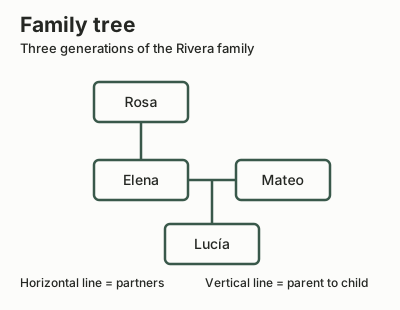
A family tree begins with an ancestor and follows the generations down, or begins with one person and follows the parents up. Each person is a name with dates, each marriage is a line, and each child hangs beneath the couple. The chart answers questions of ancestry and says nothing about how these people got on with one another, because the records rarely do.
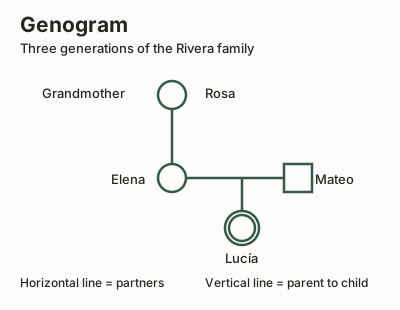
A genogram begins with one person, the index, marked with a double line, and draws the family around them for three generations or so. It uses a fixed notation, that of McGoldrick, Gerson and Petry, in which a square is a man, a circle is a woman, a cross through a symbol is a death, a horizontal line is a union and a vertical line is a child. The purpose is not to record ancestry but to see a pattern, such as a depression that appears in three generations or a conflict that has been handed from mother to daughter.
The genogram adds the lines that a family tree has no place for
The emotional lines are what most people notice first. A family tree joins a couple with a single line and says nothing more. A genogram can say that the couple is married, cohabiting, separated or divorced, and with a second line between the two symbols it can say that they are close, fused, distant or hostile, or that one is cut off from the other. The same lines run between a parent and a child, between siblings and between any two people on the chart.
Health is the second addition. A genogram shades or colours a symbol for a condition, names the condition in the key, records the cause of death beside the cross, and so lets a reader follow a condition down the generations by eye. A family tree might note a cause of death in a comment, but the notation has no place for it. The third addition is the household, a dotted outline around the people who live together, which matters to a social worker in a way it never matters to a genealogist.
Close
Fused
Distant
Hostile
Cutoff
A genetic pedigree and a genogram answer different questions
A pedigree is the family chart of genetics. It shows how a trait or a health condition is inherited through the generations of a family, with the relationships and, where the information exists, who has the trait. It starts from the proband, the affected person through whom the family came to attention, as a genogram starts from its index person, and often records a consultand, the person seeking counselling, who may be unaffected.
The difference between a genogram and a pedigree lies in how each is read. A genetic counsellor reads a pedigree for a pattern of inheritance. A genogram is read for the family as a system. The National Society of Genetic Counselors proposed a standard pedigree nomenclature in 1995, reviewed it in 2008 and revised how it records sex and gender in 2022. Draw a pedigree when a genetics clinic asks for one, and a genogram when the relationships matter as much as the condition.
A GEDCOM file turns a family tree into a genogram in a few steps
A family tree already holds most of the structure of a genogram, so the work is to add what it leaves out. Export the tree from the genealogy program as a GEDCOM file, open the editor here, choose Export and then Import a family file, and select the file. Genogram Builder reads the individuals, families, dates and notes, shows how many people and connections it found, and lists anything it could not read before anything is placed. You then choose the index person, and the chart is arranged by generation around them with no line crossing a name.
A file of up to 50 people opens without an account and on a free account, and Pro removes the limit. Trim a larger tree in the genealogy program first to the three or four generations that matter, because a genogram of three hundred people is not one anyone can read.
Feature by feature
Each row states what the two products offer in their own terms. Checked on 20 October 2026 against the notation reference on this site.
| Feature | A genogram | A family tree |
|---|---|---|
| People and dates | ||
| Names and dates | Included. Birth, death and age inside or beside the symbol. | Included. Birth, death and often marriage dates. |
| Generations | In part. Usually three around the index person. | Included. As many as the records allow. |
| An index person | Included. Marked with a double line. | Not included. None. The tree starts from an ancestor or a descendant. |
| Relationships | ||
| Parent and child | Included. Biological, adopted, foster, step and donor lines. | Included. A line of descent, sometimes marked adopted. |
| Emotional ties | Included. Close, fused, distant, hostile, cut off and the rest of the standard set. | Not included. None. |
| Households | Included. A dotted outline around the people who live together. | Not included. None. |
| Health and context | ||
| Conditions | Included. Shaded or coloured symbols, named in the key. | Not included. None in the notation. Sometimes a note. |
| Notation and files | ||
| A key on the chart | Included. On every chart drawn here. | Not included. Rarely needed. |
| File format | In part. A JSON backup here. GEDCOM, GenoPro and Gramps files are read in. | Included. GEDCOM, read and written by nearly every genealogy program. |
Sources: Genogram symbols and relationship lines, the documentation.
Before you decide
Whether a genogram can hold a whole family tree
Start with the three or four generations around the person you are focusing on, and keep the wider ancestry in the tree, so a reader can follow the relationships that matter to the question.
Whether a family tree can be made from a genogram
Not as a GEDCOM file from here. Genogram Builder exports PNG, PDF, SVG and a JSON backup, which genealogy programs do not read. A genogram drawn here can be printed or placed in a family history as an image.
Which one a school or university assignment wants
A family tree assignment asks for ancestry, and a drawing of names and dates answers it. A genogram assignment in nursing, social work or counselling asks for the notation, the emotional lines, the health and the household, and usually for a key. If the brief mentions McGoldrick, three generations or relationships, it is asking for a genogram.
Sources and methodology
We make Genogram Builder. We used the references below for this comparison. Last checked on 5 November 2026.
Draw a genogram in the browser now, or import a GEDCOM file from your family tree and add the ties here. No account is needed to begin.
Open the editor