Family Tree Coloring Page to Print, Color and Fill In
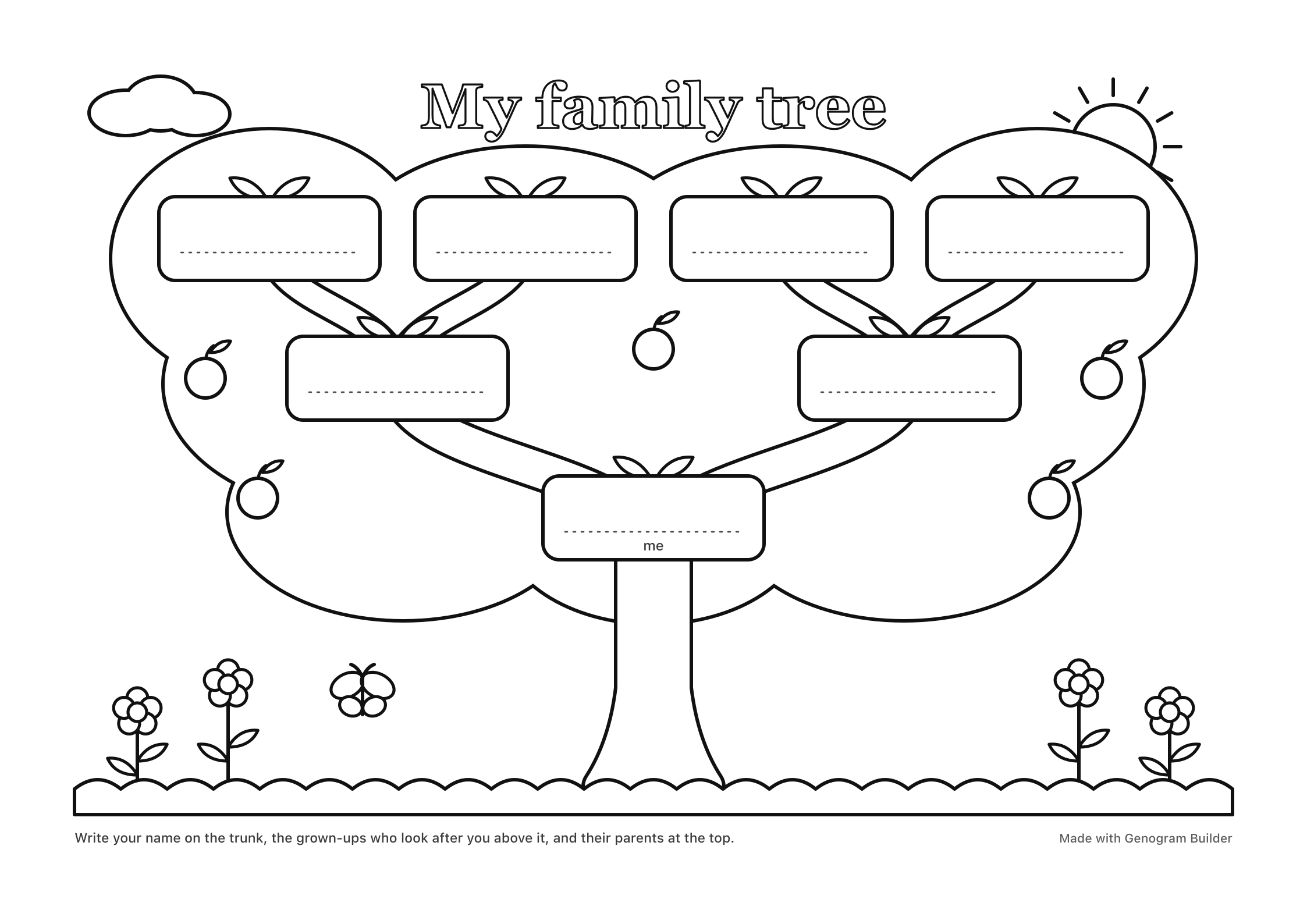
This family tree coloring page is a tree in black outline with seven signs to write names on, one for the child on the trunk, two above it and four at the top. Print the PDF on A4 or US Letter, color the leaves, the apples and the flowers, and write a name on each sign. A second page adds signs for brothers and sisters, and a colored example shows a finished tree.
Blank coloring page
Colored in for a fictional family
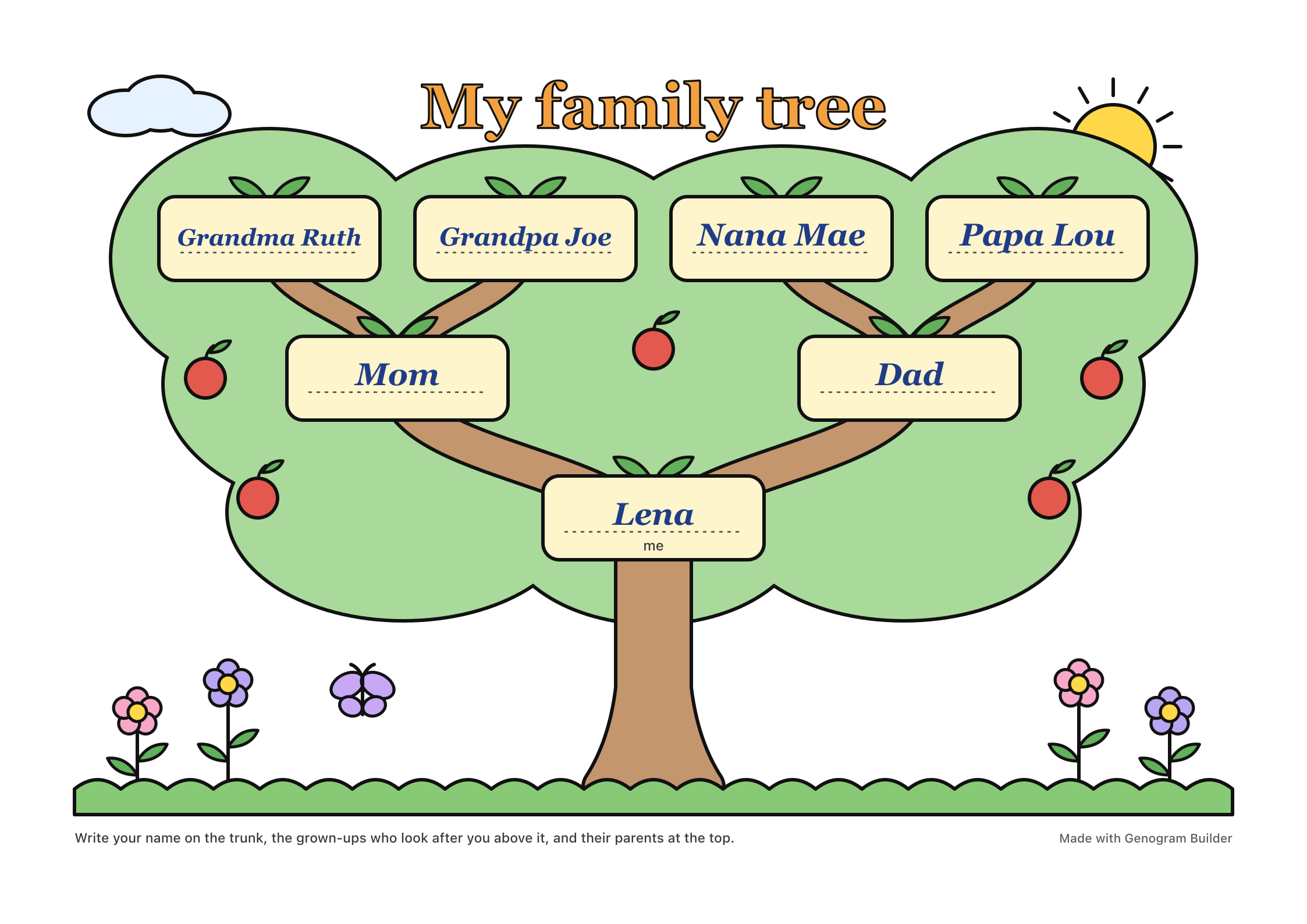
On the left is the blank page. On the right is the same page colored in and filled with the names of a fictional child called Lena and her family.
The page is a tree with seven signs for names
The drawing is our own, made for this page. A tree with a wide crown fills the sheet, and seven signs hang in it on its branches. The sign on the trunk is marked me. Two signs sit above it and four at the top, so the page reads from the child upward to parents and grandparents, the way a small child thinks about a family.
Each sign has a dotted line to write on and two leaves above it. Around the signs are five apples, and under the tree are four flowers, a butterfly and a strip of grass. A cloud and a sun sit in the top corners, and the words My family tree are drawn in outline so the letters can be colored too.
Only the first sign is labeled. The others are blank on purpose, so a child with two mothers, one parent, a grandmother who is the main carer or a foster family can fill the page without crossing anything out.
The page prints whole on A4 and on US Letter
The PDF is one A4 landscape page, 297 by 210 millimeters. Every line of the drawing stays at least 16 millimeters inside the edge of the paper, which is well inside the strip a home printer cannot reach. US Letter is 18 millimeters narrower, so a printer set to fit the page shrinks the drawing to 94 percent, and a printer set to actual size trims only blank margin.
| Part of the page | Size on A4 | What it is for |
|---|---|---|
| Whole page | 297 by 210 mm | A4 landscape, or US Letter with fit to page |
| Clear margin | 16 mm or more on every side | Nothing is cut off by the printer |
| Each sign | 50 by 19 mm | A first name in large letters, or two short words |
| Writing line | 40 mm | A dotted line that keeps the letters level |
| Outlines | About 0.8 mm thick | Bold enough for crayons and thick markers |
The picture is black line on white with no shaded areas, so it photocopies cleanly. Ordinary printer paper suits crayons and pencils. For felt pens or paint, print on heavier paper so the color does not soak through. The PNG is the same picture for a slide or a class handout.
Color the tree first and write the names last
Coloring over a penciled name smudges it, so the names go on last. Leave the signs white or color them lightly, because pencil and pen do not write well over thick crayon wax. A child of four or five can color and say the names while an adult writes them, and an older child can write the names alone.
- Talk about who belongs. Ask the child who is in the family before anyone writes, and let the child decide who goes on the tree.
- Color the big shapes. Start with the crown and the trunk, and go on to the grass and the sun.
- Color the small shapes. Finish the apples, the leaves, the flowers, the butterfly and the letters of the title.
- Write the names. Write the name of the child on the trunk, the grown-ups above it and their parents at the top. Use the names the child says, such as Nana or Papa.
- Leave or reuse a sign. Leave a sign empty where nobody fits, or use it for another person who matters, such as an aunt, a godparent or a family friend.
A child may prefer to draw a small face on each sign instead of writing. The space above the dotted line is 12 millimeters tall, which is enough for a face or for a name.
The colored example shows the page finished by Lena
Lena is a fictional child, and the names on her tree are invented. She wrote Lena on the trunk, Mom and Dad on the two signs above it, and her four grandparents at the top by the names she calls them, Grandma Ruth, Grandpa Joe, Nana Mae and Papa Lou. The longer names are written smaller to fit the line, as a child would write them.
Show the example before the child starts and put it away afterward. It is there to explain where the names go, and the colors are for the child to choose.
A second page adds signs for brothers and sisters
The second coloring page is the same tree with nine signs. Two low branches leave the trunk and carry a sign on each side of the child, for a brother or a sister. A child with more than two can share a sign between two names or add a sign by hand on the grass.
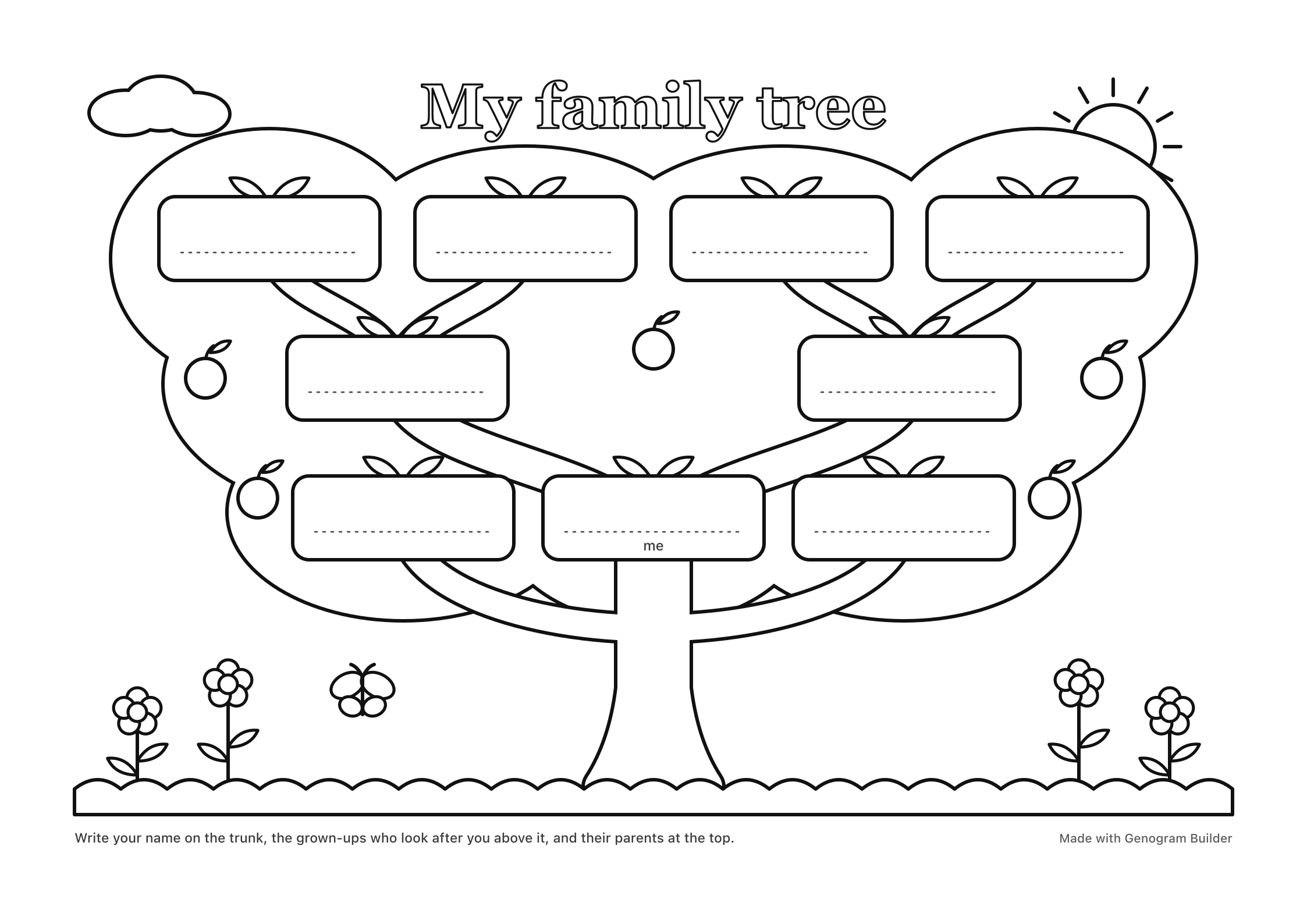
Both pages are free PDF and PNG files that download without an account, and a small credit line sits at the foot of each. For a class, print some of each and let every child pick the tree that fits.
Older children can move on to a full family tree
A coloring page holds seven or nine names and no dates. A child who wants aunts, uncles and cousins on the tree can go on to the extended family tree diagram, which has sixteen places and a line for each branch. A class that is learning Spanish can use the family tree in Spanish template, which prints the Spanish and the English word under every place.
These sheets are ordinary family trees. A genogram adds health and relationship marks for adults who study or work with families, and the comparison of a genogram and a family tree sets the two side by side. Teachers of older students can start from the guide to teaching genograms.
Common questions
The family tree coloring page is free to print
Both coloring pages and the colored example download as PDF and PNG without an account. Print as many copies as a family or a class needs.
What age the page suits
The outlines are bold and the shapes are large, which suits children from about four to eight. A younger child colors while an adult writes the names, and an older child writes them alone.
Whether the names can be typed before printing
The coloring page is a picture and has no text boxes. To add typed names, place the PNG on a slide or in a document and put a text box over each sign.
Families that do not fit two parents and four grandparents
Only the sign on the trunk is labeled, so the other signs can hold whoever looks after the child. Leave a sign empty, or write a stepparent, a foster carer, an aunt or a family friend on it.