Every title on a family tree is measured from one person
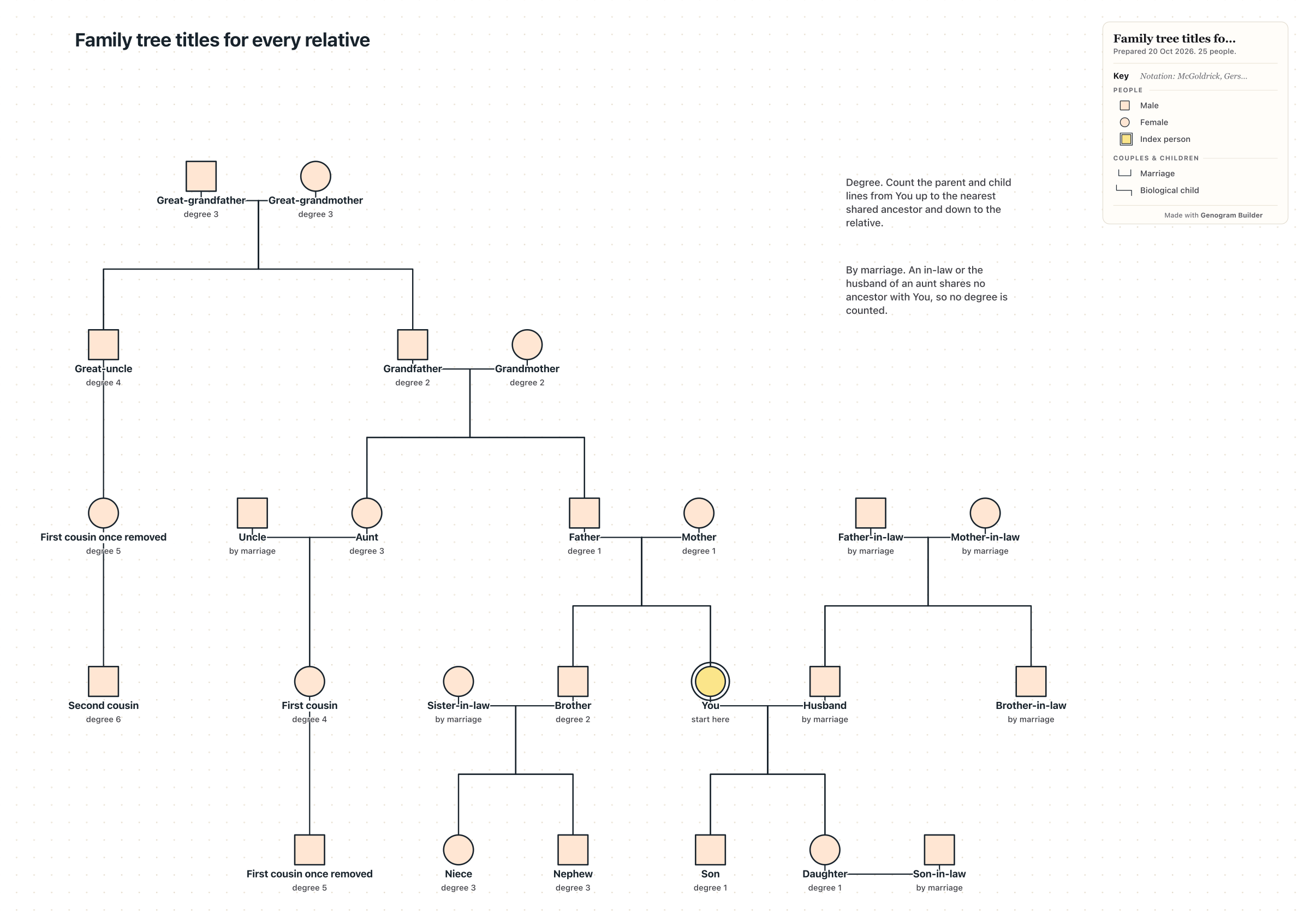
A title describes a relationship, so it changes with the person you start from. The woman who is your aunt is also the sister of your father, the daughter of your grandparents and the mother of your cousin. The chart on this page fixes the starting point at the person marked You and names everyone else from there.
The family is invented and carries no names, because the titles are the subject. It runs through five generations, from two great-grandparents at the top to a son, a daughter, a niece and a nephew at the bottom.
Genogram Builder
Keep the chart of titles beside your own tree
Download the chart as a PDF, or draw the relatives of your own family in the editor.
- Twenty-five titles in five generations
- Opens without an account
- PNG and PDF export with a free account, with a watermark
Relatives fall into three groups, direct, collateral and by marriage
Direct relatives, also called lineal, are the people you descend from and the people who descend from you. Parents, grandparents and great-grandparents stand above You, and children and grandchildren stand below.
Collateral relatives share an ancestor with you without being in your direct line. Brothers and sisters share your parents. Aunts, uncles and first cousins share your grandparents, and great-uncles and second cousins share your great-grandparents.
Relatives by marriage share no ancestor with you. They are the family of your husband or wife and the husbands and wives of your blood relatives. English calls the husband of an aunt an uncle and adds in-law to most of the other titles.
The legend gives each title with the person it names
The first column lists the family tree titles. Find one there, then find the same words on the chart. The last column is the degree printed under the name, which a later section explains.
| Title | Who it names | Group | Degree |
|---|---|---|---|
| Father, mother | Your parents | Direct | One |
| Son, daughter | Your children | Direct | One |
| Grandfather, grandmother | The parents of your parents | Direct | Two |
| Great-grandfather, great-grandmother | The parents of your grandparents | Direct | Three |
| Brother, sister | The other children of your parents | Collateral | Two |
| Uncle, aunt | A brother or sister of your parent | Collateral | Three |
| Nephew, niece | A son or daughter of your brother or sister | Collateral | Three |
| Great-uncle, great-aunt | A brother or sister of your grandparent | Collateral | Four |
| First cousin | A child of your uncle or aunt | Collateral | Four |
| First cousin once removed | A child of your first cousin, or a first cousin of your parent | Collateral | Five |
| Second cousin | A grandchild of your great-uncle or great-aunt | Collateral | Six |
| Husband, wife | The person you married | By marriage | None |
| Father-in-law, mother-in-law | The parents of your husband or wife | By marriage | None |
| Brother-in-law, sister-in-law | A brother or sister of your husband or wife, or the person your brother or sister married | By marriage | None |
| Son-in-law, daughter-in-law | The person your child married | By marriage | None |
| Uncle or aunt by marriage | The person your aunt or uncle married | By marriage | None |
Nieces and nephews are the children of your brothers and sisters
On the chart the brother of You married the woman titled sister-in-law, and their daughter and son are the niece and the nephew. The same titles cover the children of the brothers and sisters of your husband or wife. The children of a niece or a nephew are great-nieces and great-nephews, which some families write as grandniece and grandnephew.
A cousin number counts generations and removed counts the gap
First cousins share grandparents, second cousins share great-grandparents and third cousins share great-great-grandparents. The number rises by one for each generation further back that the shared couple stands.
Removed means that the two people stand in different rows. The child of your first cousin is your first cousin once removed, and so is the first cousin of your parent, because each is one row away from a first cousin of your own. Twice removed is a gap of two rows. The title appears twice on the chart for that reason, once in the row of your parents and once in the row of your children.
A degree is the number of steps between two relatives
The line under each name gives the degree by the civil count. Start at You, count one step for each line between a parent and a child up to the nearest shared ancestor, and keep counting down to the relative. A parent is one step away. A brother is two, one up to your parents and one down. A first cousin is four, two up to the grandparents and two down.
An in-law has no degree in this count, because no path of parents and children joins the two of you. Laws on marriage and inheritance use counts of this kind and differ from place to place, so read the law that applies to you before you rely on a number.
Medicine uses the word in another way. A first-degree relative is a parent, a brother, a sister or a child. A second-degree relative is a grandparent, a grandchild, an aunt, an uncle, a niece, a nephew or a half-sibling, and a first cousin is a third-degree relative. When a form asks for a degree, find out which count it means.
Use the titles on your own family tree
Choose the starting person, then name each relative from that person and keep to it across the whole chart. A tree drawn for a child calls the same woman grandmother that a tree drawn for the parent calls mother. The guide to how a family tree works explains the rows and lines that the titles hang from.
To draw the tree itself in Genogram Builder, follow Add a person for each relative and keep this chart beside you for the titles. Choose what is written sets which lines appear under a symbol.
Common questions
Whether a great-aunt and a grandaunt are the same person
Yes. Both words name a sister of your grandparent, and great-uncle and granduncle both name a brother. Great-aunt is the more common form in everyday English.
What a half-sibling and a step-sibling are on the chart
A half-sibling shares one parent with you and is two steps away, as a full brother or sister is. A step-sibling is the child of the person your parent married and shares no ancestor with you, so the chart would mark that person by marriage.
What to call the husband or wife of a cousin
English has no settled title. Most families say cousin by marriage or use the first name, and a family tree can write either under the symbol.
Sources and methodology
We make Genogram Builder. We used the references below for this guide. Last checked on 10 November 2026.
Draw your own family, then use the chart to name what each relative is to you. No account is needed to begin.