Family Tree in Spanish Template with a Classroom Example
This family tree in Spanish template has fourteen places, from abuelo and abuela down to primo and prima, with the Spanish word and the English word printed under each one. Print the blank A4 sheet for a Spanish class, type the names into the same tree online, or open the filled classroom example of a fictional family and change it.
Blank sheet
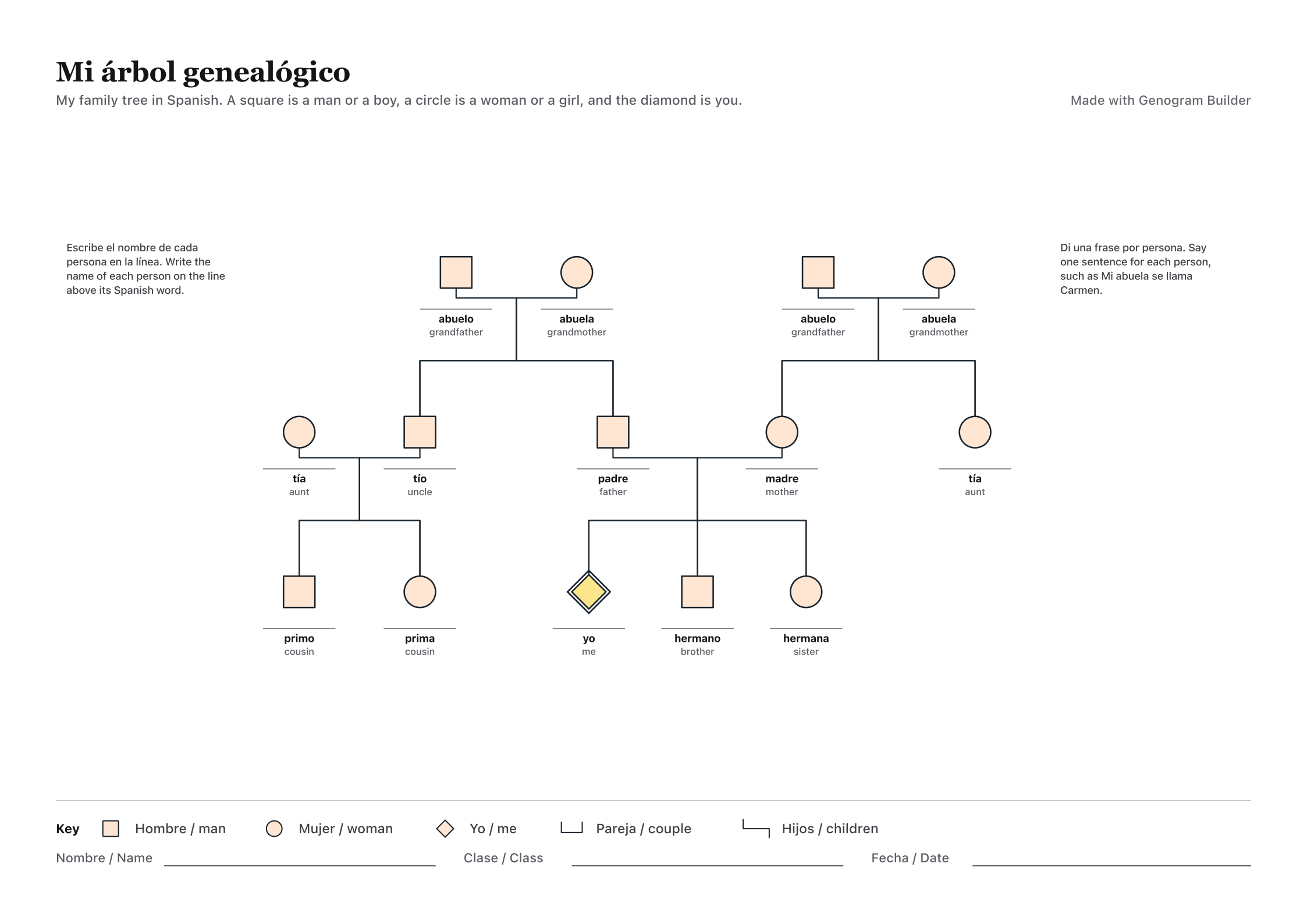
Filled in for a fictional family
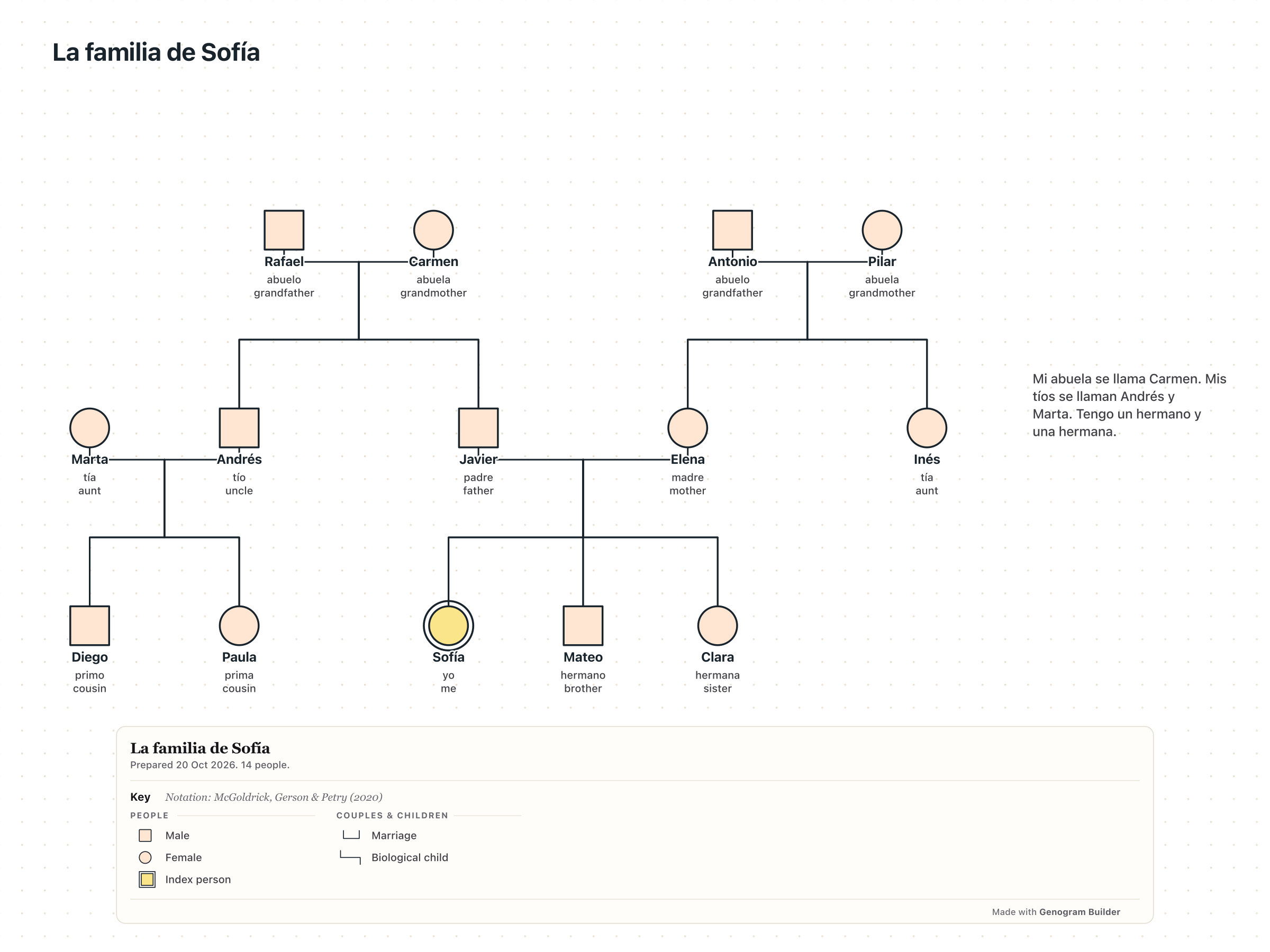
On the left is the blank sheet. On the right is the fictional family of Sofía, a Spanish 1 student, with a first name in every place and both words under it.
Edit the family tree in Spanish template online
Open the blank sheet to type a name over each of the fourteen places marked Nombre, or open the family of Sofía and change it. Each one starts a separate chart in this tab and leaves the family saved on the homepage alone.
Double-click a person and type the name. The Spanish word and the English word stay under it as two short lines, which are fields under Notes in the side panel.
Edits stay in this tab until you continue in the full editor, which keeps the tree. A visitor can edit without an account but cannot export. A free account exports a PNG, a PDF or a JSON project, with a watermark on the picture and the PDF, and Pro removes the watermark and adds SVG.
The sheet names fourteen relatives in Spanish and English
The template is drawn from the point of view of one student, who is the diamond marked yo in the bottom row. Above it stand the parents, padre and madre, and above them the four grandparents. To the left of the father is his brother, the tío, with his wife, a tía by marriage, and their two children, a primo and a prima. To the right of the mother is her sister, a second tía. Beside the student stand a hermano and a hermana.
A square is a man or a boy and a circle is a woman or a girl, so the shape above each word agrees with its ending. Most masculine words on the sheet end in o and sit under a square, and their feminine partners end in a and sit under a circle. Padre and madre are the pair that breaks the pattern. The diamond for yo assumes nothing, since the student may be a boy or a girl.
| Spanish | English | Where it stands on the sheet |
|---|---|---|
| abuelo, abuela | grandfather, grandmother | Top row, one couple above each parent |
| padre, madre | father, mother | Middle row, joined by a couple line |
| tío, tía | uncle, aunt | Middle row, beside the parent who is their brother or sister |
| primo, prima | cousin | Bottom row, under the uncle and the aunt |
| hermano, hermana | brother, sister | Bottom row, beside the student |
| yo | I or me | Bottom row, the diamond with a double outline |
Print the blank sheet for a Spanish class
The PDF is one A4 landscape page and also fits US Letter when the printer is set to fit the page. It reads clearly in black and white, because the symbols are told apart by shape. A note in Spanish and English on each side tells the student what to do, and the foot of the page has lines for Nombre, Clase and Fecha.
The PDF and the PNG download without an account. A lesson with the printed sheet runs in four steps.
- Write the names. The student writes the first name of each relative on the line above its Spanish word, starting with yo.
- Adjust the tree. The student strikes through a place that does not fit the family and draws a symbol and a line for a relative the sheet leaves out.
- Write a sentence. For each person the student writes one sentence on the back of the sheet, such as “Mi tío se llama Andrés.”
- Present it. The student points at each symbol in turn and reads the sentences aloud to a partner.
A family tree can be a private matter for a student. Offer the choice of an invented family or a family from a book, and mark the vocabulary and the sentences, not the family.
The classroom example shows the family of Sofía
Sofía Morales Vega is a fictional Spanish 1 student, and every person on her tree is invented. Her parents are Javier and Elena. Her grandparents are Rafael and Carmen on her father’s side and Antonio and Pilar on her mother’s. Her tío Andrés is married to Marta, and their children Diego and Paula are her cousins. Her tía Inés is her mother’s sister, and Mateo and Clara are her brother and sister.
The names follow the Spanish custom of two surnames. Sofía takes Morales, the first surname of her father, and then Vega, the first surname of her mother. Her cousins are Morales Gil for the same reason. The chart writes first names, and the side panel shows the full name when the example is opened in the editor.
Each line of the tree gives a sentence to write
The symbols of the tree are the vocabulary, and the lines between them are the grammar practice. A couple line joins two people and a line down joins parents to a child, and each can be said in Spanish with a verb the class already knows.
| What the tree shows | Sentence in Spanish | In English |
|---|---|---|
| A name under a symbol | Mi abuelo se llama Rafael. | My grandfather is called Rafael. |
| Two people on a couple line | Javier es el esposo de Elena. | Javier is the husband of Elena. |
| A line down to a child | Diego es el hijo de Andrés y Marta. | Diego is the son of Andrés and Marta. |
| Children on one bar | Tengo un hermano y una hermana. | I have one brother and one sister. |
| The brother or sister of a parent | Inés es la hermana de mi madre. | Inés is the sister of my mother. |
| The children of an uncle and an aunt | Mis primos se llaman Diego y Paula. | My cousins are called Diego and Paula. |
Words the sheet leaves out can be written in by hand. Common ones are bisabuelo and bisabuela for great-grandparents, padrastro and madrastra for a stepfather and a stepmother, hermanastro and hermanastra for a stepbrother and a stepsister, medio hermano for a half brother, and sobrino and sobrina for a nephew and a niece. An aunt by marriage can be called tía política, though most families say tía.
Change the tree where a family differs
No printed tree fits every family. A student with one parent at home, two mothers, a stepfather or a grandparent as the main carer changes the sheet to match.
To add a relative online, hover over a person and click Sibling, Child, Partner or Parents on the ring around the symbol. The guide to adding a sibling shows the ring. To give the new person the two words, open Notes in the side panel and click Add a field.
This template is an ordinary family tree. It records who is related to whom and leaves out the health and relationship marks of a genogram. The comparison of a genogram and a family tree explains the difference.
Common questions
The family tree in Spanish template is free to print
The blank PDF and PNG download without an account, and the tree can be edited online as a guest. Exporting an edited tree needs a free account, and the free export carries a watermark.
How to say family tree in Spanish
The usual phrase is árbol genealógico, and the sheet is titled Mi árbol genealógico, which means my family tree. In class you will also hear árbol familiar and árbol de la familia.
Whether the labels can be in Spanish only
They can on screen. Open a person, find the two fields under Notes and delete the English one. The printed PDF always carries both words, which suits a first-year class.