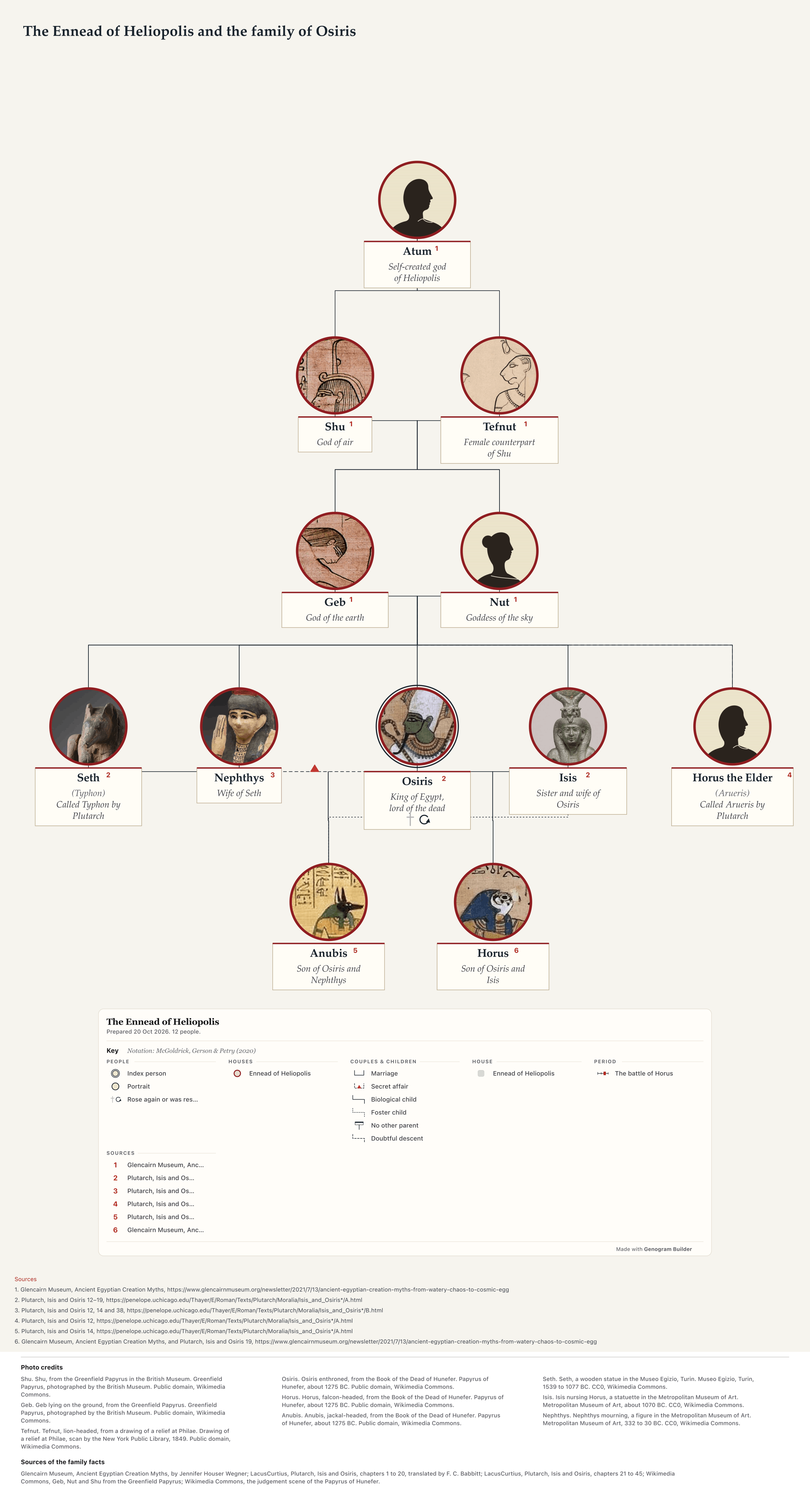
How to read this Osiris family tree
Read this Osiris family tree from the top down, one generation to a row. The gods have no dates, so each plate gives a title in place of years. Each picture is a detail of an Egyptian papyrus, a temple relief or a statue, named in the credits.
A double ring is the centre
Osiris, the eldest son of Geb and Nut.
A solid line is a marriage
Osiris married Isis, and Seth married Nephthys.
A dashed line is no marriage
Osiris lay with Nephthys thinking she was Isis.
A red line is a killing or a war
Seth killed Osiris, and Horus fought Seth.
Atum, Shu and Tefnut, Geb and Nut
The Osiris family tree of Heliopolis begins before there is any world. In the account of the priests of that city, Atum “is self-created and arises in the shape of an obelisk-like pillar,” the benben, out of a chaotic and watery state.1 He has no parents, so he stands alone at the top of the chart.
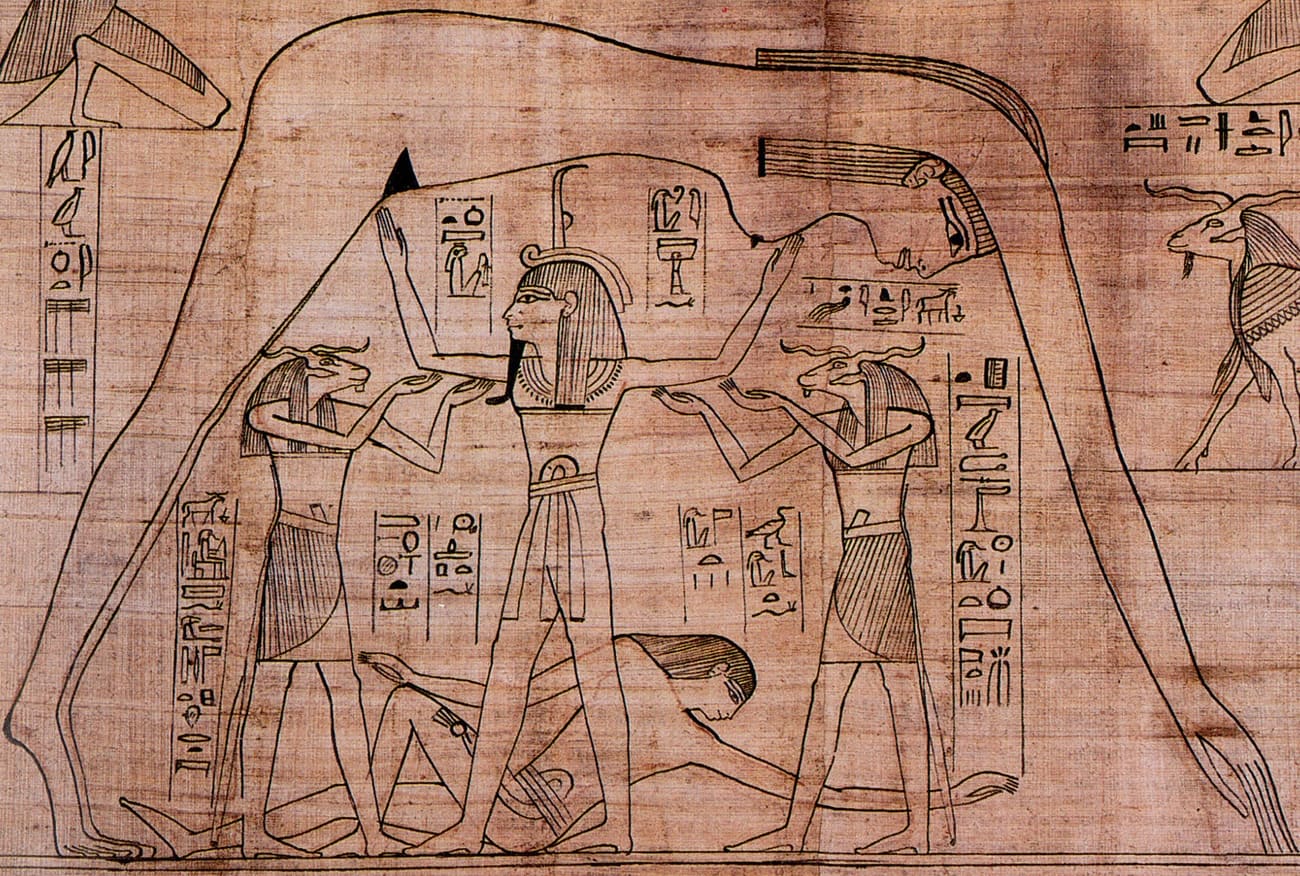
Atum engenders the next generation from his own body. He “spits out a pair of divine beings,” Shu, the god of air, and Tefnut, his female counterpart.1 No mother takes part, so the chart joins each of them to Atum alone. Their son Geb is the god of the earth, and his sister and wife Nut is the goddess of the sky.1 Egyptian artists showed Shu standing between them and holding the sky away from the earth.1
Geb and Nut then produced four children, Isis, Osiris, Seth and Nephthys. With Atum, Shu, Tefnut, Geb and Nut they make the nine gods of the Ennead, which the Old Kingdom Pyramid Texts already name.1 Isis and Osiris in turn produced Horus, the tenth figure that later texts often add.1

Five children born on five added days
Plutarch tells how the children of Geb and Nut were born. He writes in Greek and calls the parents Cronus and Rhea. The Sun cursed Rhea so that she could bear a child in no month and no year. Hermes, who loved her, won five days from the Moon, and the five days were added to the year.2
A child was born on each day. Osiris came first, and a voice declared “The Lord of All advances to the light.” Arueris, whom the Greeks call Apollo and some call the elder Horus, came on the second day. Typhon came on the third, breaking out through his mother’s side. Isis was born on the fourth day and Nephthys on the fifth.2
The brother that Plutarch names Typhon stands where the Egyptian list of the Ennead has Seth, the third son, husband of Nephthys and enemy of Osiris.21 Plutarch says Isis and Osiris were in love before they were born, and that Nephthys became the wife of Typhon.2
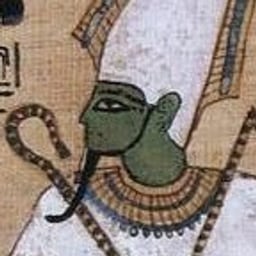 OsirisEnthroned as judge of the dead.
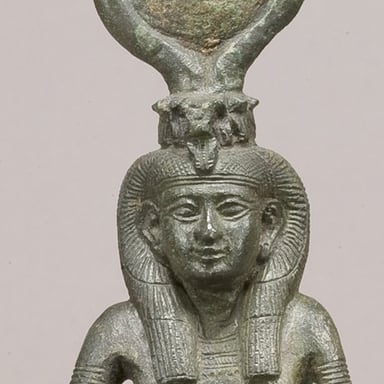 IsisWith the horns and sun disk.
 HorusFalcon-headed son of Osiris.
Seth, the chest and the search of Isis
Osiris ruled Egypt and taught its people, then travelled the world. While he was away, Typhon gathered seventy-two conspirators and a queen of Ethiopia named Aso. They made a chest to his measure, shut him inside, sealed it with nails and molten lead and sent it down the Nile to the sea.2
Isis searched for the chest. On the way she learned that Osiris had lain with her sister Nephthys, thinking her to be Isis, and she found their son Anubis and raised him as her guard and attendant.2 Plutarch adds later that “Nephthys bore Anubis clandestinely,” after her marriage to Typhon had been barren.3 The chest had come to rest in a heather tree at Byblus, and Isis brought it home.2
Typhon found the body and cut it into fourteen parts. Isis went through the marshes in a boat to gather them, and wherever she found a part she held a funeral, which is why Egypt has many tombs of Osiris.2
Horus avenges his father
Osiris trained his son Horus for battle. Horus defeated Typhon, but Isis let Typhon go. Horus in his anger tore the royal diadem from her head, and Hermes gave her a helmet in the shape of a cow’s head. Typhon was defeated in two more battles.2
Plutarch ends the family with one more child. After his death Osiris consorted with Isis, and she bore Harpocrates, who is not drawn on this Osiris family tree.2 The family of the Greek gods, which Plutarch sets beside this one, is drawn on the Greek mythology family tree.
Where Plutarch and the Egyptian list differ
This Osiris family tree draws the Ennead as the Egyptian texts list it and adds Plutarch where he gives more. The two do not agree on four points.
| Question | The Ennead of Heliopolis | Plutarch, Isis and Osiris |
|---|---|---|
| The children of Geb and Nut | Four, Osiris, Isis, Seth and Nephthys | Five, with Arueris, the elder Horus, as the second |
| The father of the children | Geb, the earth | Osiris and Arueris by the Sun, Isis by Hermes, Typhon and Nephthys by Cronus |
| The names | Egyptian names | Cronus and Rhea for the parents, Typhon for Seth |
| The mother of Anubis | Not part of the nine | Nephthys, by Osiris |
Plutarch himself reports a choice of fathers for the five children, so the chart keeps Geb as the father of the four whom the Egyptian list names, as that list does.21 Horus the Elder is not in the list, and Plutarch gives him the Sun for a father, or says that some make him the child of Isis and Osiris. The sources differ, so his line from Geb is drawn broken and marked as disputed.2 The Norse gods have a family of their own on the Odin family tree.
Questions about the Osiris family tree
Who the parents of Osiris were
Geb, the god of the earth, and Nut, the goddess of the sky. On the Osiris family tree they stand on the third row, the grandchildren of Atum.
How Osiris and Isis are related
They are brother and sister, children of Geb and Nut, and also husband and wife. Their son is Horus.
How Seth is related to Osiris
Seth is his brother, a son of Geb and Nut, and also his brother-in-law, since he married their sister Nephthys.
Who the gods of the Ennead are
Atum, Shu, Tefnut, Geb, Nut, Osiris, Isis, Seth and Nephthys, the nine gods of Heliopolis named in the Pyramid Texts.
People and sources
A page of its own lists all 12 people on the chart, each with a short note and the sources for it, and the three numbered sources this article cites. It also gives the credits of the portraits and this page as a reference in the APA, MLA, Chicago and Harvard styles, ready to copy.