Work back one generation at a time from yourself
Learning how to look up your family tree starts with one rule, which is that family history runs backwards. You start with the person you can prove best, which is you, and move to your parents, then your grandparents. Each step uses the facts of the last one to find the next record. FamilySearch gives the same order, starting with yourself, gathering the records at home and then talking to relatives and family friends.
- Write down what you know
Put your own birth, your parents and your grandparents on paper, with dates and places, and mark each fact you cannot prove yet.
- Gather the papers at home
Collect certificates, letters, funeral cards, family Bibles and photographs with names on the back.
- Interview relatives
Ask the oldest relatives first, record the conversation and write down the names, places and years they give.
- Search the census
Find each household in every census year you can, starting with the most recent one that is open.
- Order the vital records
Use the birth, marriage and death indexes to find the certificate that names the parents of each person.
- Record the source
Write down where every fact came from before you move up a generation.
Genogram Builder
Keep the family tree you find
Draw each generation as you confirm it, and write the record you found in the Notes of each person.
- Opens without an account
- Imports GEDCOM, GenoPro and Gramps files
- PNG, PDF and JSON with a free account
Interview the oldest relatives before you open an archive
A grandmother may know the maiden name of her own grandmother, the town the family left and the name of a child who died young. No index will tell you those things, and they are the clues that let you choose the right record later. The FamilySearch guide to creating oral histories recommends open questions that invite a story, a quiet room, a charged and tested recorder and interviews of 30 to 60 minutes. It also advises against interrupting.
Write down every name with its spelling as the relative says it, and every place and year, even a guessed one. Treat what you hear as a lead to check. Memories move dates by a few years and merge two cousins into one, so a family story becomes a fact only when a record agrees with it.
People and names
- What were the full names of your parents and grandparents?
- What was your mother’s surname before she married?
- Did anyone in the family change their name, or use a nickname?
Places and dates
- Where and when were you born, and where did you grow up?
- Where did your parents marry, and where are they buried?
- Did the family move from another town or country, and when?
Stories and papers
- Do you remember any of the stories your grandparents used to tell you?
- Who kept the family photographs, letters or Bible?
- Which relative would know more about the other side of the family?
The census places a household in one year and one street
A census lists everyone in a household on one night, usually with ages, birthplaces and how each person was related to the head. Finding the same family every ten years shows children arriving, parents dying and a household moving.
In the United States the National Archives holds the census schedules from 1790 to 1950. Each census stays closed for 72 years, so 1950 is the latest open year, and it was released on 1 April 2022. The 1950 census website shows the images with a search by name and by place. Most of the 1890 census was destroyed by a fire in January 1921, and the surviving fragments name a little over 6,160 people. The National Archives lists FamilySearch as free with an account.
In England and Wales the censuses from 1841 to 1921 are online and each stays closed for 100 years. FamilySearch has free indexes to every census up to 1911, and FreeCEN has volunteer transcripts for the counties it has covered. The 1921 census is on Findmypast and can be viewed free at Manchester Central Library and the National Library of Wales. The 1931 census for England and Wales was destroyed by fire in 1942 and no census was taken in 1941, so the 1939 Register fills that gap.
| Census | Years open today | Where to search free |
|---|---|---|
| United States | 1790 to 1950, with most of 1890 lost | FamilySearch with a free account, and the 1950 census website |
| England and Wales | 1841 to 1921, with no 1931 or 1941 | FamilySearch indexes to 1911, and FreeCEN transcripts |
| 1939 Register for England and Wales | Open for people who have died or were born more than 100 years ago | Findmypast and Ancestry, both paid |
Birth, marriage and death records prove each link between generations
A census suggests who belonged together, and a birth or marriage certificate proves it, because it names the parents. In England and Wales civil registration began on 1 July 1837. FreeBMD transcribes the national index and makes no charge, and its coverage of 1837 to 1999 is not yet complete. Anyone can register on the General Register Office site and search its birth and death indexes free, says the FamilySearch guide to English registration. The certificates themselves are ordered from the General Register Office, and The National Archives does not hold them. Before 1837, the record is a baptism, marriage or burial in a parish register in a local archive.
In the United States, vital records are kept by each state, and the CDC page Where to Write for Vital Records says that the federal government does not distribute certificates. Look up the vital records office of the state where the event happened on that CDC page, which gives the address and fees for each state.
Archives and societies hold what the indexes leave out
Indexes are made by people, so a name can be misread, and a family that moved can vanish from one index and appear in another. When a search fails, try the surname with other spellings, search for a brother or sister instead, or search by place and read the pages around it. Wills, military files, passenger lists, land records and newspapers carry the people forward between censuses.
The US National Archives points beginners to its genealogy tutorials and research topics, and it suggests joining the genealogical society where you live as well as the one where your ancestors lived. A local society can often tell you which church registers survive and which cemeteries have been transcribed.
A DNA test can confirm a link but cannot name an ancestor
A DNA test compares your sample with other customers of the same company. A match who shares a known ancestor with you supports a line you have built from records, and a match you cannot place may point to a branch you did not know. MedlinePlus, from the US National Library of Medicine, notes that tests read only a portion of your genetic information, that populations are not represented equally in reference databases, that ancestry estimates may differ from one company to another and that mitochondrial DNA tells you only about the female line.
The amount of DNA you share does not fix the relationship. FamilySearch explains that a match of 575 to 1,330 centimorgans could be a first cousin, a half aunt or a grandparent, so the records decide which. The genome.gov guide for clinicians warns that a test may reveal an unexpected biological relative, that law enforcement has searched third-party databases and that DNA may be used for research. Ownership also changes. 23andMe entered Chapter 11 in March 2025, and its testing service passed to TTAM Research Institute in July 2025. Read the privacy terms, and talk to the relatives a result could affect, before you test.
Write the source of every fact on the chart you keep
Every fact on a family tree should answer where it came from. A short citation is enough, such as the 1911 census of England and Wales, the parish and the household, or the death certificate of a grandfather and the year it was issued. Note the searches that found nothing as well, so that you do not repeat them. When two records disagree on a birth year, keep both and say which one you trust and why.
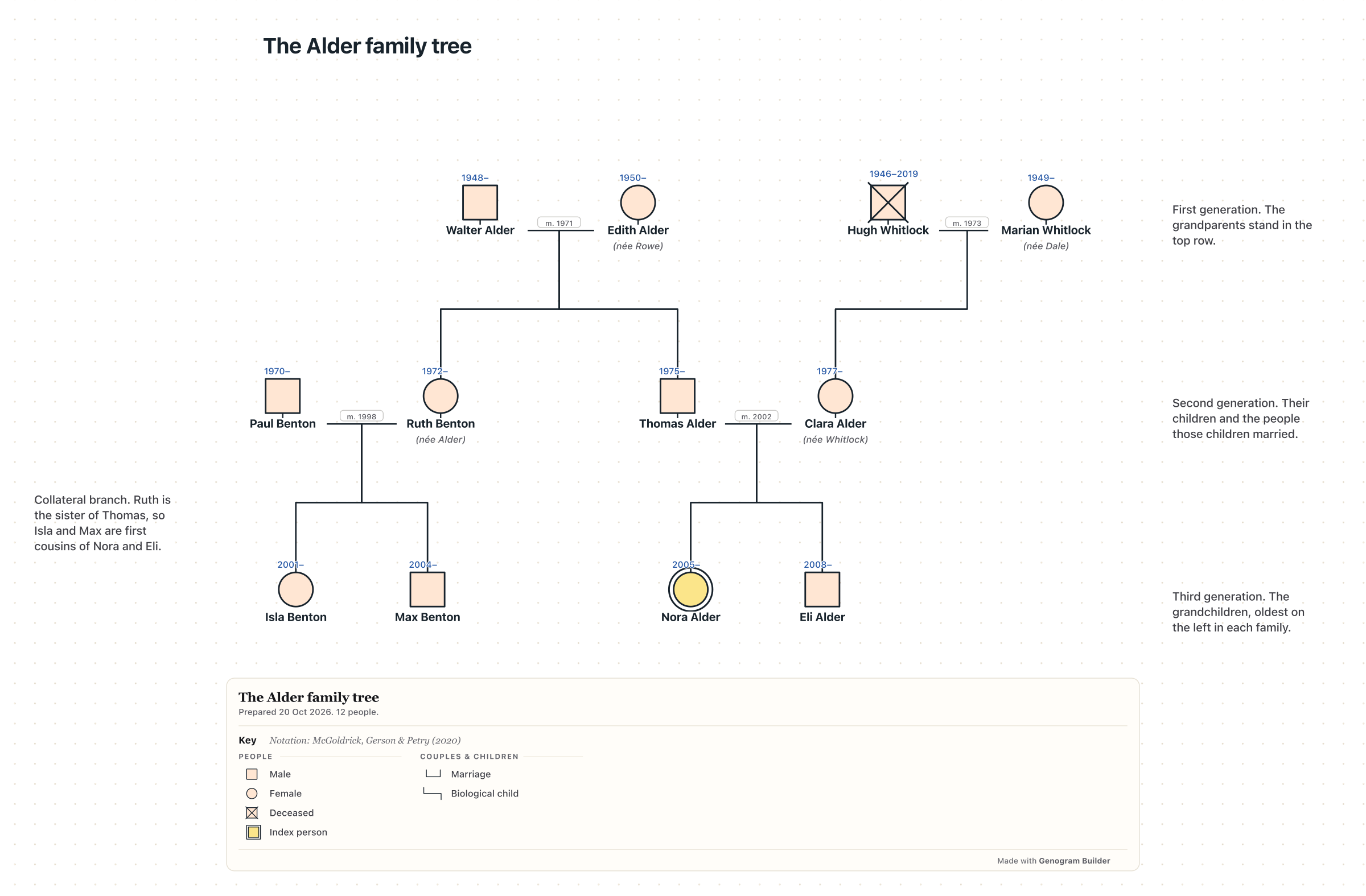
Keep the tree in a file that another program can open. GEDCOM is the exchange format of genealogy software, and version 7.0 is the current release. Genogram Builder imports a GEDCOM file through Import a family file, keeps a Notes field on each person for the citation, and saves a JSON project of the whole chart with a free account. Draw each generation as you confirm it, starting with the blank three generation chart, and read the guide to reading a family tree for the lines and rows.
Common questions
How to look up your family tree for free
FamilySearch, FreeBMD, FreeCEN, the 1950 census website and the indexes of the General Register Office cost nothing to search. Certificates, DNA tests and some census images cost money, and the guide to family tree research cost sets out the ranges.
Searching a family tree by name alone
A name alone matches thousands of people. Add a year and a place from an interview or a certificate, and confirm the result with a second record before you add the person to your chart.
Choosing software for the tree
Desktop programs, online services and browser editors keep a tree in different places and exchange it through GEDCOM. The guide to family tree software compares the main ones by price, platform, files and syncing.
Sources and methodology
We make Genogram Builder. We used the references below for this guide. Last checked on 10 November 2026.
- FamilySearch, How to Start Your Family History
- FamilySearch, Creating Oral Histories
- StoryCorps, great questions
- US National Archives, census records
- US National Archives, the 1890 census
- US National Archives, census records online
- The 1950 census website
- US National Archives, start your genealogy research
- The National Archives, census records
- The National Archives, the 1939 Register
- The National Archives, births, marriages and deaths
- FreeBMD
- FreeCEN
- FamilySearch, England civil registration
- CDC, Where to Write for Vital Records
- MedlinePlus, genetic ancestry testing
- FamilySearch, centimorgan chart
- genome.gov, direct-to-consumer genetic testing
- 23andMe, Chapter 11 announcement
- GEDCOM specifications
Put your grandparents, your parents and yourself on a blank chart, and add each record to the Notes as you find it. No account is needed to begin.
Start your family tree