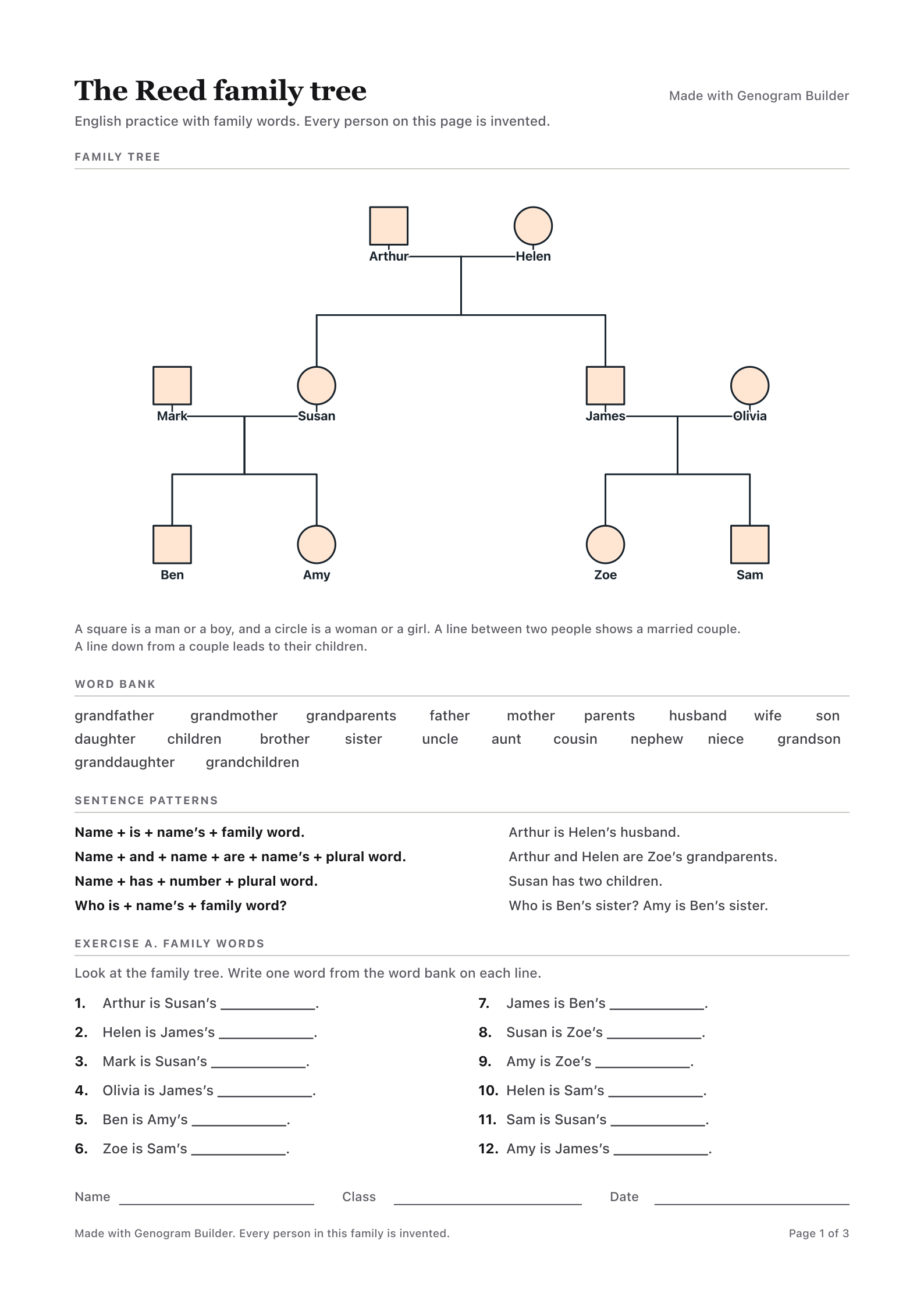
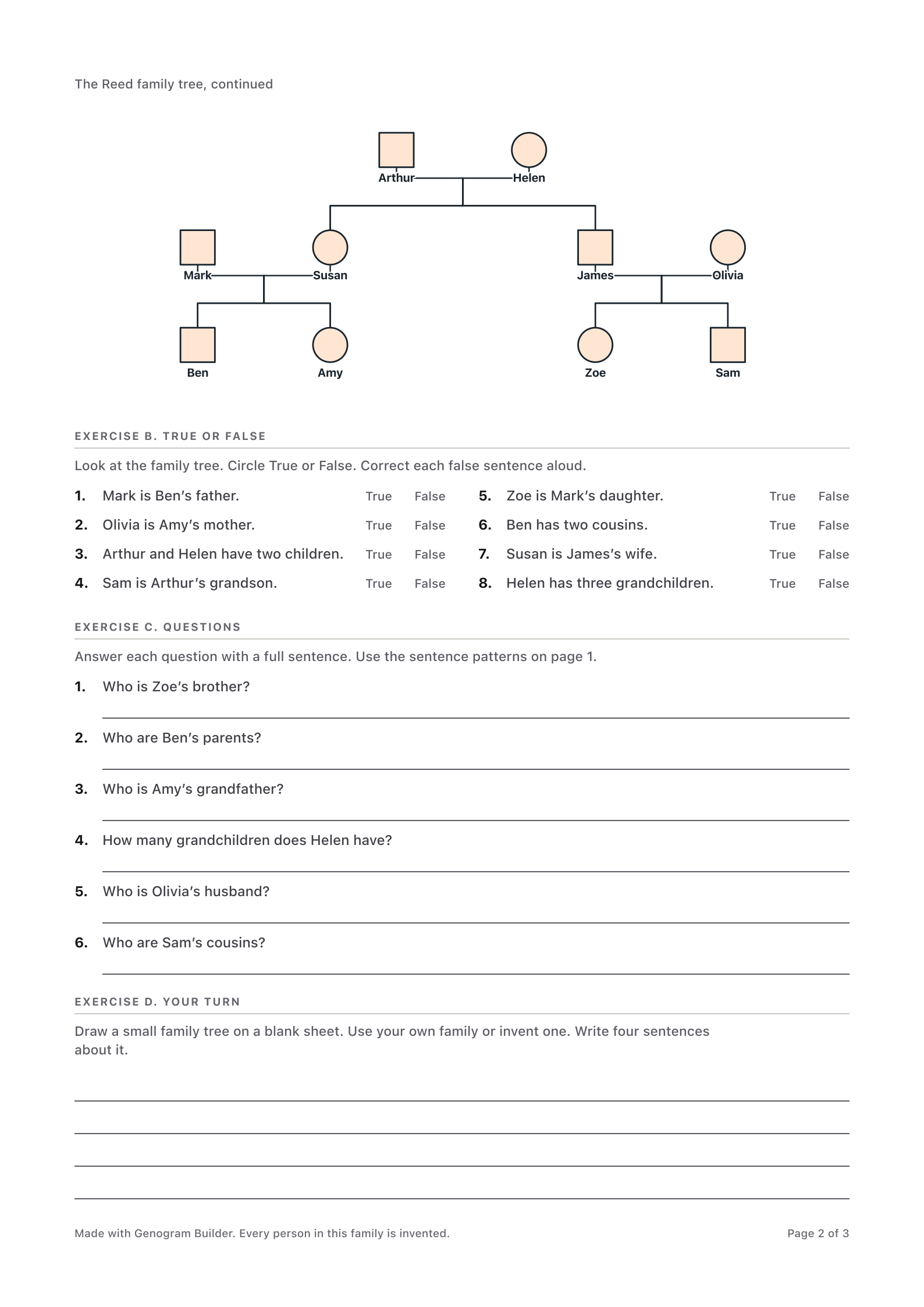
The practice pack is one PDF of three pages
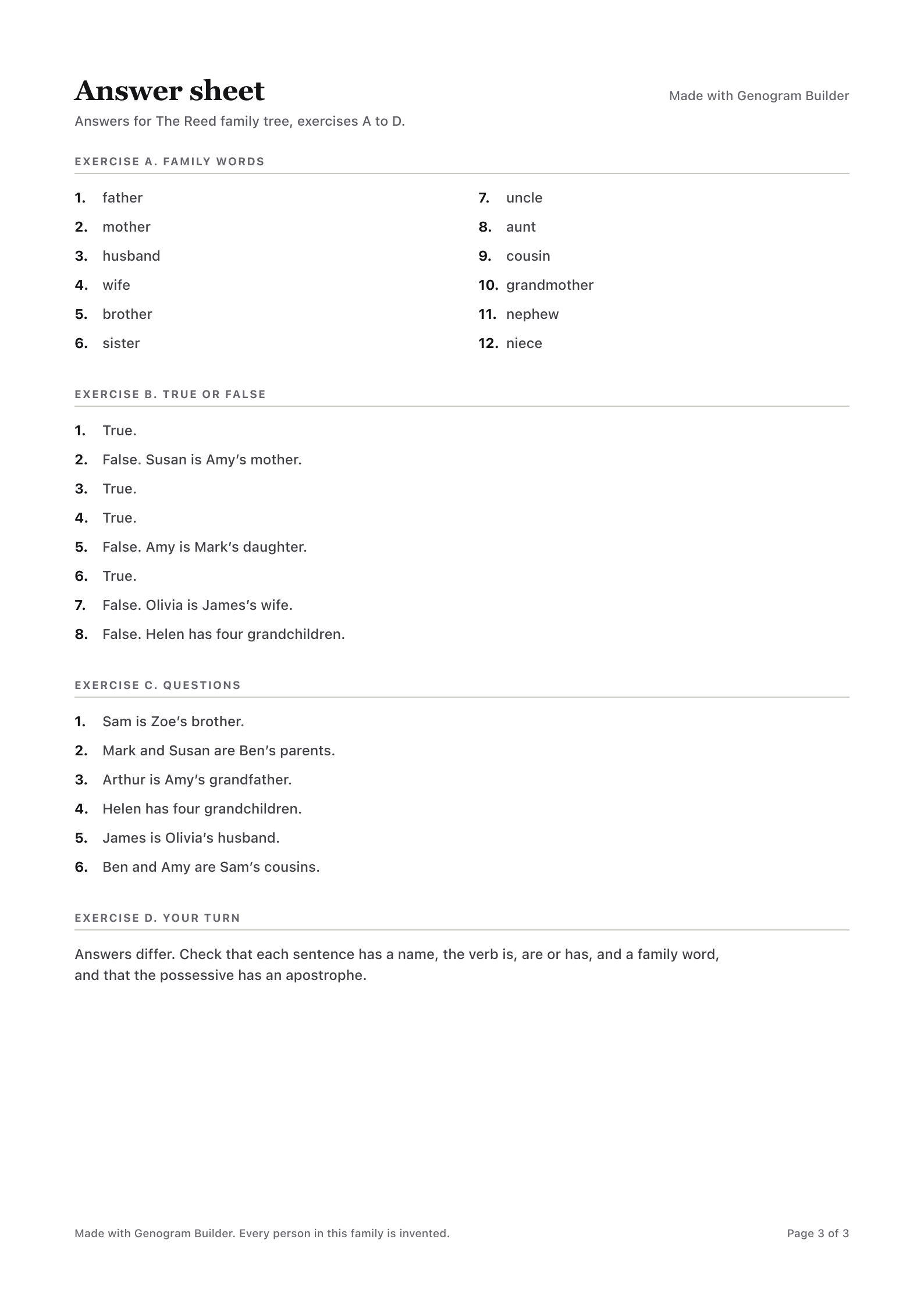
The first page holds the Reed family tree, a word bank of twenty-one family words, four sentence patterns and Exercise A. The second page repeats the tree and adds Exercises B, C and D. The third page is the answer sheet. The file is free, needs no account and carries no watermark.
The Reed family was invented for this pack. Arthur and Helen are the grandparents. Their daughter Susan married Mark, their son James married Olivia, and the four grandchildren are Ben, Amy, Zoe and Sam. No name, face or story comes from a real family, a film or a series.
Genogram Builder
Download the family tree practice pack
Three A4 pages that also print whole on US Letter, with the answer sheet on the last page.
- Ten invented people in three generations
- No account and no watermark
- Answers worked out from the tree itself
Twenty-one English kinship terms cover the whole tree
English kinship words mark gender in every pair except cousin. The plural words grandparents, parents, children and grandchildren name a mixed group. The table sorts the word bank and points to an example of each row on the tree.
| For a man or a boy | For a woman or a girl | For both together | On the Reed tree |
|---|---|---|---|
| grandfather | grandmother | grandparents | Arthur and Helen, for the four grandchildren |
| father | mother | parents | Mark and Susan, for Ben and Amy |
| husband | wife | Not in the word bank | James and Olivia |
| son | daughter | children | James and Susan, for Arthur and Helen |
| brother | sister | Not in the word bank | Sam and Zoe |
| uncle | aunt | Not in the word bank | James and Olivia, for Ben and Amy |
| nephew | niece | Not in the word bank | Ben and Amy, for James and Olivia |
| cousin | cousin | cousins | Ben and Zoe |
| grandson | granddaughter | grandchildren | Sam and Amy, for Arthur and Helen |
Four sentence patterns turn the words into sentences
Each pattern is printed on the first page with an example about the Reed family. Learners reuse the patterns in every exercise, so the grammar stays small while the vocabulary grows.
| Pattern | Example | What it practises |
|---|---|---|
| “Name + is + name’s + family word.” | “Arthur is Helen’s husband.” | The verb is and a possessive with an apostrophe |
| “Name + and + name + are + name’s + plural word.” | “Arthur and Helen are Zoe’s grandparents.” | The verb are with two subjects |
| “Name + has + number + plural word.” | “Susan has two children.” | The verb has with a number and a plural noun |
| “Who is + name’s + family word?” | “Who is Ben’s sister? Amy is Ben’s sister.” | A question and a full answer |
Three exercises have fixed answers and one is free writing
Exercise A asks for one word on each of twelve lines. Exercise B gives eight statements to mark true or false, and Exercise C asks six questions that need a full sentence. Exercise D asks each learner to draw a small tree and write four sentences about it.
The lines below are the ones printed in the PDF, for a teacher who wants to copy them into slides or a quiz.
Exercise A. Family words
- Arthur is Susan’s ____________.
- Helen is James’s ____________.
- Mark is Susan’s ____________.
- Olivia is James’s ____________.
- Ben is Amy’s ____________.
- Zoe is Sam’s ____________.
- James is Ben’s ____________.
- Susan is Zoe’s ____________.
- Amy is Zoe’s ____________.
- Helen is Sam’s ____________.
- Sam is Susan’s ____________.
- Amy is James’s ____________.
Exercise B. True or false
- Mark is Ben’s father.
- Olivia is Amy’s mother.
- Arthur and Helen have two children.
- Sam is Arthur’s grandson.
- Zoe is Mark’s daughter.
- Ben has two cousins.
- Susan is James’s wife.
- Helen has three grandchildren.
Exercise C. Questions
- Who is Zoe’s brother?
- Who are Ben’s parents?
- Who is Amy’s grandfather?
- How many grandchildren does Helen have?
- Who is Olivia’s husband?
- Who are Sam’s cousins?
The answer sheet lets learners check their own work
The third page gives the twelve words of Exercise A, the answers of Exercise B with each false sentence corrected, and a model sentence for every question of Exercise C. The same program that prints the questions works the answers out from the family tree, and a test in our build reads them back, so the sheet and the tree agree.
Exercise D has no single answer. The sheet tells the checker what to look for, which is a name, the verb is, are or has, a family word and an apostrophe in the possessive.
Run the activities in one lesson of about forty minutes
The order below suits a family tree ESL lesson for a beginner class that knows the verb to be. The timing is a suggestion, and a class of young learners can split the pack over two lessons.
- Read the tree together
Show the first page and ask who is married and who the children are. Point out that a square is a man or a boy and a circle is a woman or a girl.
- Teach the word bank
Say each word, let the class repeat it and find one person on the tree that it fits.
- Model the patterns
Write the four patterns on the board and build one new sentence for each with the class.
- Work in pairs
Learners complete Exercises A and B, then ask and answer the questions of Exercise C aloud before they write.
- Check and extend
Hand out the answer sheet or show it on a screen, and set Exercise D as homework.
An invented family keeps the lesson safe for every learner
Questions about a real family can be hard for a learner who has lost a parent, lives apart from relatives or would rather not say. The pack therefore practises on the Reed family, and Exercise D lets each learner choose between a real family and an invented one. Accept either without comment.
As a follow-up, learners can draw the invented family on screen in Genogram Builder, which opens without an account. The guide to how a family tree works explains the rows and the lines, and a class that also studies Spanish can compare the English words with the Spanish family tree.
Common questions
Which level the pack suits
It suits beginner and elementary learners who know the verb to be and are meeting the possessive. Stronger classes can cover the word bank and write the answers to Exercise A from memory.
Whether the pack prints on US Letter paper
Yes. The pages are A4 with wide margins, so a printer set to fit the page keeps every line on US Letter. Printing on both sides of one sheet also works, because the second page repeats the tree.
Whether the pack can be shared with a class
Yes. Print it, project it or post it on a class site for your own learners. Each page names Genogram Builder in its foot.
Print the three pages for your next lesson on family words. The file is free and needs no account.
Download the practice PDF