Gather paper, a pencil and one colour for each person
The paper version needs no paint. The hand of each person is traced on coloured paper, cut out and glued above a trunk, so the tree can be made at a kitchen table and put right if a hand goes on crooked.
| Material | What to prepare | Why it matters |
|---|---|---|
| Tree sheet | The printable sheet, or its trunk copied onto a poster sheet | The trunk is the one part everyone shares |
| Coloured paper | One colour for each person, in pieces larger than the hand | Colour tells the hands apart once they overlap |
| Pencil | A soft pencil for tracing | Pencil lines can be cut away or rubbed out |
| Scissors | Scissors made for children, and a pair for the adult | The gaps between fingers are the hardest part to cut |
| Glue stick | One glue stick for the table | A stick wrinkles paper less than liquid glue |
| Pen | A dark pen for the names | The key must stay readable in a photograph |
Genogram Builder
Print the bare tree sheet
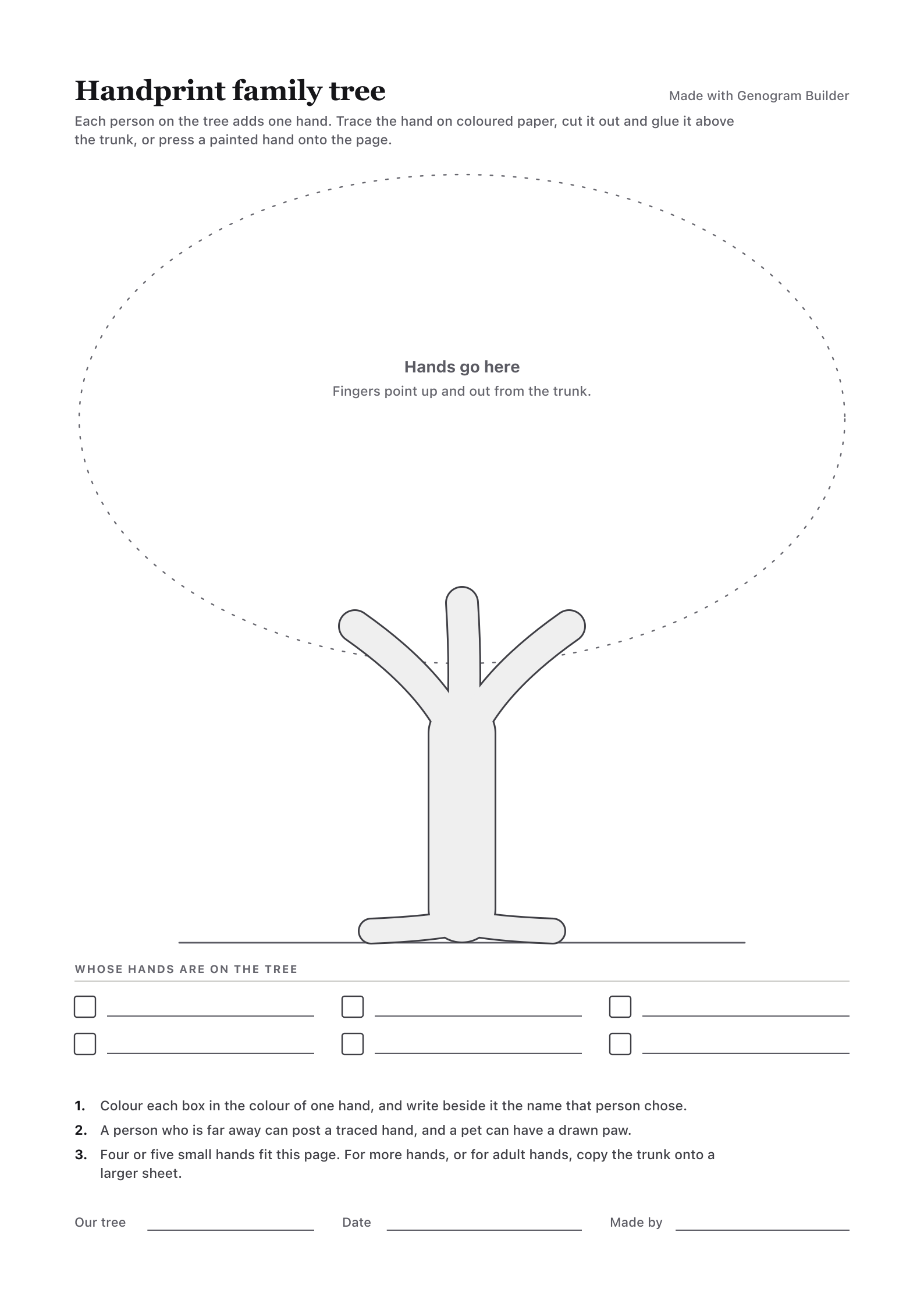
A trunk under an empty crown, with a colour key for the names of the people on the tree.
- One A4 page that also prints whole on US Letter
- Clear in black and white
- Free to download with no account
Traced paper hands suit most families better than paint
There are three ways to put a hand on the tree. Paint gives the most detailed print and the most mess, and a smudged print cannot be redone. A traced and cut hand is clean and can be moved before the glue goes on. A hand drawn straight onto the sheet is the fastest and suits a first try.
| Method | How the hand is made | Suits |
|---|---|---|
| Traced and cut | Trace round the hand on coloured paper, cut it out and glue it down | Mixed ages, and relatives who post a hand from far away |
| Painted print | Roll washable paint onto the palm and press it once onto the sheet | Children who enjoy paint, with an adult for each child |
| Drawn outline | Trace round the hand on the sheet itself and colour it in | Babies, short sessions and a rehearsal before the fair copy |
Make the tree in six steps on paper
In this family tree handprint activity, work from the largest hand to the smallest, so that small hands end up on top where they can be seen.
- Print or draw the trunk
Print the sheet for a few small hands, or copy its trunk onto a poster sheet for a whole family.
- Give everyone a colour
Let each person choose a colour of paper, and settle any dispute before the tracing starts.
- Trace each hand
Lay the hand flat with the fingers a little apart and draw round it with a pencil, down to the wrist.
- Cut the hands out
Cut inside the pencil line. An adult cuts for small children and between the fingers.
- Arrange before gluing
Fan the hands above the trunk with the wrists together and the fingers pointing up and out, with the largest at the back.
- Glue and fill in the key
Glue from the back row forward, then colour a box for each hand and write the name beside it.
The printable sheet holds a trunk, a crown and a key
The sheet is one A4 portrait page that also prints whole on US Letter. A trunk with three short branches stands in the lower half, and a dotted outline above it marks where the hands go. Everything is drawn in black and grey, so it prints clearly without colour.
Under the trunk is a key with six boxes and six lines. Colour each box in the colour of one hand and write the name of that person beside it, so the tree can still be read when the hands overlap. Three lines at the foot take a name for the tree, the date and the makers.
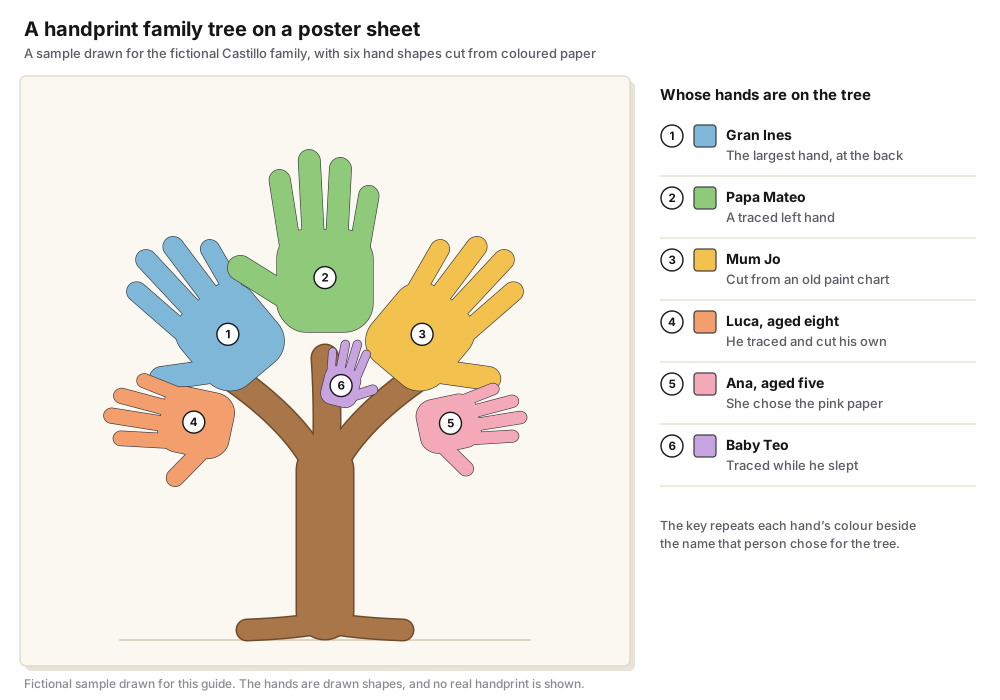
The hand of a child aged five is about 12 cm long and an adult hand is about 18 cm, while the crown on the sheet is about 17 cm wide. The sheet therefore holds four or five small hands, or two adult hands. For a larger family, copy the trunk onto a poster sheet, as the sample does.
The sample shows six hands from three generations
The tree at the top of the page was drawn for the fictional Castillo family on a poster sheet. Gran Ines, Papa Mateo and Mum Jo have the three large hands at the back. Luca, aged eight, and Ana, aged five, sit at the sides, and the hand of Baby Teo, traced while he slept, sits in front.
The names in the key are the ones the family uses at home. Nothing on the tree shows who is the parent of whom, and that is deliberate. A handprint tree records who belongs together and how big each hand was on one day, and a chart with lines can come later.
The family decides whose hands go on the tree
Ask each person whether they want to be on the tree before tracing anything, children included. A child who refuses can add a hand another day or leave a drawn leaf in its place.
People who cannot be in the room can still take part. A grandparent can trace a hand at home and post it, and a relative abroad can send a picture of a traced outline to be copied at full size. A pet can have a drawn paw.
Families often want a place for someone who has died. A leaf, a star or a hand cut from white paper with the name on it all work, and the choice belongs to the people closest to that person, including the children.
Keep real handprints and names off public pages
A finished tree usually carries first names, the shape of each hand and sometimes a date. Kept at home, that is a keepsake. Posted in public with full names, it tells strangers who lives in a household and how old the children are.
In a classroom or a nursery, send each tree home with the child and display it only if a carer agrees. Use first names or the names children choose, and photograph the trees for a newsletter only with consent. This site asks for no upload. The sheet is a file to print, and nothing made with it is sent to us.
For a version with paper leaves in place of hands, see the preschool family tree craft.
Common questions
Which paint to use for a painted print
Use washable paint sold for children, and wash hands straight afterwards. Check the label for the age it is meant for, and keep paint away from the mouth and eyes of a baby.
How to trace the hand of a baby
Wait until the baby is asleep or feeding, lay the hand on card and draw round it lightly with a soft pencil. A drawn outline works better than a print, because a baby closes a painted hand into a fist.
Whether to trace left or right hands
Either works. Many people trace the hand they do not write with, so that they can hold the pencil themselves, and a mix of left and right hands makes the fan look fuller.
Print the bare tree and begin with the largest hand. The sheet is free and needs no account.
Download the sheet as a PDF