How to read this Alfred the Great family tree
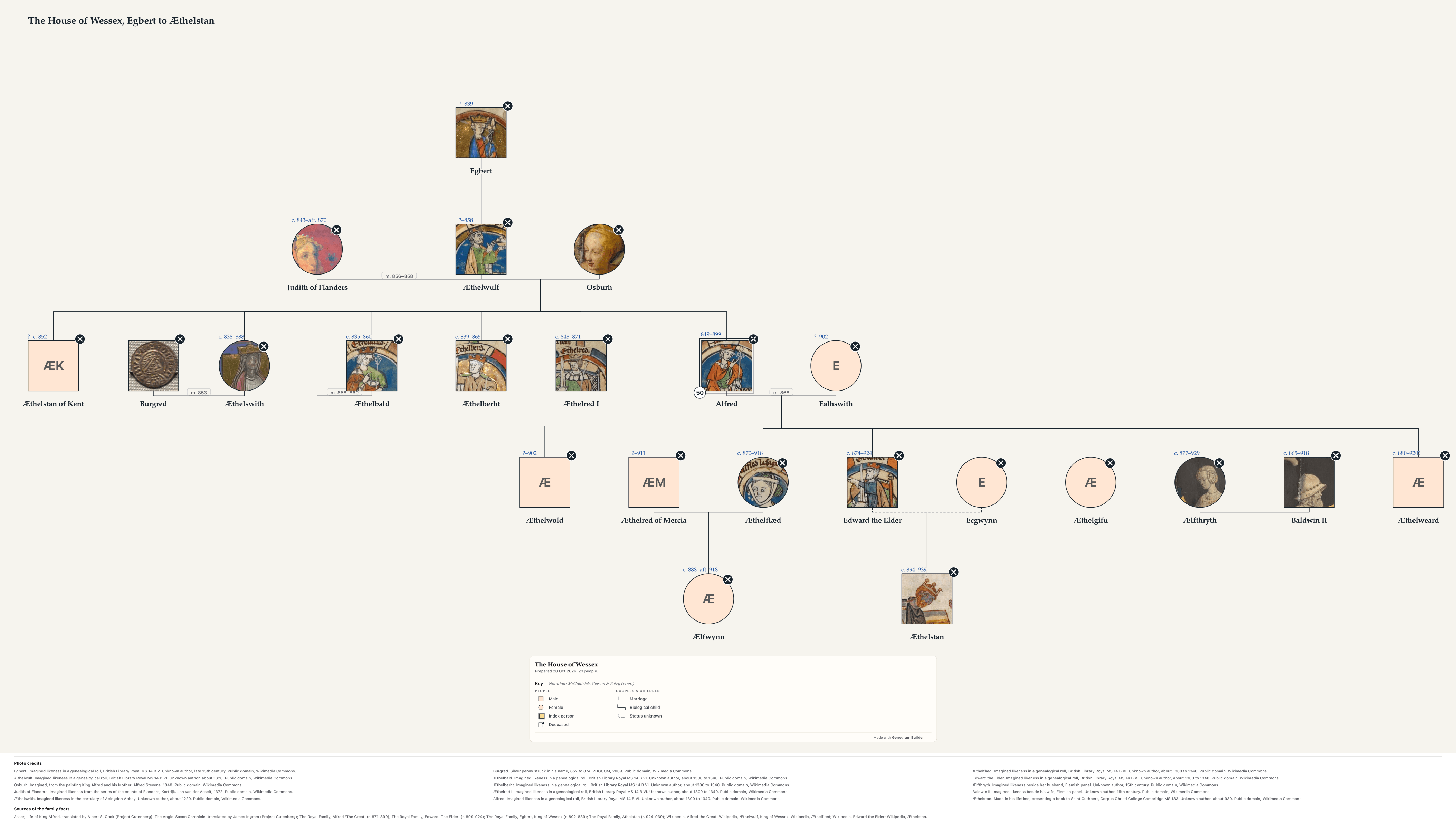
Read the Alfred the Great family tree from the top down, one generation to a row. Alfred is the centre, drawn with a double ring.
Asser gives the year of Alfred’s birth, 849. Most other years are estimates and carry the letter c, and a question mark stands for a birth year that is not known.18
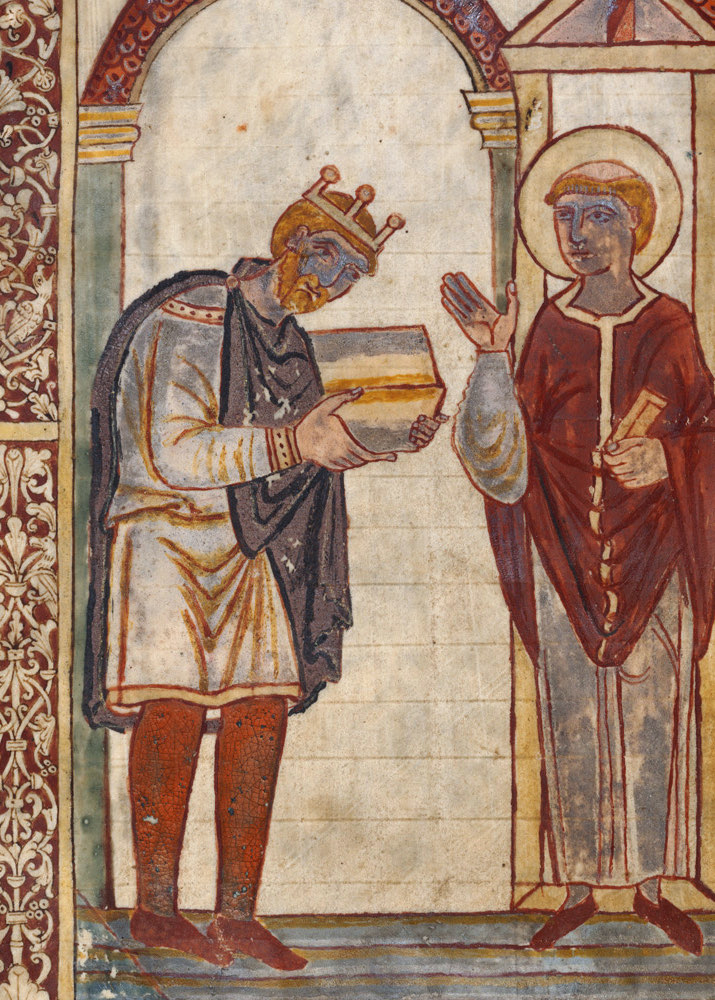
Only Æthelstan and Burgred have a likeness made in their lifetime. The kings on the Alfred the Great family tree carry imagined miniatures from genealogical rolls of about 1300, and a silhouette stands in where no picture is known.
A dashed line is a marriage in doubt
The line between Edward the Elder and Ecgwynn is dashed, since later writers disagree on whether she was his wife.
Egbert and Æthelwulf found the line
The Alfred the Great family tree begins with Egbert, who came to power in 802 and died in 839.5 Offa of Mercia and Beorhtric of Wessex had driven him into exile in Francia before he became king.27
His son Æthelwulf reigned from 839 until his death on 13 January 858.8 Asser names Alfred’s mother as Osburh, the daughter of Oslac, the king’s cupbearer.1 No other source mentions her.9
In 856, returning from Rome, Æthelwulf married Judith, the daughter of Charles the Bald, King of the West Franks. She was crowned and called queen, which was not the custom of Wessex.10
Four brothers on the throne before Alfred
On the Alfred the Great family tree, Alfred is the fifth son of his father.3 The eldest, Æthelstan, was made King of Kent in 839 and is not recorded after 851.11 Their only known sister, Æthelswith, married Burgred, King of Mercia, at Chippenham in 853.112
The other three brothers reigned in turn. Æthelbald ruled Wessex from 858 and married his father’s widow Judith, a marriage Asser condemns.1 He died in 860 and was buried at Sherborne, and Æthelberht reigned five years and was buried beside him.2 Æthelred I took the throne in 866 by the Chronicle’s count and fought the Danish army with Alfred until he died after Easter 871.21
His two sons, Æthelhelm and Æthelwold, were passed over because they were small children.13
Alfred marries into Mercia
In 868 Alfred married Ealhswith, a noblewoman of Mercia.13 Her father was Æthelred Mucel, ealdorman of the Gaini, and her mother Eadburh was of the royal line of Mercia.1
Alfred won at Edington in 878 and by about 886 ruled as King of the Anglo-Saxons.14 He died on 26 October 899, six nights before All Saints, and was buried at Winchester.23 Ealhswith founded the convent of Nunnaminster and died on 5 December 902.15
Alfred’s five children
Asser lists the children in order of birth, Æthelflæd, Edward, Æthelgifu, Ælfthryth and Æthelweard, besides others who died in childhood.1 They fill the fourth row of the Alfred the Great family tree.
The eldest, Æthelflæd, married Æthelred, ruler of western Mercia.118 After his death in 911 she ruled as Lady of the Mercians, took Derby in 917 and Leicester in 918, and died at Tamworth on 12 June 918.17
Alfred made Æthelgifu abbess of his new convent at Shaftesbury.1 Ælfthryth was brought up at court with Edward and married Baldwin II, Count of Flanders, the son of Judith by her third husband.12122 So Alfred’s daughter married the son of his own stepmother. The youngest, Æthelweard, was sent to school with the sons of the nobility to learn Latin and English.1
Edward, his cousin and his niece
When Alfred died, his nephew Æthelwold claimed the throne against Edward. He seized Wimborne, then joined the Danes of Northumbria, who took him as their king.2 He was killed at the battle of the Holme, probably on 13 December 902.16
When Æthelflæd died in 918, her daughter Ælfwynn ruled Mercia for a few months, until Edward took her into Wessex in December.24 Edward died at Farndon on 17 July 924 and was buried in the New Minster at Winchester.194
Æthelstan, the first king of England
Edward’s eldest son, Æthelstan, was born about 894 to Ecgwynn.25 The Mercians accepted him as king in 924.2 He was crowned at Kingston on 4 September 925.25
He took York from the Danes in 927 and won the battle of Brunanburh in 937. He married four of his half-sisters to rulers in western Europe, died childless in 939 and was buried at Malmesbury.6

The kings on the Alfred the Great family tree
| King | Reign | Relation to Alfred | Buried |
|---|---|---|---|
| Egbert | 802 to 839 | Grandfather | Winchester |
| Æthelwulf | 839 to 858 | Father | Steyning, later Winchester |
| Æthelbald | 858 to 860 | Brother | Sherborne |
| Æthelberht | 860 to 865 | Brother | Sherborne |
| Æthelred I | 865 to 871 | Brother | Wimborne Minster |
| Alfred | 871 to 899 | Himself | Winchester |
| Edward the Elder | 899 to 924 | Son | New Minster, Winchester |
| Æthelstan | 924 to 939 | Grandson | Malmesbury |
Where the sources disagree
The Chronicle and Asser make Egbert the son of Ealhmund, and historians differ on whether this was the Ealhmund who ruled Kent in 784.7 Late versions of the Chronicle call Æthelstan of Kent the brother of Æthelwulf, but most historians now accept the early versions, which call him his son.11
The Royal Family writes that Edward married twice and that Æthelstan may have been the son of a mistress.4 Ecgwynn is named in no contemporary record, and later writers disagree on her rank.20
The Chronicle in Ingram’s translation enters Alfred’s death under 901 and Edward’s under 925, two years after the accepted dates. John of Worcester dates Æthelweard’s death to 922, where others give 920.223
Questions about the Alfred the Great family tree
Who were the parents of Alfred the Great
His father was King Æthelwulf of Wessex and his mother was Osburh, the daughter of Oslac. Asser records that he was born at Wantage in 849.
Whether Alfred the Great was the first king of England
He was not. Alfred called himself King of the Anglo-Saxons, and his grandson Æthelstan, who took York in 927, is counted as the first king of all England.
People and sources
A page of its own lists all 23 people on the chart, each with a short note and the sources for it, and the 25 numbered sources this article cites. It also gives the credits of the portraits and this page as a reference in the APA, MLA, Chicago and Harvard styles, ready to copy.