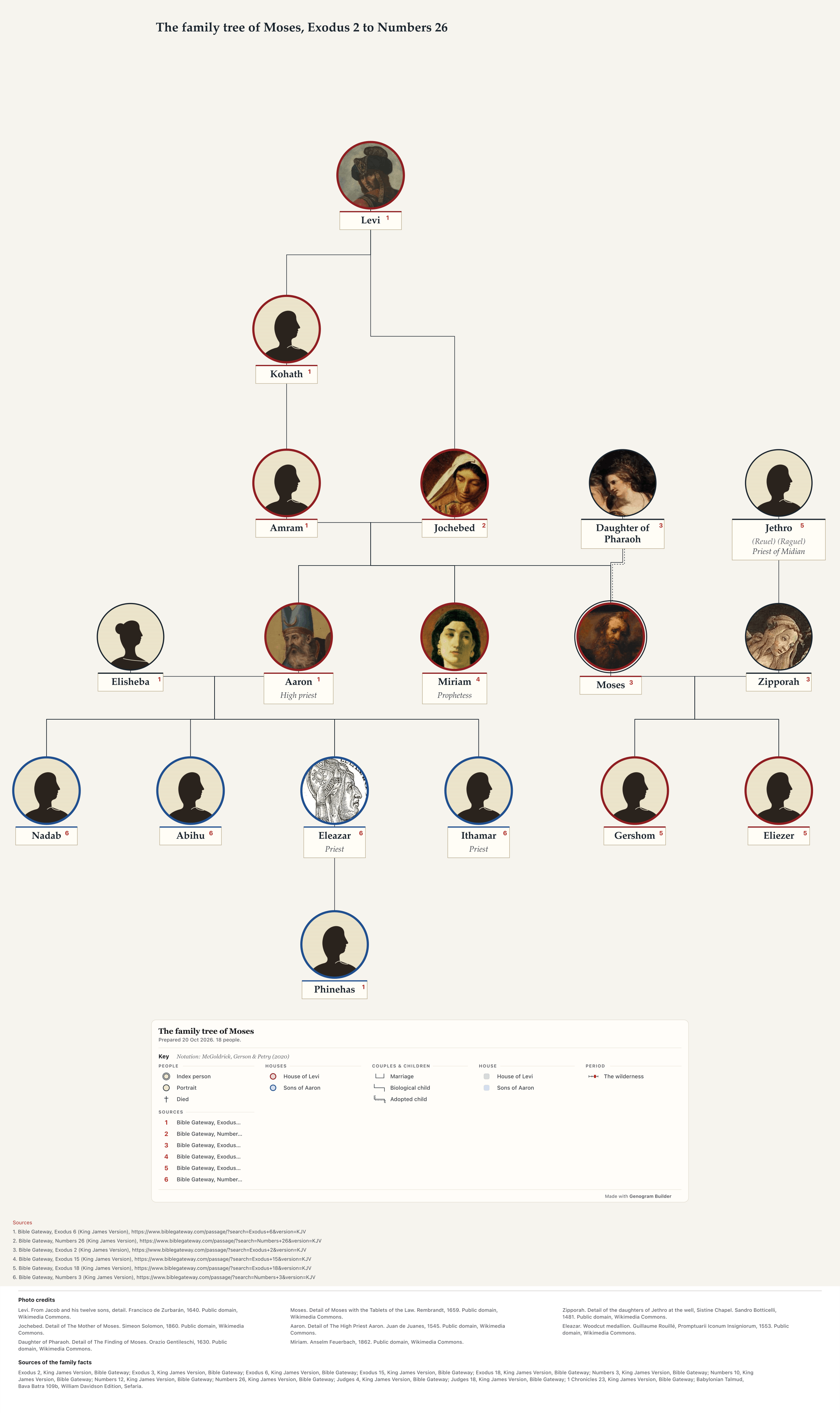
How to read the family tree Moses was born into
Read the chart from the top down, one generation to a row. The Bible gives no dates for these lives, so the plates carry names and titles only.
A picture is a detail
A detail of an old painting or woodcut, or a silhouette where none names the person.
A line between two people is a marriage
Amram and Jochebed, Aaron and Elisheba, Moses and Zipporah.
A line down is a child
A solid line runs from a parent to a child. The line from Pharaoh’s daughter to Moses, solid beside dotted, is adoption, since she raised him and “he became her son.”
Levi, Kohath and Amram
Exodus 6 gives the line in the middle of the story of the plagues. The sons of Levi were Gershon, Kohath and Merari, and the sons of Kohath were Amram, Izhar, Hebron and Uzziel.3 “Amram took him Jochebed his father’s sister to wife; and she bare him Aaron and Moses.”3
Numbers 26:59 adds that Jochebed was “the daughter of Levi, whom her mother bare to Levi in Egypt,” and that she bore Miriam as well.10 The family tree Moses was born into is therefore a close one. His mother was his grandfather’s sister, and Levi was both his great-grandfather and his grandfather.310 Leviticus 18:12 later forbids a marriage to “thy father’s sister,” a law given after this marriage was made.6
Levi was the third son of Jacob and Leah, and the Joseph family tree draws him among his eleven brothers.
Aaron, Miriam and Pharaoh’s daughter
Exodus 2 tells the birth without a name. “A man of the house of Levi” married “a daughter of Levi,” and she hid her son for three months and then laid him in an ark of bulrushes.1 His sister “stood afar off,” and offered to find a Hebrew nurse, and “the maid went and called the child’s mother.”1 Only Exodus 6 and Numbers 26 give the names of the parents.310
The child grew, and his mother brought him to Pharaoh’s daughter, “and he became her son,” and she named him Moses.1 The family tree Moses belonged to thus had two mothers in it, and the chart draws the princess with the dotted line of adoption.
His elder brother was Aaron, and his sister was Miriam the prophetess, who took a timbrel and led the women in song after the crossing of the sea.4 Numbers 26:59 names all three together, “Aaron and Moses, and Miriam their sister.”10 Exodus 2 does not say whether the watching sister was Miriam, and the chart draws one sister only.1

Zipporah, Jethro and the sons of Moses
In Midian Moses helped the seven daughters of the priest at a well, and the priest “gave Moses Zipporah his daughter.”1 Their first son was Gershom, “for he said, I have been a stranger in a strange land.”1 Exodus 18 names the second, Eliezer, and tells how Jethro brought Zipporah and both sons to Moses in the wilderness after Moses had sent her back.5
The father-in-law has three names. He is Reuel in Exodus 2:18 and Jethro in Exodus 3:1 and 18:1.125 Numbers 10:29 speaks of “Hobab, the son of Raguel the Midianite, Moses’ father in law,” and Judges 4:11 calls Hobab himself “the father in law of Moses.”811 The chart draws one man with the names Reuel and Raguel beside Jethro, and leaves Hobab in the notes.
Numbers 12:1 adds that Miriam and Aaron spoke against Moses “because of the Ethiopian woman whom he had married.”9 The verse does not say whether she was Zipporah or a second wife, and the chart draws Zipporah alone.
The family tree Moses shared with the priests
Aaron married Elisheba, the daughter of Amminadab and sister of Naashon, and had four sons, the priests “which were anointed.”37 Nadab and Abihu “died before the Lord, when they offered strange fire,” and had no children, so Eleazar and Ithamar carried on the priesthood.7 Eleazar’s son was Phinehas.3 Elisheba’s brother is the Nahshon of the Ruth family tree, so the priests descend from Judah on their mother’s side.
| Father | Sons | Verses |
|---|---|---|
| Aaron | Nadab, Abihu, Eleazar, Ithamar | Exodus 6:23, Numbers 3:2 |
| Moses | Gershom, Eliezer | Exodus 18:3-4, 1 Chronicles 23:15 |
| Eleazar | Phinehas | Exodus 6:25 |
| Gershom | Shebuel, not drawn | 1 Chronicles 23:16 |
| Eliezer | Rehabiah, not drawn | 1 Chronicles 23:17 |
Where the texts and traditions differ
Judges 18:30 names a priest of the tribe of Dan as “Jonathan, the son of Gershom, the son of Manasseh.”12 Since 1 Chronicles 23:15 makes Gershom a son of Moses, the Talmud asks whether Jonathan was not the son of Moses, and answers that the verse linked him to Manasseh because he acted like that idolatrous king.1314 The chart does not draw Jonathan, since the reading is disputed.
The marriage of Amram and Jochebed is the other question readers raise. Exodus 6:20 states it plainly, and Numbers 26:59 confirms that Jochebed was Levi’s daughter, so the chart draws Amram’s wife as his aunt.310 For the generations before Levi, see the Abraham, Isaac and Jacob family tree and the Genesis family tree.
Questions about the family tree Moses came from
Who the parents in the family tree Moses came from were
Amram, a grandson of Levi, and Jochebed, a daughter of Levi, who was Amram’s aunt.
Whether Miriam and Aaron were full siblings of Moses
Numbers 26:59 names all three as children of Amram and Jochebed.
How many sons Moses had
Two, Gershom and Eliezer, both sons of Zipporah.
People and sources
A page of its own lists all 18 people on the chart, each with a short note and the sources for it, and the 14 numbered sources this article cites. It also gives the credits of the portraits and this page as a reference in the APA, MLA, Chicago and Harvard styles, ready to copy.