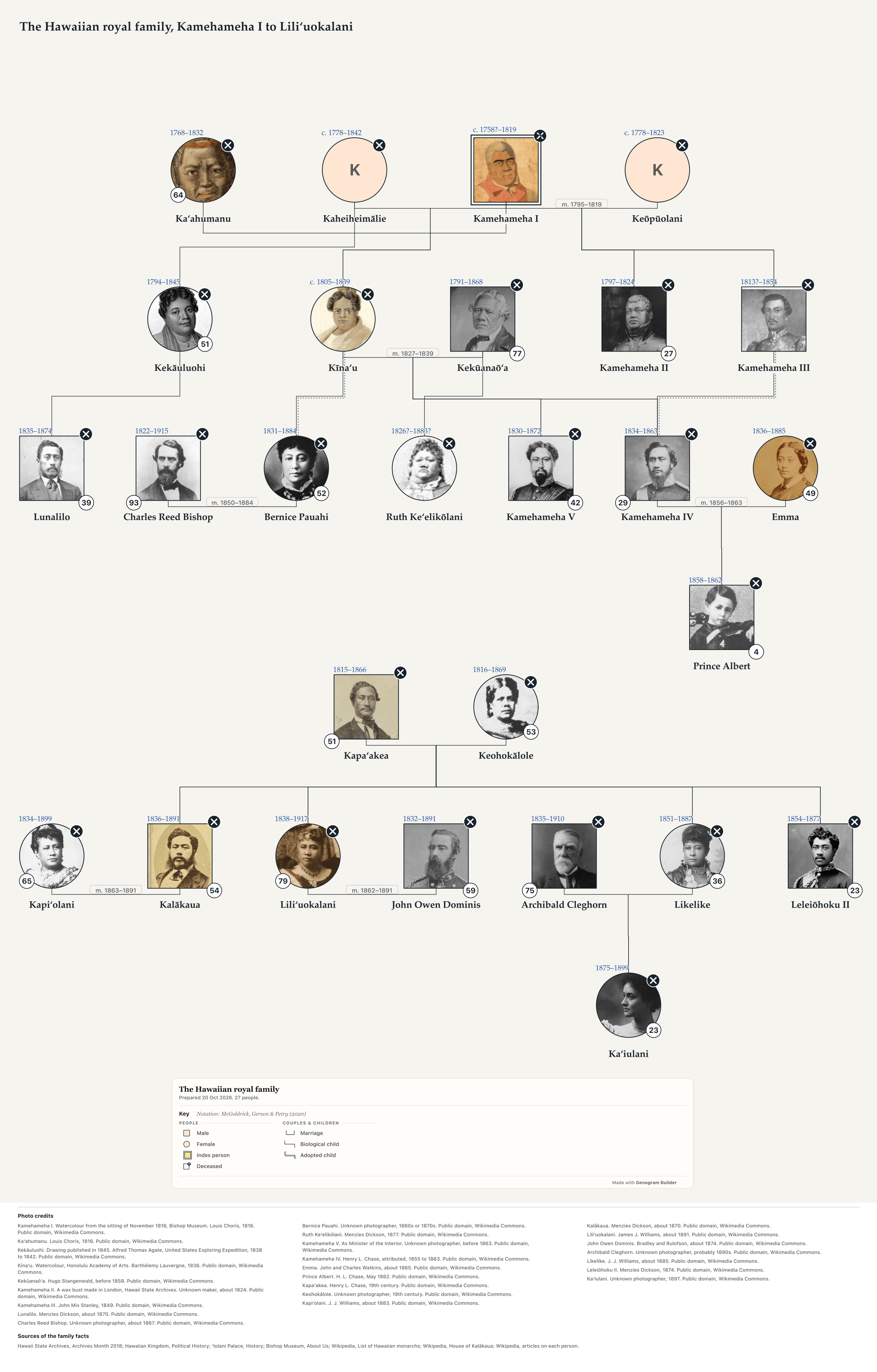
How to read this Hawaiian royal family tree
Read the Hawaiian royal family tree from the top down. The House of Kalākaua stands apart at the foot, as it descends from counsellors of Kamehameha I, not from the king.17
In hānai, a Hawaiian custom, relatives or chiefs raise a child as their own. The chart reads the published record and does not stand in for any family’s or community’s recognition of genealogy or identity.
A portrait is a picture
All twenty-five are in the public domain.
A silhouette has none
No likeness of two queens survives.
A dotted line is hānai
It runs from the parent who took the child.
A double frame is the founder
Kamehameha I is the centre of the Hawaiian royal family tree.
Kamehameha I and his wives
Kamehameha I was born at Kokoiki in Kohala to Kekuʻiapoiwa II and Keōua.1 Accounts of his birth year run from 1736 to 1761, so the chart marks it as uncertain.8 He brought the islands under one rule by 1810, when Kaumualiʻi of Kauaʻi accepted him by agreement, and he died on 8 May 1819.281
The State Archives credits his marriage to Keōpūolani, the highest-ranking woman in the islands, with a dynasty that gave the kingdom five of its eight sovereigns.1 She bore Liholiho and Kauikeaouli.9 Kaʻahumanu, his favourite wife, had no children of her own.10 Her sister Kaheiheimālie bore him Kīnaʻu, and had earlier borne Kekāuluohi to his half-brother Kalaʻimamahu.1112
Kamehameha II, Kamehameha III and the kuhina nui
Liholiho reigned as Kamehameha II from 1819 and died of measles in London in July 1824.2 His brother succeeded as Kamehameha III, in 1824 by the Hawaiian Kingdom’s account and on 6 June 1825 by the list of monarchs. He promulgated a constitution on 8 October 1840 and died on 15 December 1854.26
The office of kuhina nui, a premier who shared power with the king, passed among the women of the family. Kaʻahumanu held it from 1819 to 1832, Kīnaʻu until 1839 and Kekāuluohi until 1845.101312 Kīnaʻu married Mataio Kekūanaōʻa, later Governor of Oʻahu, in 1827.137
Alexander Liholiho, Emma and Lot Kapuāiwa
Kamehameha III named his nephew Alexander Liholiho as successor, and the list of monarchs records him as an adopted son.26 He reigned as Kamehameha IV from 1855 and in 1856 married Emma, a granddaughter of John Young, adviser to Kamehameha I. Their son Prince Albert was born in 1858 with Queen Victoria as his godmother and died at four. The king died the next year.1
The kuhina nui then proclaimed his brother Lot Kapuāiwa king as Kamehameha V. Lot never married and died on 11 December 1872 without naming a successor.26
Bernice Pauahi Bishop and Ruth Keʻelikōlani
Bernice Pauahi was born in 1831 to Abner Pākī and Laura Kōnia. Kīnaʻu took her as a hānai daughter at birth, and she went back to her parents in 1838. She refused the throne that the dying Kamehameha V offered her in 1872.15 She married Charles Reed Bishop in 1850, on 4 May by her article and on 4 June by his.1516
Ruth Keʻelikōlani was a daughter of Kalani Pauahi, and of Kekūanaōʻa by the usual account, which some dispute. She governed Hawaiʻi Island from 1855 to 1874, raised Leleiōhoku II as her hānai son, and left her lands to Pauahi.14
After Pauahi died in 1884, her husband founded the Bishop Museum in her memory, and its first collections came from the estates of Pauahi, Emma and Ruth.45
Two elected kings, Lunalilo and Kalākaua
With no heir named, the legislature elected William Charles Lunalilo, son of Kekāuluohi, on 8 January 1873. He died on 3 February 1874, again without naming a successor.212 Queen Emma then stood against David Kalākaua, and the legislature chose him on 12 February 1874 by 39 votes to 6.181
Kalākaua, Kapiʻolani and the heirs
Kalākaua was a son of the high chief Kapaʻakea and the high chiefess Keohokālole.17 He married Kapiʻolani in 1863, and they had no children.6 He named his brother Leleiōhoku heir and, after his brother’s death in 1877, his sister Liliʻuokalani.218 In 1887 he signed the Bayonet Constitution under duress, and he died in San Francisco on 20 January 1891.183

Liliʻuokalani, Kaʻiulani and the end of the kingdom
Liliʻuokalani was raised in hānai by Abner Pākī and Laura Kōnia beside their daughter Bernice Pauahi. Her husband John Owen Dominis died seven months into her reign.19 She succeeded her brother on 29 January 1891 and named as heir her niece Kaʻiulani, daughter of Likelike and Archibald Cleghorn.1920
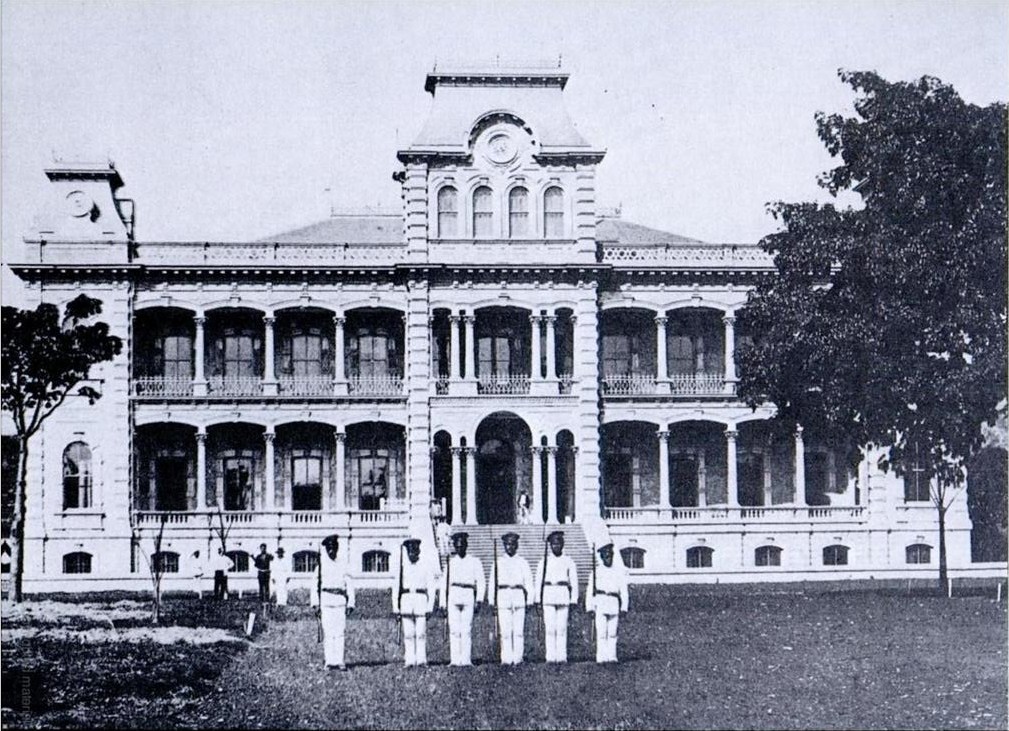
The history of ʻIolani Palace says that the Committee of Safety, backed by the American minister, overthrew her government on 17 January 1893.3 The Hawaiian Kingdom site calls that day an unsuccessful revolution and holds that the kingdom continued.2 On 24 January 1895 she signed an abdication after her jailed supporters were threatened with death.19
How the crown passed
| Sovereign | Reigned | How the crown came |
|---|---|---|
| Kamehameha I | 1810 to 1819 | United the islands |
| Kamehameha II | 1819 to 1824 | Son |
| Kamehameha III | 1825 to 1854 | Brother |
| Kamehameha IV | 1855 to 1863 | Named heir, adopted son |
| Kamehameha V | 1863 to 1872 | Brother, proclaimed |
| Lunalilo | 1873 to 1874 | Elected |
| Kalākaua | 1874 to 1891 | Elected |
| Liliʻuokalani | 1891 to 1893 | Sister, named heir |
How this Hawaiian royal family tree was drawn
The pages that rank for a Hawaiian royal family tree are encyclopedia articles and lists of monarchs, and few draw hānai beside birth. This Hawaiian royal family tree draws both and opens in the editor.
Questions about the Hawaiian royal family tree
People and sources
A page of its own lists all 27 people on the chart, each with a short note and the sources for it, and the 20 numbered sources this article cites. It also gives the credits of the portraits and this page as a reference in the APA, MLA, Chicago and Harvard styles, ready to copy.