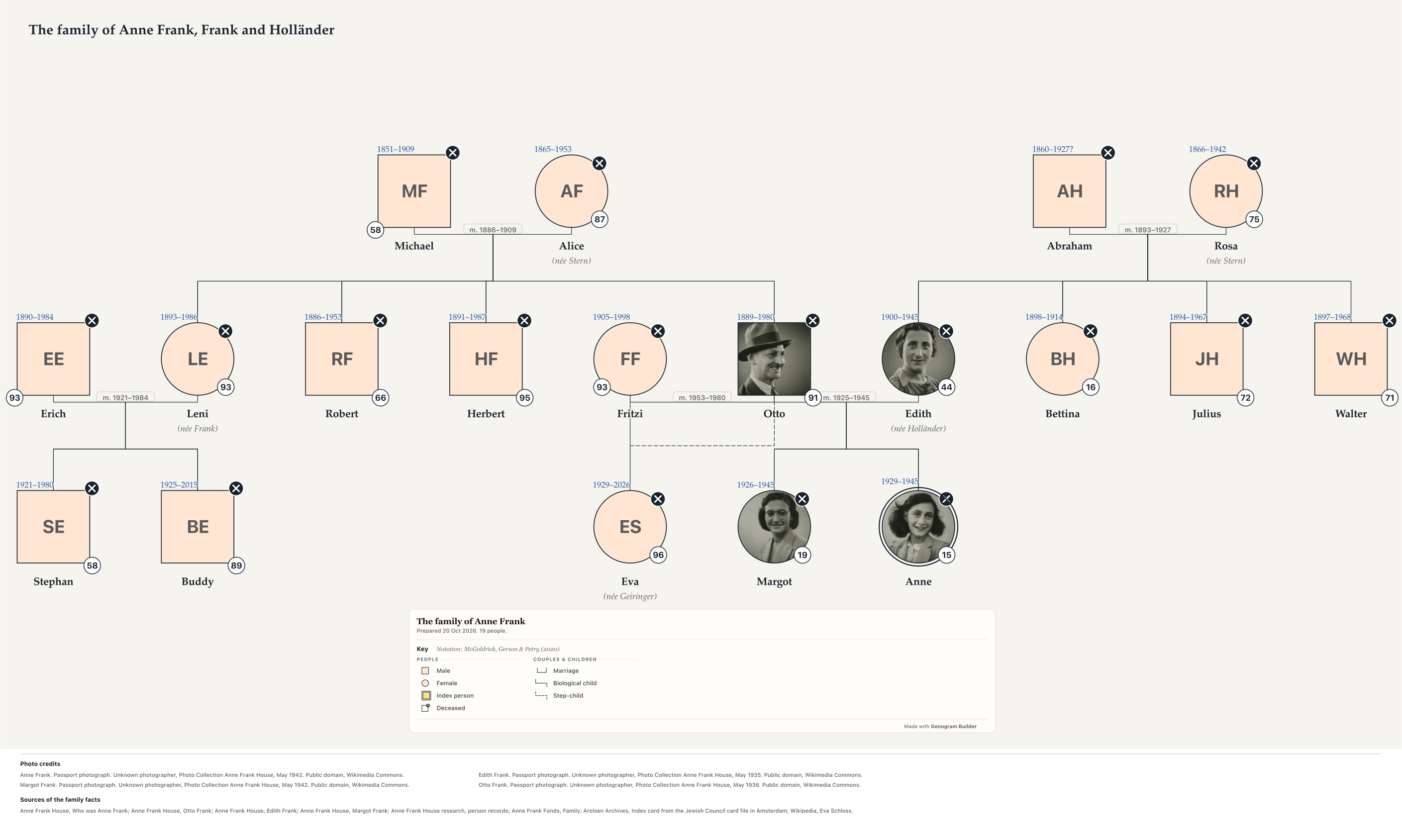
How to read this Anne Frank family tree
Read the Anne Frank family tree from the top down, one generation to a row. The Franks of Frankfurt fill the left of the chart and the Holländers of Aachen the right, joined by the marriage of Otto Frank and Edith Holländer in 1925.
A portrait is a photograph
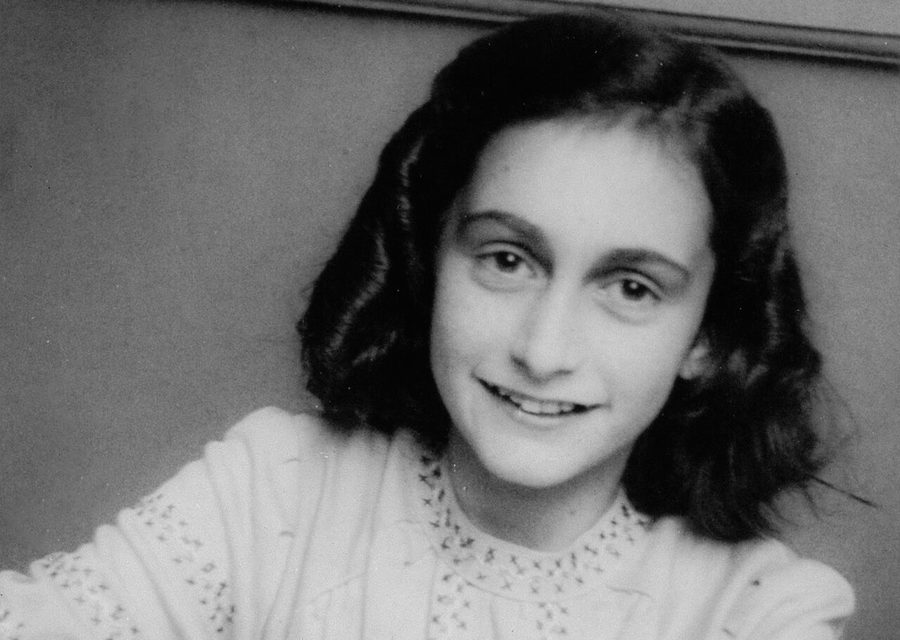
Anne, Margot, Edith and Otto each have a passport photograph.
A silhouette has none
No free photograph of the other fifteen is known.
A double frame is the centre
Anne is the centre of the chart.
The Franks of Frankfurt
On her father’s side the Anne Frank family tree begins with Michael Frank, a banker from Landau, and Alice Betty Stern of Frankfurt am Main, who married in 1886. Michael died suddenly in 1909, and Alice kept the bank going until her sons Otto and Herbert took it over after the First World War.68
They had four children.16 Robert became an art dealer and settled in London in 1933.7 Otto, born on 12 May 1889, served in the German army from 1915 to 1918.318 Herbert left for France in 1932.8 Leni married Erich Elias in 1921 and followed him to Basel, where he ran a branch of the Opekta company from 1929.169
The Holländers of Aachen
On her mother’s side the Anne Frank family tree begins with Abraham Holländer, a partner in the family firm of B. Holländer in Aachen, which traded in scrap metal and machinery.12 He married Rosa Stern at Bad Schwalbach in July 1893, on 18 July by his record at the Anne Frank House and on 19 July by hers.1213 The same site gives his death as 1927, and the Wikipedia article on Edith gives 1928.1219
Their children were Julius, Walter, Bettina and Edith, who was born on 16 January 1900. Bettina died in 1914 at sixteen.124
Otto, Edith and their daughters
Otto and Edith married at Aachen on 8 May 1925 and lived in Frankfurt, where Margot was born on 16 February 1926 and Anne on 12 June 1929.452 In 1933 the family moved to Amsterdam and settled on the Merwedeplein, where Otto sold pectin.43
Rosa Holländer joined them in March 1939 and died in Amsterdam on 29 January 1942, five months before the family went into hiding.13
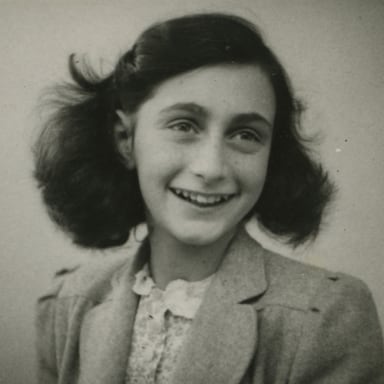 Anne FrankPassport photograph, May 1942.
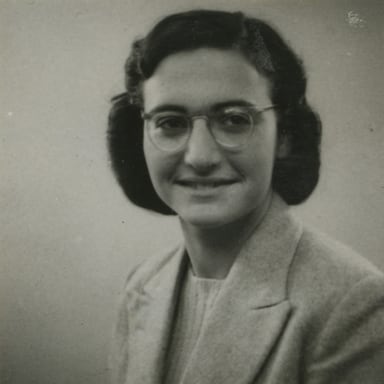 Margot FrankPassport photograph, May 1942.
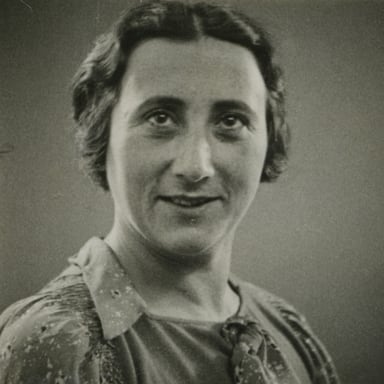 Edith FrankPassport photograph, May 1935.
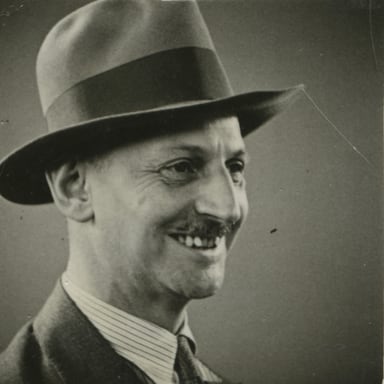 Otto FrankPassport photograph, May 1936.
Hiding, arrest and the camps
Margot received a call-up for a labour camp on 5 July 1942, and the next day the family went into hiding in the Secret Annex at Prinsengracht 263.13 On 4 August 1944 the police raided the Annex and arrested the eight people in hiding, who were taken to the Westerbork transit camp.5 The Arolsen Archives, which keep Anne’s card from the Jewish Council in Amsterdam, record that on 3 September 1944 she and her family were deported from Westerbork to Auschwitz-Birkenau with more than a thousand other Jews.17
At the end of October 1944 Edith was parted from her daughters, and she died in Auschwitz-Birkenau on 6 January 1945.4 Margot and Anne were sent on to Bergen-Belsen in November and died there in February 1945, Margot shortly before Anne.51 The Arolsen Archives give typhus as the cause of Anne’s death.17 Otto survived at Auschwitz, which Soviet troops reached on 27 January 1945.3

The relatives who survived
Edith’s brothers left Germany after the pogrom of November 1938. Walter was held at Sachsenhausen until 1 December 1938, when Julius won his release with a guarantee from Otto.15 Julius reached the United States in 1939, and Walter followed after almost a year in the refugee camp at Zeeburg in Amsterdam.1415
Robert spent the war in London, and Herbert was held for a time in the internment camp at Gurs in France.78 In Basel, Leni kept the family with an antiques shop that she opened in 1943.16 Her son Stephan worked there as a clerk.10 Buddy, born in 1925, toured with Holiday on Ice from 1947, acted on stage and served as president of the Anne Frank Fonds. He died in Basel in 2015.11
Otto Frank after the war
Otto reached Amsterdam again on 3 June 1945, having learned on the journey that Edith had died.3 The first Dutch edition of Anne’s diary, Het Achterhuis, appeared on 25 June 1947.18 In 1952 he moved to Basel to live with Leni’s family.316
On 10 November 1953 he married Elfriede Geiringer, called Fritzi. The Anne Frank House names her Fritzi Markovits in one place and Fritzi Geiringer in another, Geiringer being the name of her first husband.320 She and her daughter Eva, born in Vienna in 1929, had survived Auschwitz, and Eva joined the Anne Frank family tree as Otto’s stepdaughter. Eva married Zvi Schloss in 1952 and died in London in January 2026.20 Otto founded the Anne Frank Fonds in Basel in 1963 and died at Birsfelden on 19 August 1980.183
How this Anne Frank family tree was drawn
The results for this search are mostly genealogy sites, short articles and an illustrated story of the Franks in Frankfurt. Few give a source for each relative or say where each person died. This chart does both and opens in the editor, and the guide to genograms for family history shows how to draw a second marriage and a stepchild. For everyone who died in 2000 or later, Buddy Elias and Eva Schloss among them, the page gives only public facts.
Questions about the Anne Frank family tree
Whether Anne Frank has living descendants
Anne and Margot died in their teens and had no children.52 This chart stops with their generation and draws no one who is living.
How many of the family died in the camps
Of the people on this chart, three died in the camps, Edith at Auschwitz-Birkenau and Margot and Anne at Bergen-Belsen.45
How to use the Anne Frank family tree in a class
The PNG and the PDF of the Anne Frank family tree carry the portrait credits and the sources, and a free account opens the chart in the editor.
People and sources
A page of its own lists all 19 people on the chart, each with a short note and the sources for it, and the 20 numbered sources this article cites. It also gives the credits of the portraits and this page as a reference in the APA, MLA, Chicago and Harvard styles, ready to copy.