The edition and what this page covers
The Alex Haley family tree on this page follows Roots, The Saga of an American Family, as Doubleday first published it in 1976. The Wikipedia article on the book gives two dates for the first edition, 17 August and 12 September.1 Haley received a special Pulitzer citation for the book in 1977.1
The page tells the whole story generation by generation. It also keeps three things apart. The chart and the generation cards are the book. Haley’s own account of his research is reported as his. The findings of later genealogists and historians are set out in their own section and attributed to them. Roots is in copyright, so this page shows no picture and quotes nothing.
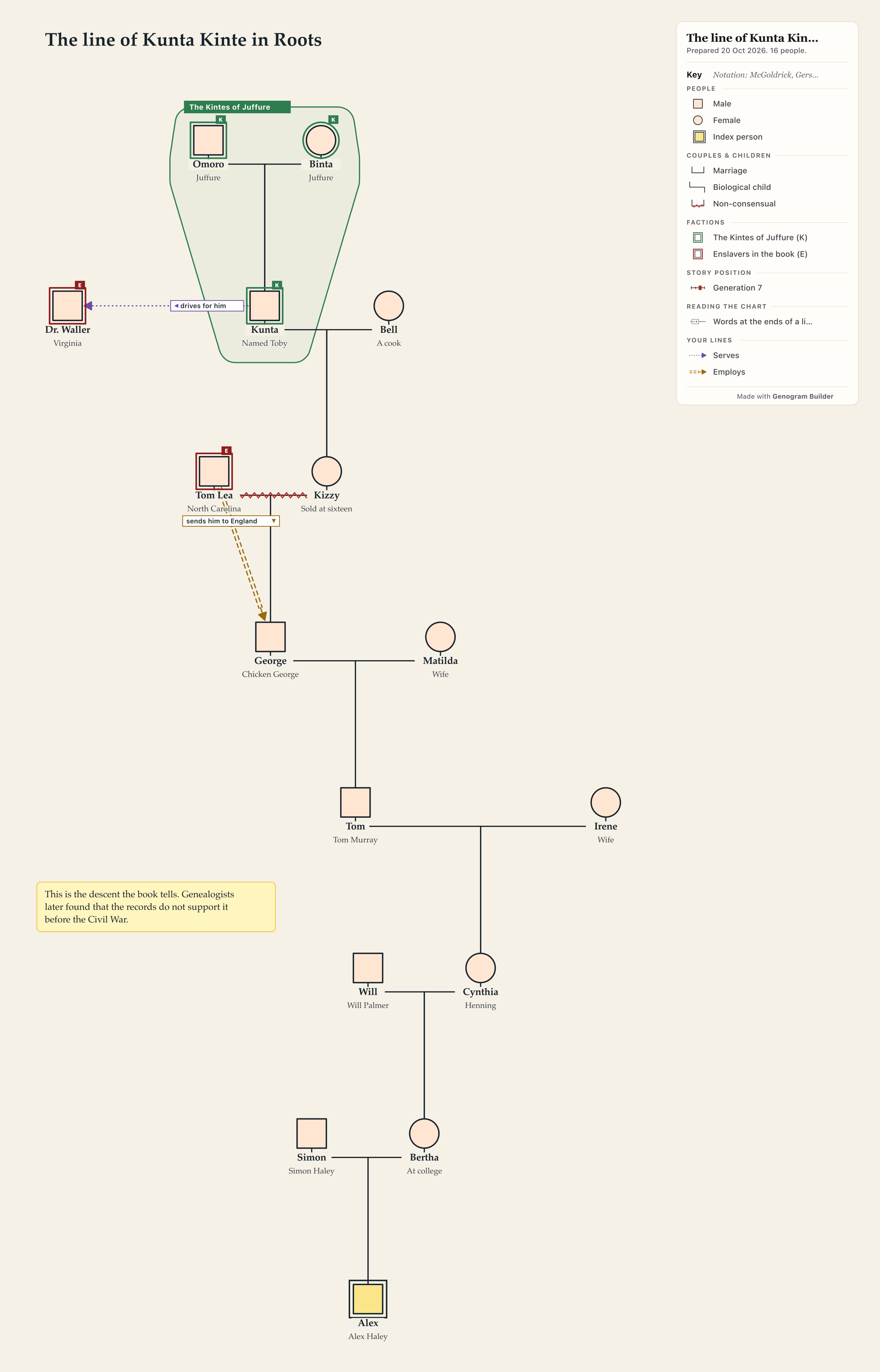
Omoro, Binta and Kunta Kinte in Juffure
The Alex Haley family tree of the book begins in Juffure, a village in The Gambia. Omoro Kinte is the father of Kunta Kinte, and the book’s family tree names Binta Kebba as his mother.1
In the book Kunta is captured as a young man around 1767 and carried on the slave ship Lord Ligonier to Annapolis, where he is sold to John Waller, who names him Toby.1 Haley later said that he chose the year 1767 to match the research he had done in America.1
Kunta, Kizzy and Chicken George
Kunta tries to escape four times, and after the last attempt slave hunters cut off part of his right foot. He later drives for Dr. William Waller and marries Bell, the doctor’s cook, after the American Revolutionary War.1
Their daughter Kizzy forges a travel pass for a young man named Noah. When he is caught she is sold at sixteen to Tom Lea in North Carolina. Lea rapes her and fathers her son George.1 The Alex Haley family tree on this page draws that union with the mark for a relationship that was not consented to, so the line from Kizzy to George does not read as a marriage.
George becomes a trainer of fighting cocks and is known as Chicken George. He marries Matilda. When Tom Lea loses money on a cockfight, George is sent to England for several years to work off the debt.1
Tom Murray, Cynthia and the move to Henning
Tom Murray, the son of George and Matilda, marries Irene. After the Civil War the family moves from North Carolina to Henning, Tennessee.1 Their daughter Cynthia marries Will Palmer.1
From this generation on, the Alex Haley family tree of the book and the record start to meet. The National Archives describes how Haley came to its building in 1964 and found in the 1870 census of Alamance County, North Carolina, details he had heard in the family’s oral history.3 The genealogists who later tested the book also found the records in agreement only after the Civil War.2
Bertha Palmer, Simon Haley and Alex Haley
Bertha, the daughter of Cynthia and Will Palmer, is the first of the family in the book to go to college. She marries Simon Haley, a professor of agriculture, and their son is Alex Haley, who closes the book as its author.1
Outside the book, Alexander Murray Palmer Haley was born in Ithaca, New York, on 11 August 1921 to Simon Haley, who taught agriculture at Alabama A and M University, and Bertha Palmer, who had grown up in Henning. He was the eldest of three brothers. He served in the Coast Guard from 1939 to 1959, wrote The Autobiography of Malcolm X with Malcolm X, and died in Seattle on 10 February 1992.2
This page gives only those public facts about the author at the foot of the Alex Haley family tree and names no living relative. His second family book, Queen, about his father’s side, was finished by David Stevens after his death and published in 1993.2
The Alex Haley family tree generation by generation
Each card gives one generation of the Alex Haley family tree as the book tells it.
Generations 1 and 2
Juffure and Virginia
The book’s account.
- Omoro and Binta Kinte in Juffure, and Kunta taken around 1767.
- Kunta named Toby, maimed after his escapes, and married to Bell.
Sources1
Generations 3 and 4
North Carolina
The book’s account.
- Kizzy sold to Tom Lea, who fathers George.
- Chicken George marries Matilda and is sent to England over a debt.
Sources1
Generations 5 and 6
Henning
The book’s account, close to the record from here.
- Tom Murray and Irene take the family to Henning after the Civil War.
- Cynthia marries Will Palmer.
Generation 7
The author
The book and the public record.
- Bertha Palmer marries Simon Haley.
- Their son Alex Haley is born in 1921 and writes the book.
The accuracy of the Alex Haley family tree in Roots
Haley called the book faction, a mix of fact and fiction, and acknowledged that most of its dialogue and incidents were invented. He also said he had thought of calling it a historical novel.1
In 1981 the historian Gary B. Mills and the genealogist Elizabeth Shown Mills checked the book against census returns, deeds and wills in Virginia and North Carolina. They concluded that the records contradict every statement of lineage in Roots before the Civil War. They found that the Wallers owned a man named Toby in 1762, before the ship of the book arrived, that this Toby appears to have died before the year the book gives for Kizzy’s birth, and that the records show neither Kizzy nor George among the people owned by Tom Lea.1
The same year the historian Donald R. Wright reported in History in Africa that elders and griots in The Gambia could not give details of people before the middle of the nineteenth century, and that Haley’s story of Kunta Kinte had passed into local tradition after he told it there.1 In 1977 a London newspaper had already questioned whether Kebba Kanji Fofana, the man in Juffure whom Haley treated as a griot, was one.1
Haley also faced a claim of copying. The anthropologist Harold Courlander said that passages of Roots came from his novel The African, and the case was settled out of court in 1978 for 650,000 dollars, with Haley acknowledging that some passages had been taken from it. A second claim, by Margaret Walker, was dismissed.12
None of this unmade the book’s effect. The National Archives notes that scholars questioned some story lines and still credits Roots with sending many Americans to search for their own families.3 Read the chart on this page as the Alex Haley family tree of the book, and treat any line before Tom Murray as unconfirmed by records.
How to read this Alex Haley family tree
A square is a man and a circle is a woman. A line between a couple with a line down to the child is a marriage. The line between Tom Lea and Kizzy carries the mark for an incident without consent, and George hangs from it as their son. No death is marked, because the book and the sources give the deaths of only some of these people.
The green ring holds the Kintes of Juffure, and the red letter E marks the two enslavers the chart draws. The dotted arrow from Kunta to William Waller and the double dashed arrow from Tom Lea to George are the work each was made to do. The ABC miniseries of January 1977 tells the same line, and this chart draws the book.1
To build an Alex Haley family tree of your own, or a tree of your own family, open the chart in the editor from this page or start from the story charts. The symbols are set out in the genogram symbols.
Questions about the Alex Haley family tree
How is Alex Haley related to Kunta Kinte
On the Alex Haley family tree of the book, Kunta Kinte is the father of Kizzy, whose son Chicken George is the great-grandfather of Bertha Palmer, Alex Haley’s mother. Genealogists have found no record that confirms the line before the Civil War.1
Who were Alex Haley’s parents
Simon Haley, a professor of agriculture, and Bertha Palmer of Henning, Tennessee.2
People and sources
A page of its own lists all 16 characters on the chart, each with a short note and the sources for it, and the three numbered sources this article cites. It also gives this page as a reference in the APA, MLA, Chicago and Harvard styles, ready to copy.