The edition behind this Homegoing family tree
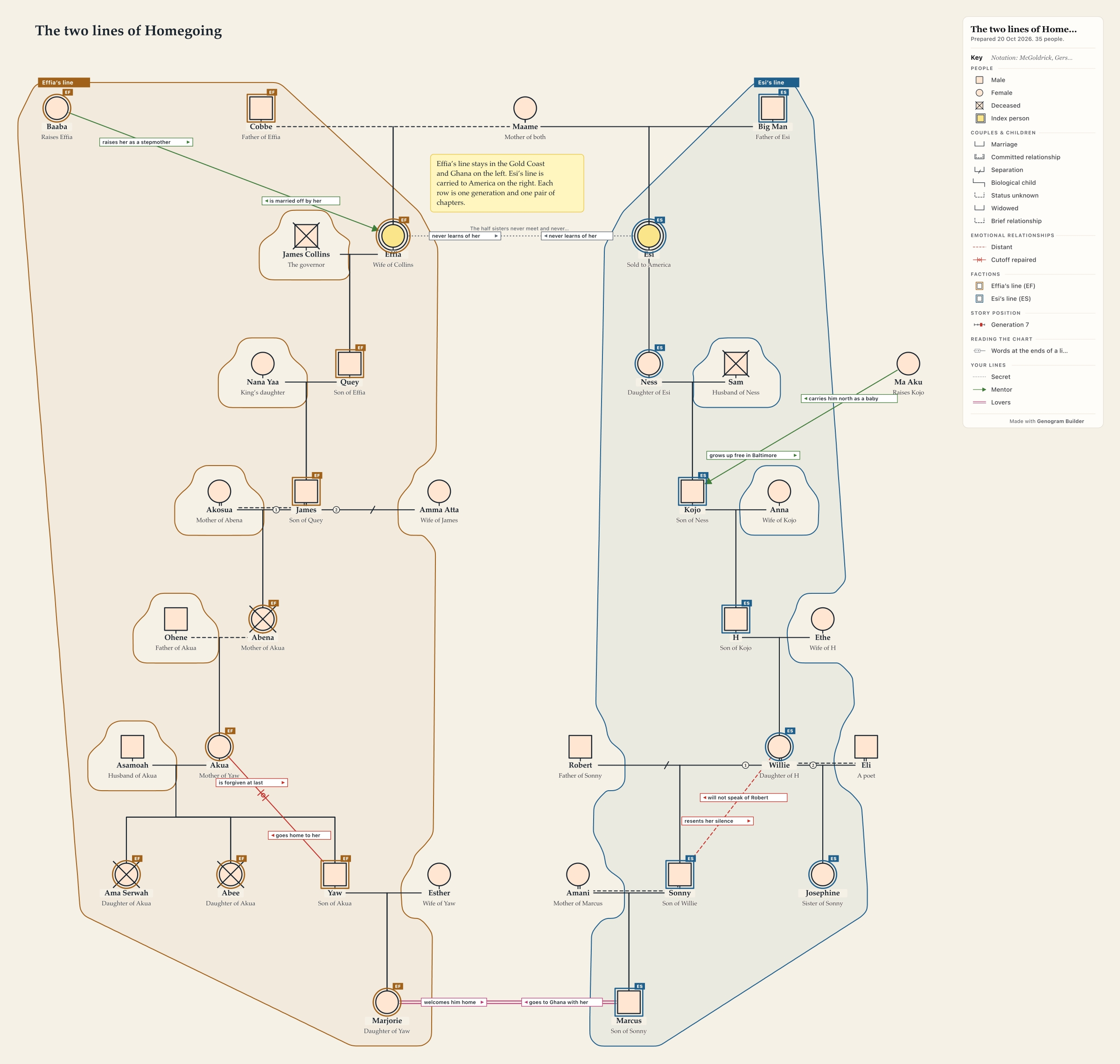
The Homegoing family tree on this page follows the novel as Alfred A. Knopf first published it in New York in June 2016, in fourteen chapters set in two parts.4 Each chapter follows one descendant, alternating between the lines, so each row of the chart pairs two chapters.6
The chart opens at Generation 7 with every descendant drawn and every death marked. Set Story position to Generation 1 before you start, and it shows only the first two chapters. The cards below give away each generation in turn. The novel is in copyright, so this page shows no picture and no quotation, and it does not copy the family tree printed at the front of the book.
Maame at the top of the Homegoing family tree
Maame is the mother of both lines. She is a house girl in the household of Cobbe Otcher in Fanteland when she gives birth to Effia, and she runs away on the night of the birth. Baaba, the wife of Cobbe, raises Effia, who learns only later who her real mother was.63
In Asanteland Maame becomes the wife of Kwame Asare, called Big Man, and their daughter is Esi.5 The girls are half sisters through their mother, and they never meet.8 The dotted grey line between them on the Homegoing family tree stands for a bond that neither of them knows about.
Maame leaves each daughter a black stone. Effia receives hers from Baaba before her wedding, and Esi loses hers in the dungeon of Cape Coast Castle.64 Effia’s stone travels the whole length of her line.
Effia’s line on the Homegoing family tree
Baaba arranges Effia’s marriage to James Collins, the British governor of Cape Coast Castle, who runs the slave trade there, and Effia lives in comfort in the Castle above the dungeon.31
Their son Quey is sent to school in London and comes back after his father dies. He marries Nana Yaa, the daughter of an Asante king, to secure an alliance for the trade.67 Their son James is expected to marry Amma Atta, but he loves Akosua Mensah. He lets it be thought that he has died and goes to live with her as a farmer.8
Their daughter Abena never marries. Ohene Nyarko promises to take her as a second wife and breaks the promise, and Abena goes to Kumasi carrying his child.8 That child is Akua, who is raised by missionaries after her mother dies.7
Akua marries Asamoah, a man who lost a leg in war. In a dream she sets their hut on fire. Her two daughters, Abee and Ama Serwah, die, and her son Yaw survives with deep scars, and the village calls her Crazy Woman.85
Yaw becomes a teacher, marries his house girl Esther and in the end goes back to his mother and makes peace with her.8 Their daughter Marjorie is born in Ghana and raised in Alabama. She spends her summers in Ghana with Akua, who gives her the stone.6 Marjorie is the seventh generation from Effia and the last of her line on the Homegoing family tree.
Esi’s line on the Homegoing family tree
Esi is captured in a raid, held in the dungeon of the Castle where her half sister lives, and shipped to America to be sold.3 Her daughter Ness is taken from her when young. Ness is made to marry Sam, and they have a son, Kojo.8 Sam is hanged after the family tries to escape, and Ness is whipped and kept on a plantation in Alabama.6
Kojo gets away as a baby with Ma Aku, who brings him north and raises him. As Jo he lives free in Baltimore and marries Anna, a freeborn woman.6 After the Fugitive Slave Act of 1850 Anna is seized while she is pregnant with their son H.4
H grows up enslaved, works as a sharecropper after freedom, and is arrested and leased to a coal mine at Pratt City, near Birmingham.84 He comes out a union man and goes back to Ethe, and their daughter is Willie.6
Willie moves to Harlem with her husband Robert Clifton, who can pass for white, and that ability drives them apart. Their son is Carson, known as Sonny. Willie later has a daughter, Josephine, with the poet Eli, and gives up her hope of singing jazz.8
Sonny works for the NAACP in the civil rights years and resents his mother for refusing to talk about Robert.46 Through the singer Amani Zulema he comes to heroin, then moves back in with Willie and gets clean. His son by Amani is Marcus, who studies Black history for a doctorate at Stanford.8 Marcus is the seventh generation from Esi on the Homegoing family tree.
Where the two lines of the Homegoing family tree meet
Marjorie and Marcus meet in California while he is at Stanford, and they travel to Ghana together.8 They tour Cape Coast Castle, where Effia lived above and Esi was held below, and they run into the sea from the beach. Marjorie gives Marcus the stone that came down to her from Akua and welcomes him home.64
Counted on the Homegoing family tree, Marjorie and Marcus are half sixth cousins, since Effia and Esi share only their mother and each of the pair stands six generations below one sister.
The Homegoing family tree generation by generation
Each card gives both lines at the end of one generation, with the places that Wikipedia gives.4 Read it after its two chapters.
Generation 1
Effia and Esi
Part One. Fanteland, Asanteland and the Castle.
- Effia marries Collins and lives in the Castle.
- Esi is held in its dungeon and shipped away.
Generation 2
Quey and Ness
Part One. The Castle, England and Alabama.
- Quey returns from London and marries Nana Yaa.
- Sam is hanged, and Ma Aku carries Kojo away.
Generation 3
James and Kojo
Part One. Asante country and Baltimore.
- James leaves Amma Atta for Akosua.
- Anna is seized while pregnant with H.
Generation 4
Abena and H
Parts One and Two. A village in famine and the mines of Pratt City.
- Abena goes to Kumasi carrying her child.
- H is leased to the mines and returns to Ethe.
Generation 5
Akua and Willie
Part Two. The War of the Golden Stool and Harlem.
- Akua burns her hut in a dream, and her daughters die.
- Willie loses Robert and has Josephine with Eli.
Generation 6
Yaw and Sonny
Part Two. Ghana and the civil rights years.
- Yaw marries Esther and goes home to his mother.
- Sonny turns to heroin, has Marcus and gets clean.
Generation 7
Marjorie and Marcus
Part Two. Alabama, Stanford and Cape Coast.
- Marjorie keeps the stone from Akua.
- At Cape Coast she gives Marcus the stone.
Where the guides to the Homegoing family tree disagree
The guides agree on every line of descent and differ on smaller points. Kojo and Anna have six children with a seventh on the way in the LitCharts summary, while GradeSaver and Wikipedia give eight, H among them.674 The chart draws H alone, because the line runs through him.
LitCharts names the father of Ness as a British soldier, and GradeSaver says that he is not named, so the chart draws Ness from Esi alone.57 LitCharts counts Eli as the second husband of Willie, while GradeSaver does not call them married, so the chart draws them as partners.
The publisher counts eight generations, because it begins with Maame.32 This page counts seven in each line, one for each chapter. LitCharts opens Part Two with H, so the break between the parts falls inside the fourth generation.6
How to read this Homegoing family tree
A square is a man, a circle is a woman and a cross marks a death. A solid line joins a married couple, a dashed line a partnership or a brief affair, and a slash marks a couple that has parted. The amber outline holds Effia’s line and the blue outline Esi’s line, with the letters EF or ES on each descendant.
The dotted grey line joins the sisters who never meet. The green arrows run from Baaba and Ma Aku to the children they raise. The red line between Akua and Yaw is a cutoff that is repaired, the dashed red line between Sonny and Willie a distant bond, and the double rose line joins Marjorie and Marcus.
To build a Homegoing family tree of your own, open the chart in the editor from this page or start from the story charts. The symbols are set out in the genogram symbols.
Questions about the Homegoing family tree
People and sources
A page of its own lists all 35 characters on the chart, each with a short note and the sources for it, and the eight numbered sources this article cites. It also gives this page as a reference in the APA, MLA, Chicago and Harvard styles, ready to copy.