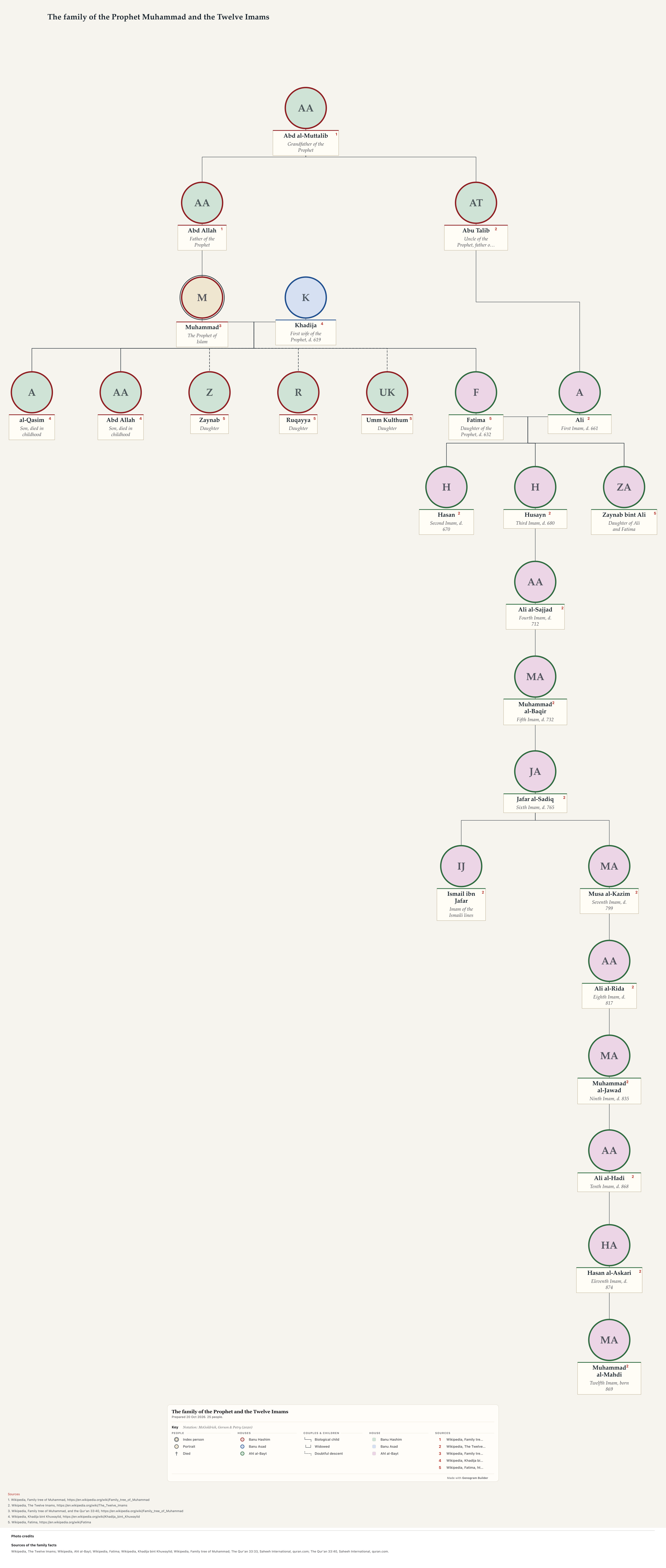
How to read this Ahlul Bayt family tree
Read the Ahlul Bayt family tree from the top down, one generation to a row. This page and its chart use no portrait, painting or silhouette of the Prophet, of his family or of the Imams. Every person is a plain medallion with initials and a name plate, and the titles carry the years.
The double ring is the Prophet Muhammad
The chart is drawn around his household.
Initials stand in for any image
Each medallion carries the initials of the name under it.
What Ahl al-Bayt means
Ahl al-Bayt means the people of the house. The Qur’an uses the phrase for the household of Ibrahim, when the messengers sent to Ibrahim bless his household as “people of the house”.4 It is best known from Surah 33:33, which in the Saheeh International translation reads, “Allāh intends only to remove from you the impurity [of sin], O people of the [Prophet’s] household”. The same verse opens with commands addressed to the Prophet’s wives.1
Wikipedia sums up the question this way. Muslims agree in honouring the Ahl al-Bayt and differ on who belongs to it and on its religious authority.5 The Ahlul Bayt family tree draws the wider family, so a reader of either view can find the people it names.
| Point | Sunni understanding | Shia understanding |
|---|---|---|
| Core members | Commonly the Prophet’s wives with Ali, Fatima, Hasan and Husayn | The Prophet, Ali, Fatima, Hasan and Husayn |
| Wider circle | Some authors include the clan of Hashim, or the families of Ali, Aqil, Jafar and Abbas | The later Imams of the line of Husayn |
| The Imams | Honoured, but not held to be divinely appointed | Divinely guided leaders protected from major error |
Sources5
Two reports shape the Shia reading. In the report of the cloak, Umm Salama hears the Prophet say of Ali, Fatima, Hasan and Husayn, “these are my ahl al-bayt”. In the mubahala of Surah 3:61, the Prophet answers a challenge with the words, “let us call our sons and your sons, our women and your women, ourselves and yourselves”, and most reports say he came with the same four.53
The Prophet Muhammad, Khadija and their children
The Prophet Muhammad, at the centre of the Ahlul Bayt family tree, was the son of Abd Allah, son of Abd al-Muttalib, of the clan of Hashim in the tribe of Quraysh. His mother was Amina bint Wahb, and his uncle Abu Talib was the father of Ali.9 The Qur’an calls him the Messenger of Allah and the seal of the prophets, and says that he is not the father of any of your men.2
He married Khadija bint Khuwaylid about 595, and she died in 619, in the year remembered as the Year of Sorrow. The traditional Sunni account calls her the first person to accept Islam.8 They had two sons, al-Qasim and Abd Allah, also called al-Tayyib and al-Tahir, and both died in childhood.8
The Sunni view gives them four daughters, Zaynab, Ruqayya, Umm Kulthum and Fatima. Twelver Shia sources hold that Zaynab, Ruqayya and Umm Kulthum were daughters of Hala, Khadija’s sister, raised in the household after their mother died, and most Shia hold that Fatima was the only daughter.78 The Ahlul Bayt family tree draws the three lines broken for that reason.
Fatima, Ali and their children
Fatima, called al-Zahra, was born in Mecca. Sunni sources place her birth about 605 and Twelver Shia sources between 612 and 615. She married Ali, the son of Abu Talib, in Medina in the first or second year after the Hijra, and she died in 632, within six months of her father.7
Their children were Hasan, Husayn, Zaynab and Umm Kulthum. A further son, Muhsin, died before or soon after birth, and Sunni and Shia sources tell his death differently.7 The Ahlul Bayt family tree draws Hasan, Husayn and Zaynab.
Sunnis count Ali as the fourth caliph, and the Twelve Imams of the Ahlul Bayt family tree begin with him.6 Hasan and Husayn are the second and third Imams. Husayn died at Karbala in 680 and is buried there.6

The Twelve Imams from father to son
Twelver Shia tradition counts twelve Imams, each the son of the one before from Husayn onwards. The table gives each Imam on the Ahlul Bayt family tree with his title, years and place of burial.6 Other Shia communities count the line differently. The Ismaili lines follow Ismail, a son of Jafar al-Sadiq, while the Twelver line passes to his brother Musa al-Kazim, who led the Shia community during that schism.6
In Twelver belief the twelfth Imam, Muhammad al-Mahdi, has lived in occultation since 874 and will return.6 The chart draws him without the mark of death for that reason. The Ahlul Bayt family tree makes no claim about any present-day descent from the family.
| Imam | Name and title | Years | Buried |
|---|---|---|---|
| 1 | Ali ibn Abi Talib | 599 to 661 | Najaf |
| 2 | Hasan ibn Ali, al-Mujtaba | 625 to 670 | Medina |
| 3 | Husayn ibn Ali, Sayyid al-Shuhada | 626 to 680 | Karbala |
| 4 | Ali ibn Husayn, al-Sajjad | 658 to 712 | Medina |
| 5 | Muhammad ibn Ali, al-Baqir | 677 to 732 | Medina |
| 6 | Jafar ibn Muhammad, al-Sadiq | 702 to 765 | Medina |
| 7 | Musa ibn Jafar, al-Kazim | 744 to 799 | Baghdad |
| 8 | Ali ibn Musa, al-Rida | 765 to 817 | Mashhad |
| 9 | Muhammad ibn Ali, al-Jawad | 810 to 835 | Baghdad |
| 10 | Ali ibn Muhammad, al-Hadi | 827 to 868 | Samarra |
| 11 | Hasan ibn Ali, al-Askari | 846 to 874 | Samarra |
| 12 | Muhammad ibn al-Hasan, al-Mahdi | Born 869 | In occultation |
Sources6
The line before the Prophet is drawn in the family tree of Ibrahim. The Ahlul Bayt family tree opens in the editor and prints as a PNG or a PDF.
Questions about the Ahlul Bayt family tree
Who the Ahl al-Bayt are
Shia Muslims name the Prophet, Ali, Fatima, Hasan and Husayn, and the Imams after them. Sunni authors usually add the Prophet’s wives, and some include his wider clan.
How many children the Prophet had with Khadija
Two sons who died young and four daughters in the Sunni view. Most Shia hold that Fatima was his only daughter.
People and sources
A page of its own lists all 25 people on the chart, each with a short note and the sources for it, and the nine numbered sources this article cites. It also gives the credits of the portraits and this page as a reference in the APA, MLA, Chicago and Harvard styles, ready to copy.