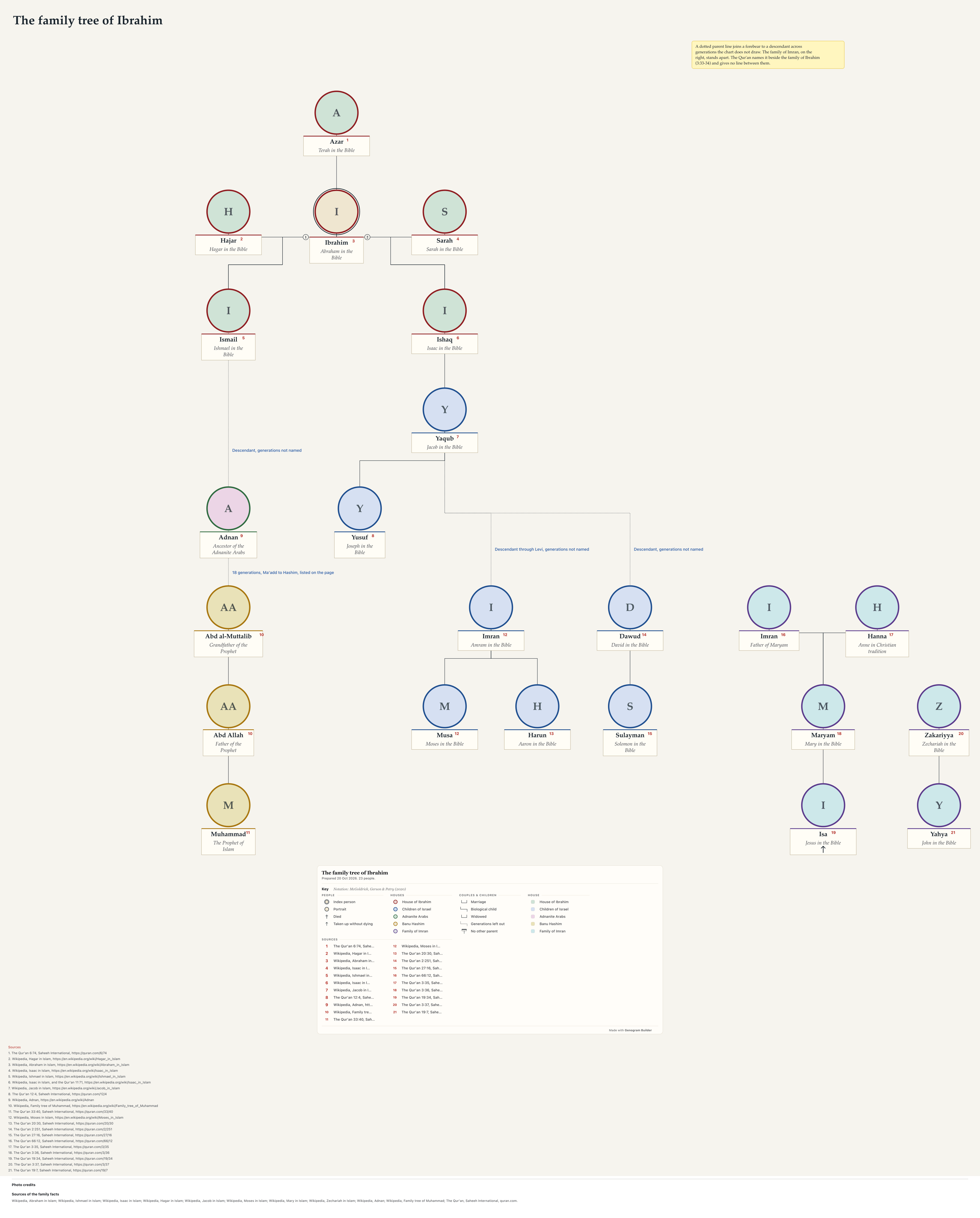
How to read this family tree of Ibrahim
Read the family tree of Ibrahim from the top down, a generation to a row. No portrait, painting or silhouette of any prophet appears here. The title under each name is the name the Bible uses.
The double ring is Ibrahim
The chart is drawn around his two sons.
Initials stand in for any image
Each medallion carries the initials of its name.
A solid line is a named parent
A source names the parent of the person below.
A dotted line spans generations the chart leaves out, from Ismail to Adnan, Adnan to Abd al-Muttalib, and Yaqub to Imran and Dawud. The family of Imran, the father of Maryam, stands apart on the right with no line to Ibrahim.
Ibrahim, Azar, Hajar and Sarah
The Qur’an names the father of Ibrahim once, in Surah 6:74, where Ibrahim reproaches his father Azar for taking idols as deities.1 Genesis calls him Terah.21 Islamic tradition makes Azar a maker of idols in Ur, whose son Ibrahim mocked the idols he was sent to sell.22
The Qur’an names both sons in Ibrahim’s thanks, “Praise to Allāh, who has granted to me in old age Ishmael and Isaac.”2 Ismail was the first son, and his mother was Hajar.23 The Qur’an does not name her. Tradition makes her a maid of the king of Egypt, given to Sarah and then to Ibrahim as a wife.25 Ishaq was the son of Sarah, whom Surah 11:71 calls only his wife when she receives “good tidings of Isaac and after Isaac, Jacob.”243
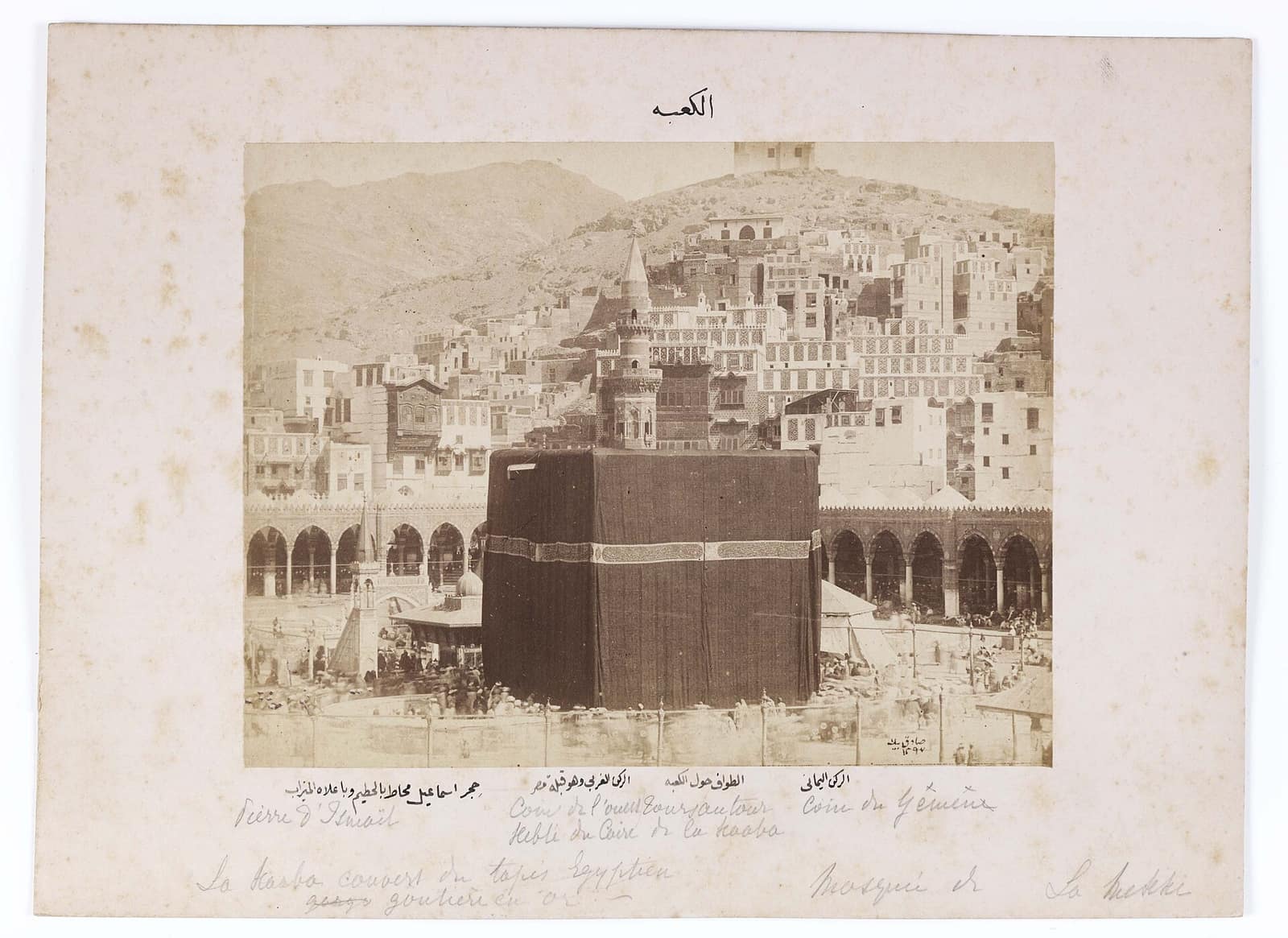
Ibrahim and Ismail raised the foundations of the House, which Muslims hold to be the Kaaba in Mecca.422 Surah 19:54 calls Ismail “a messenger and a prophet.”5 Surah 37 does not name the son Ibrahim was ready to sacrifice.6 Al-Tabari recorded both views, and Eid al-Adha remembers the son as Ismail.22

The line of Ismail to the Prophet Muhammad
Islamic tradition traces the Prophet Muhammad to Ismail through Adnan, the forefather of the Adnanite Arabs.30 The genealogies do not agree on the number of ancestors between Ismail and Adnan, though they agree on the names from Adnan to the Prophet.30 The family tree of Ibrahim draws that gap as a dashed line and names nobody in it.
The table lists the twenty-two names from Adnan to the Prophet, father to son, as the family tree of Muhammad on Wikipedia gives them.31 The family tree of Ibrahim draws Adnan, Abd al-Muttalib, Abd Allah and the Prophet, noting the eighteen names between.
| Names | From Adnan to the Prophet |
|---|---|
| 1 to 5 | Adnan, Ma’add, Nizar, Mudar, Ilyas |
| 6 to 10 | Mudrikah, Khuzaymah, Kinanah, an-Nadr, Malik |
| 11 to 15 | Fihr, Ghalib, Lu’ayy, Ka’b, Murrah |
| 16 to 20 | Kilab, Qusayy, Abd Manaf, Hashim, Abd al-Muttalib |
| 21 and 22 | Abd Allah, Muhammad |
Sources31
The same article notes that modern historians do not take this genealogy as fact, since the early Arab genealogies were an oral tradition shaped by their listeners.31 The Qur’an calls Muhammad the seal of the prophets, in Surah 33:40.20 His household is drawn on the Ahlul Bayt family tree.
From Ishaq to Musa, Harun, Dawud and Sulayman
Surah 12:6 speaks of the “fathers before, Abraham and Isaac” of Yusuf.8 Yaqub was later called Israil, and his twelve sons fathered the twelve tribes.26 At his death his sons promise to worship “the God of your fathers, Abraham and Ishmael and Isaac.”7 The family tree of Ibrahim draws one of the twelve, Yusuf, whose story Surah 12 tells.26
Musa asks for “Aaron, my brother” as his helper, in Surah 20:30.9 In tradition the father of Musa and Harun is Imran, the Amram of the Bible, and Levi, a son of Yaqub, is named as his ancestor.27 The Qur’an names no generation between Yaqub and Imran, so a dashed line joins them.
Dawud appears among the Children of Israel after Musa, when he kills Goliath.10 “And to David We gave Solomon,” says Surah 38:30, and Surah 27:16 adds that “Solomon inherited David.”1112 Sulayman is drawn as his son, and a dashed line joins Dawud to Yaqub.
The family of Imran, Maryam and Isa
Surah 3:33 sets “the family of Abraham and the family of ʿImrān” side by side, and the next verse adds “descendants, some of them from others.”14 No line between the two families is given, so the family tree of Ibrahim draws the family of Imran apart.
The wife of Imran pledged her unborn child to Allah and named the daughter Mary, and Allah put the girl in the care of Zakariyya.14 Al-Tabari names the mother Hanna. Mary in Islam makes Zakariyya her maternal uncle, and Zechariah in Islam calls him her guardian, so the chart gives him no line to her.2829
Surah 66:12 calls Maryam “the daughter of ʿImrān,” and Surah 19:34 names “Jesus, the son of Mary.”1517 Isa has no father in the Qur’an, so one line runs from Maryam. Surah 4:158 says “Allāh raised him to Himself,” so he has no mark of death.19 Yahya is the son promised to Zakariyya in Surah 19:7.18
Her father is not to be confused with Amram, the father of Moses, although N. J. Dawood held that the Qur’an joins the two.28 Surah 19:28 calls Maryam “sister of Aaron,” which the Saheeh International translation glosses as descendant.16 The chart keeps the two Imrans apart.
The names in the Qur’an and in the Bible
Lot, the nephew of Ibrahim who believed him, is not drawn, because no Islamic source read here names his father.2213 Genesis makes him the son of Haran.21
The biblical Abraham family tree draws the same family from Genesis. The table pairs each name on the family tree of Ibrahim with its biblical form.
| On the chart | In the Bible |
|---|---|
| Azar and Ibrahim | Terah and Abraham |
| Hajar and Sarah | Hagar and Sarah |
| Ismail and Ishaq | Ishmael and Isaac |
| Yaqub and Yusuf | Jacob and Joseph |
| Musa and Harun | Moses and Aaron |
| Dawud and Sulayman | David and Solomon |
| Maryam and Isa | Mary and Jesus |
| Zakariyya and Yahya | Zechariah and John |
The family tree of Ibrahim opens in the editor and prints as a PNG or a PDF.
Questions about the family tree of Ibrahim
Who the father of Ibrahim was
The Qur’an names him Azar in Surah 6:74. Genesis names him Terah.
How the Prophet Muhammad descends from Ibrahim
Through Ismail and Adnan, in Islamic tradition.
People and sources
A page of its own lists all 23 people on the chart, each with a short note and the sources for it, and the 31 numbered sources this article cites. It also gives the credits of the portraits and this page as a reference in the APA, MLA, Chicago and Harvard styles, ready to copy.