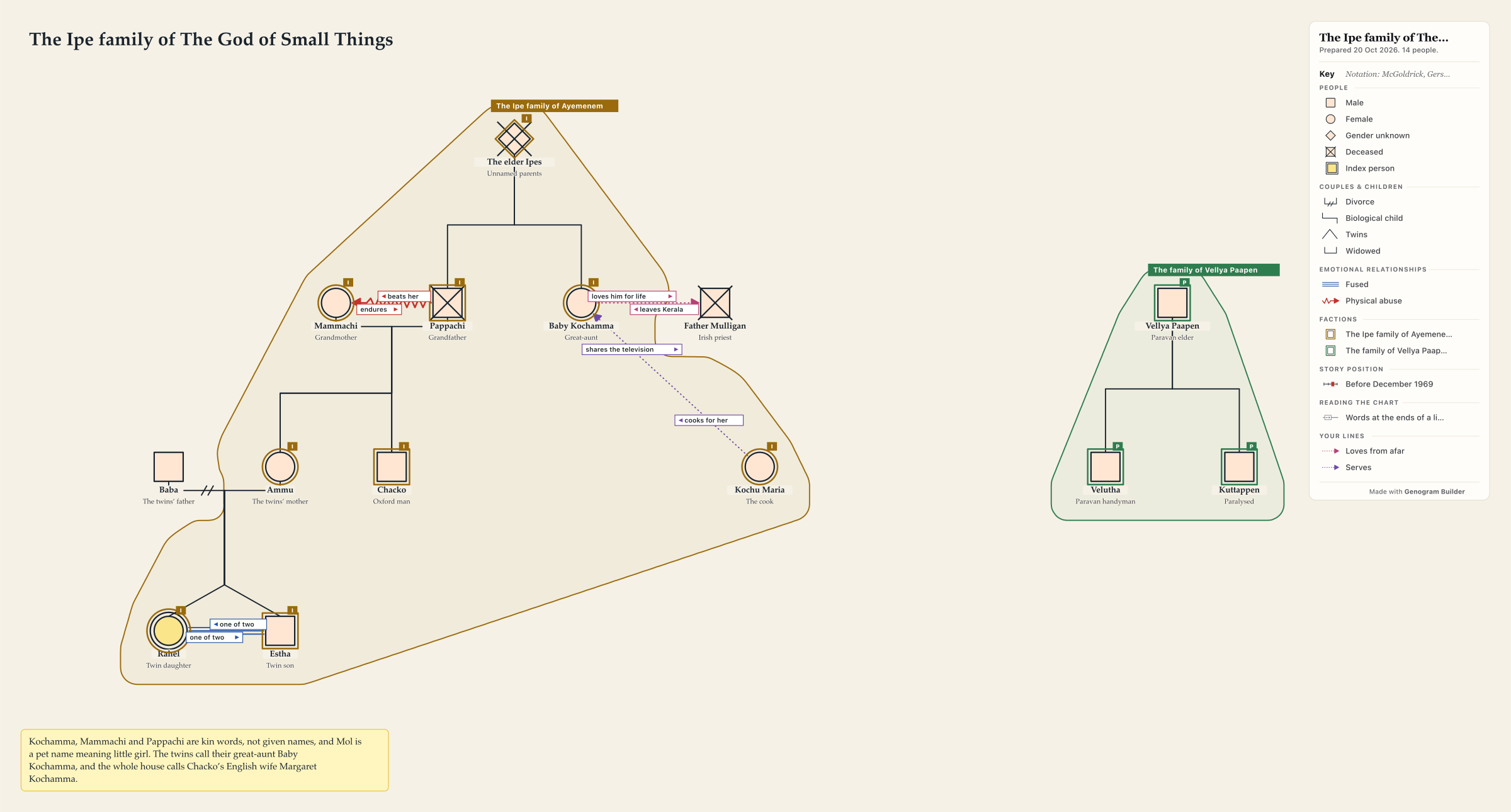
The grandparents on the God of Small Things family tree
The top row of the God of Small Things family tree is the twins’ grandparents and their great-aunt. Pappachi, whose name is Benaan John Ipe, was an Imperial Entomologist, and he is dead by 1969.12 He beat his wife, Mammachi, Soshamma Ipe, until their son Chacko stopped him.4
Mammachi is blind by 1969. She owns the family business, Paradise Pickles and Preserves, which her son manages, and she has died by 1993.12 The chart draws a dark red arrow of abuse from Pappachi to Mammachi that ends with his death.
Pappachi’s sister is Baby Kochamma, Navomi Ipe, the twins’ great-aunt.1 At eighteen she fell in love with Father Mulligan, an Irish priest, followed him to Madras and became a Roman Catholic. He left Kerala, and she never married.3 In 1993 she is eighty-three and spends her days in front of the television with the cook, Kochu Maria.3 Pappachi and Baby Kochamma hang from one symbol for their parents, whom the chart does not name.
Chacko, Ammu and their marriages
Chacko is the only son of Pappachi and Mammachi. He studied at Oxford and married Margaret Kochamma, an Englishwoman, and their daughter is Sophie Mol.24 Margaret left Chacko for Joe, who later died in an accident, and after his death she brings Sophie Mol to Ayemenem in 1969.24 The chart draws Joe as Sophie’s stepfather.
Ammu is Chacko’s sister. She married Baba to get away from Ayemenem, but he drank and beat her, and after the twins were born she left him and came home.2 In 1969 Ammu begins a love affair with Velutha, the son of Vellya Paapen, a Paravan, and the two meet by the river at night.24
Velutha is a handyman whom the caste rules of the town hold untouchable, and his brother Kuttappen is paralysed.4 On the God of Small Things family tree his family stands to the right of the Ipes, in its own green outline, and the pink line of lovers between Ammu and Velutha appears only for the weeks of the affair.
Ammu dies at thirty-one, alone in a hotel room away from home, when Rahel is eleven.12 The chart marks her death at the story point between 1969 and 1993.
The twins, Estha and Rahel
Estha, whose full name is Esthappen, and Rahel are fraternal twins, a boy and a girl, seven years old in 1969.14 The God of Small Things family tree draws them from one point on their parents’ line, the mark for twins, and joins them with a fused line for the closeness the novel gives them.
On the night of the crossing the twins and Sophie Mol take a boat across the river, the boat overturns and Sophie Mol drowns.1 Baby Kochamma goes to the police and blames Velutha, the police beat him nearly to death, and he dies in a cell.41 The police press Estha into a false accusation of Velutha.2
About two weeks after the funeral, Estha is returned to his father in Calcutta, and the twins are parted for twenty-three years.3 Rahel marries Larry McCaslin, an American, and the marriage ends in divorce.4 In 1993 Baba sends Estha back to Ayemenem, and Rahel comes home to meet him. Both are thirty-one, the age at which their mother died.31
Names, kin terms and nicknames on the family tree
Several of the names on this God of Small Things family tree are kin words of Malayalam rather than given names. The chart writes the name the novel uses on the symbol and keeps the given name beside it.
Pappachi is Benaan John Ipe and Mammachi is Soshamma Ipe, the grandfather and grandmother. Baby Kochamma is Navomi Ipe. Kochamma is a term of address rather than a surname, which is why Chacko’s English wife is called Margaret Kochamma too.13 Sophie Mol carries the pet name Mol for a little girl, and Estha is short for Esthappen.4
The references spell the twins’ father in two ways. LitCharts writes Baba and GradeSaver writes Babu, and the chart follows the first.34
The God of Small Things family tree across 1969 and 1993
The novel opens in 1993 with Rahel’s return and moves back and forth from there. This God of Small Things family tree puts the story in time order, so each card gives the state of the family at one time of the story. Read each card after the chapters that tell it.
Before December 1969
The house at Ayemenem
Spoiler note. Nothing beyond the family’s past.
- Pappachi has died, and Mammachi runs the pickle factory with Chacko.
- Ammu has left Baba and lives at home with the twins.
1969, the visit
Sophie Mol arrives
Spoiler note. The affair begins.
- Margaret Kochamma brings Sophie Mol to Ayemenem after Joe’s death.
- Ammu and Velutha begin to meet by the river.
1969, the crossing
Two deaths
Spoiler note. Sophie Mol and Velutha die.
- Sophie Mol drowns when the boat overturns.
- Velutha dies after the police beating, and Estha is returned to Baba.
The years between
Ammu and Rahel
Spoiler note. Ammu dies.
- Ammu dies at thirty-one.
- Rahel marries Larry McCaslin in America, and they divorce.
1993
The twins meet again
Spoiler note. The ending is told in full.
- Estha and Rahel meet in Ayemenem at thirty-one.
- Mammachi has died, and Baby Kochamma and Kochu Maria keep the house.
How to read this God of Small Things family tree
On the God of Small Things family tree a square is a man and a circle is a woman. A double line is a marriage, a line with two strokes is a divorce, and a line down from a couple leads to a child. Chacko and Margaret, Ammu and Baba, and Rahel and Larry all end in divorce on the chart.
The gold outline is the Ipe household and the green outline is the family of Vellya Paapen. Estha leaves the Ipe outline when he is returned to his father and comes back into it in 1993. The coloured lines carry the story. The purple dashed arrow from Ammu to Estha is the return to Baba, the red dashed arrow from Baby Kochamma to Velutha is her accusation, and the dotted pink arrow from Baby Kochamma to Father Mulligan is a love that was never returned.
To draw a God of Small Things family tree for a class, open this chart in the editor, or start from the story charts. The symbols are set out in the genogram symbols.
Questions about the God of Small Things family tree
People and sources
A page of its own lists all 18 characters on the chart, each with a short note and the sources for it, and the five numbered sources this article cites. It also gives this page as a reference in the APA, MLA, Chicago and Harvard styles, ready to copy.