Reverend Parris, his daughter and his niece
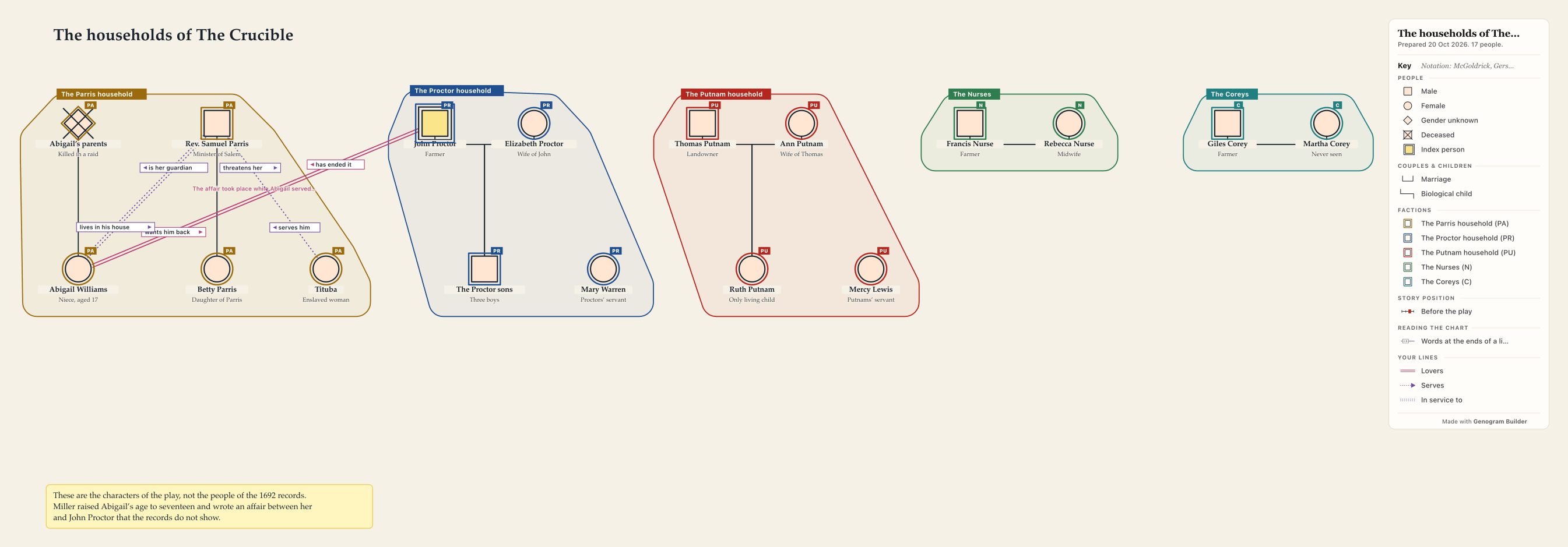
Every family tree of The Crucible begins in the house of Reverend Samuel Parris, the minister of Salem. Act I opens in his upstairs room, where his daughter Betty lies as if asleep after the girls were found dancing in the woods.1 The family is small and uneasy, and the play gives Parris no wife.
His niece Abigail Williams is seventeen and lives with him because her parents were killed in a raid when she was a child.23 The chart draws her parents as one unnamed symbol, since the play does not say which of them was kin to Parris. Abigail has lately been dismissed from the Proctor house, where she worked as a servant.1
Tituba is enslaved in the Parris house and comes from Barbados.2 She is the first to be accused, and once she confesses she names others.3 On the family tree of The Crucible her line to Parris is a line of service, with the words of each side at its two ends.
John and Elizabeth Proctor
John Proctor is a farmer and the husband of Elizabeth. The couple have three sons, who are drawn as one symbol because they matter to the story only as the children Elizabeth will leave behind.1 Their servant Mary Warren has taken Abigail’s place in the house.2
The affair between John and Abigail is the secret at the heart of this family tree of The Crucible. It happened while she served in the house, and Elizabeth dismissed her when she learned of it.2 Abigail then accuses Elizabeth in Act II, and Cheever arrests her on the evidence of a needle in a poppet.13
In Act III John confesses the affair to the court to break Abigail’s word, and Elizabeth, asked whether her husband is a lecher, denies it to protect his name.15 Mary Warren, who came to court to tell the truth, turns on Proctor, and he is arrested. Elizabeth is pregnant, so the court spares her until the child is born.1
The Putnams, the Nurses and the Coreys
Thomas Putnam is one of the richest landowners in Salem. His wife Ann has buried seven infants, and their daughter Ruth is the only child who lived.23 Their servant Mercy Lewis is Abigail’s closest friend.2
Rebecca Nurse is the wife of Francis Nurse and once served as Ann Putnam’s midwife. Ann blames her for the dead babies, and Rebecca is charged with their murder.3 The family tree of The Crucible draws that charge as a dark red dashed arrow.
Giles Corey is an old farmer who goes to law with his neighbours. When he mentions that his wife Martha reads books, she is charged, and Martha never appears on stage.32 Giles accuses Thomas Putnam of driving the cries in order to buy the land of the accused, and he refuses to name the man who told him.1
The accusers, the accused and the court
The play redraws Salem into three sides, and the family tree of The Crucible gives each a mark. The accusing girls are Abigail, Betty, Ruth, Mercy and, for most of the play, Mary Warren. The accused grow act by act, from Tituba and Sarah Good in Act I to Rebecca, Martha and Elizabeth in Act II, and John and Giles in Act III.1
The court is led by Deputy Governor Danforth, with Judge Hathorne beside him and Ezekiel Cheever as clerk.2 Reverend John Hale of Beverly comes as an expert on witchcraft in Act I, but in Act III he denounces the proceedings and leaves the court.1 In Act IV he returns to beg the condemned to confess and save their lives.
Mary Warren is the one person who changes sides twice. She stands with Proctor at the start of Act III, the girls turn their cries on her, and she rejoins them by accusing him.1 The chart draws each of these spells as a separate membership.
The family tree of The Crucible act by act
Each card gives the changes to the family tree of The Crucible at the end of an act. Read each card after its act, since the last one names the dead.
Act I
The first names
Spoiler note. The first accusations.
- Betty will not wake, and Parris sends for Reverend Hale.
- Tituba confesses, and the girls cry out names.
Act II
Arrests in the village
Spoiler note. Elizabeth is taken.
- Rebecca Nurse and Martha Corey are arrested.
- Cheever finds the needle in the poppet and arrests Elizabeth.
Act III
The court
Spoiler note. Proctor is arrested.
- John confesses the affair, and Elizabeth denies it to save his name.
- Mary Warren turns on John, and Hale quits the court.
Sources1
Act IV
The jail at Salem
Spoiler note. The ending is told in full.
- Abigail and Mercy Lewis have fled Salem.
- Giles has been pressed to death, and John tears up his confession and goes to hang with Rebecca Nurse.
The characters beside the people of 1692
Miller took his names from the records of the Salem witch trials, and he changed the people to make a play. He raised Abigail from eleven to seventeen, placed her in the Proctor house and wrote an affair that the records do not show.5 He also made the real John Proctor, who was about sixty, a younger man, and he folded several judges into Danforth and Hathorne.1
The table below keeps the family tree of The Crucible apart from the records. Every person in it died more than two centuries before 2000. The ages are those the records give in 1692, and the sources disagree by a year for Abigail and for John Proctor.
| Name | In the play | In the records of 1692 |
|---|---|---|
| Abigail Williams | Niece of Parris, seventeen, former servant of the Proctors | Niece of Samuel Parris and cousin of Betty, eleven or about twelve, one of the first two afflicted girls in February |
| Betty Parris | Daughter of Parris | Daughter of Samuel Parris, nine years old |
| Tituba | Enslaved woman from Barbados | Enslaved in the Parris household, among the first three accused, later released |
| John Proctor | Farmer, hanged in Act IV | Convicted on 5 August and hanged on 19 August, aged 59 or 60 |
| Elizabeth Proctor | Wife of John, spared by her pregnancy | Arrested on 11 April, spared by her pregnancy, gave birth to a son in January 1693 and was reprieved |
| Rebecca Nurse | Wife of Francis, hanged in Act IV | Hanged on 19 July, aged 71 |
| Giles Corey | Pressed to death before Act IV | Refused to enter a plea and was pressed to death on 19 September, aged 81 |
| Martha Corey | Wife of Giles, never seen | Hanged on 22 September, aged 72 |
| Ruth Putnam | Only surviving child of the Putnams | No Ruth in the records. Ann Putnam Jr., aged 12, was one of the chief accusers |
| Mary Warren | Servant of the Proctors | Servant of the Proctors, about twenty |
| Danforth | Deputy Governor who leads the court | Thomas Danforth sat on the court of 1693, and William Stoughton led the court of 1692 |
How to read this family tree of The Crucible
On the family tree of The Crucible a square is a man and a circle is a woman. A double line is a marriage, and a line down from a couple or a parent leads to a child. Most people of the play are not related, so the households are drawn as coloured outlines with a mark at the corner of each member, and the sides are drawn as further marks that change act by act.
The coloured lines carry the plot. The pink double line from John to Abigail is the affair, the dark red dashed arrows are the accusations, and the triple blue arrow from Danforth to John is the sentence. Each line has words at both ends, so the line between John and Abigail reads differently before and after he confesses in court.
To build a family tree of The Crucible for a class, open this chart in the editor and add the characters your edition lists, or start from the story charts. The symbols are set out in the genogram symbols.
Questions about the family tree of The Crucible
How is Abigail related to Reverend Parris
Abigail is his niece. Her parents were killed when she was a child, and she lives in his house with his daughter Betty.23
Were the Proctors real people
Yes. John Proctor was hanged on 19 August 1692, and Elizabeth was spared because she was pregnant.56
Who survives at the end of The Crucible
Elizabeth Proctor, Hale, Parris and the court survive, and Abigail and Mercy Lewis have fled.1
People and sources
A page of its own lists all 22 characters on the chart, each with a short note and the sources for it, and the seven numbered sources this article cites. It also gives this page as a reference in the APA, MLA, Chicago and Harvard styles, ready to copy.