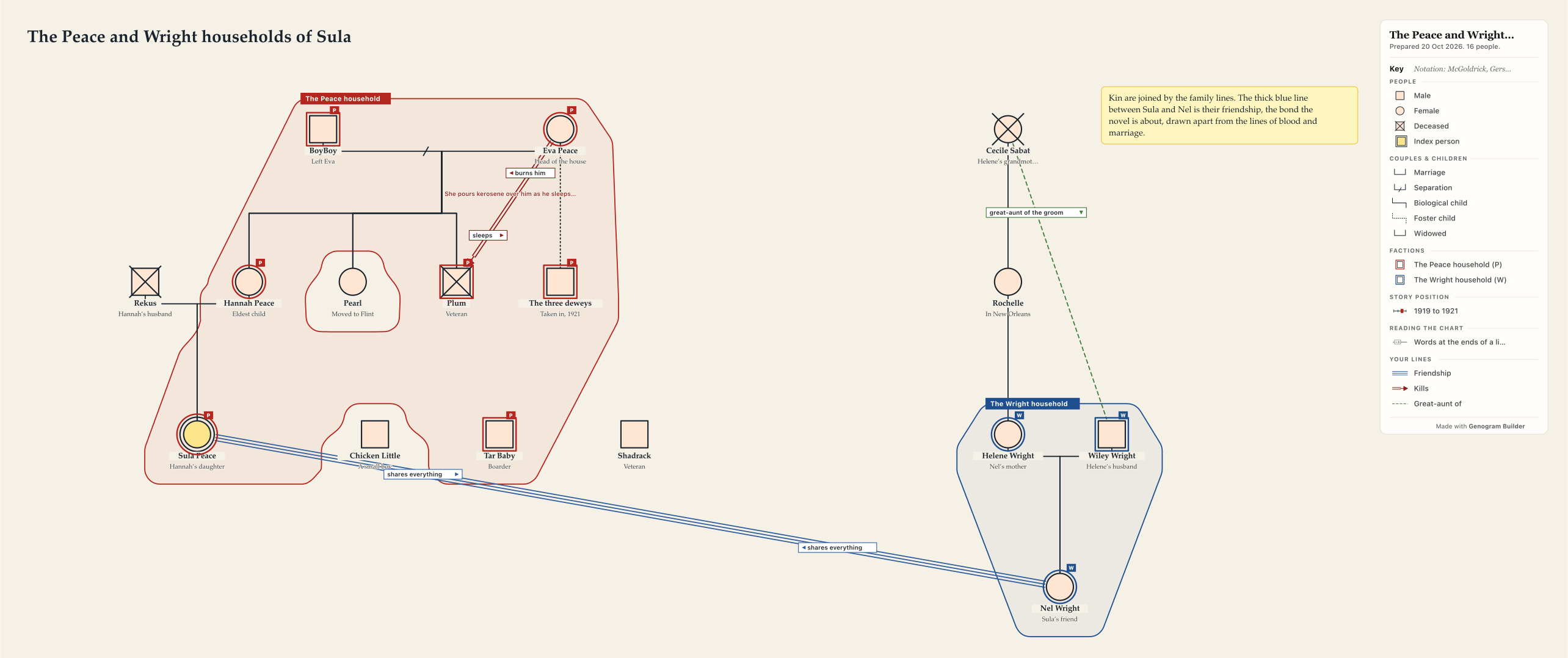
Eva Peace and her children on the Sula family tree
The Sula family tree begins with Eva Peace and her husband BoyBoy, who brought her from Virginia to Medallion, Ohio, and then left her with three children and no money or food.3 Eva went away for a winter and came back with one leg and money, and the novel never says how she lost the other.23 With it she built a large house on Carpenter’s Road in the Bottom, the Black neighbourhood on the hill above the town.1
Her three children are Hannah, Pearl and Ralph, whom everyone calls Plum.3 Pearl married at fourteen and moved to Flint, Michigan, the only child to leave for good.3 Plum came home from the First World War addicted to heroin, and in the 1921 chapter Eva pours kerosene on him as he sleeps and sets him alight.12
Hannah married Rekus, who died when their daughter Sula was three, and mother and daughter moved back into Eva’s house.13 In the 1923 chapter Hannah catches fire, Eva throws herself from an upper window to reach her, and Hannah dies. Eva believes that Sula stood on the porch and watched.2
The house was never only family. Eva took in three small boys in 1921 and named all three Dewey, and the chart draws the three deweys as one symbol joined to her by a foster line.3 Tar Baby, a boarder who drinks, has a room upstairs.3
The Wrights on the Sula family tree
The Wright side of the Sula family tree runs back to New Orleans. Helene Wright is the daughter of Rochelle, a Creole woman who worked in a brothel, and she was raised by her strict grandmother, Cecile Sabat.3 Cecile is also the great-aunt of Wiley Wright, the ship’s cook whom Helene marries, so the chart gives her a dashed green line to him as well as the line down to Rochelle.3
Helene and Wiley have one child, Nel, born after nine years of marriage, and Wiley is away on the lake boats most of the time.3 When Cecile dies, Helene takes Nel south for the funeral and they meet Rochelle, who shows no interest in either of them.2 Soon afterwards Nel makes friends with Sula, whose mother, Hannah, Helene looks down on.
In 1927 Nel marries Jude Greene, and the chart opens a third household for the couple and the children they have in the next ten years.2 The novel does not name the Greene children, so they are drawn as one symbol that appears at the 1937 story point.
A friendship drawn apart from the family lines
Sula and Nel are not related, yet their bond is the centre of the book, so this Sula family tree gives it a line of its own. Kin are joined by the black lines of birth and marriage. The friendship is a thick blue line of three strands, and it changes with the story, with words at both of its ends.
In 1922 the two girls are twelve and inseparable. Chicken Little, a small boy, slips from Sula’s hands as she swings him by the river and drowns, and the girls tell no one.2 Shadrack, the veteran who founded National Suicide Day, says one word to Sula that she takes to mean he saw it.2
After Nel’s wedding Sula leaves the Bottom for ten years. She returns in 1937, has Eva taken to a home, and sleeps with Jude, and when Nel finds them together Jude leaves for Detroit.2 The friendship line breaks at that story point. In 1939 Sula falls for Ajax, who later leaves her.3 In 1940 Nel visits Sula once as she lies ill, and Sula dies soon after.2
The last chapter returns in 1965. Nel visits the old woman in her home, and Eva insists that Nel shares the blame for Chicken Little. At the graves of the Peace family Nel understands that it was Sula she had been missing all along.2
The Sula family tree year by year
Each card gives the changes to the Sula family tree at the end of a group of chapters. The chapters are named by year, so the cards are too. Read each card after its chapters.
1919 to 1921
Two households
Spoiler note. Plum dies.
- Shadrack founds National Suicide Day, and Nel sees New Orleans.
- Eva takes in the deweys and kills Plum by fire.
1922 and 1923
Water and fire
Spoiler note. Chicken Little and Hannah die.
- Chicken Little drowns, and the girls keep the secret.
- Hannah burns to death, and Eva is hurt trying to save her.
Sources2
1927
A wedding
Spoiler note. Sula leaves.
- Nel marries Jude Greene, and Sula leaves the Bottom.
Sources2
1937 and 1939
The return
Spoiler note. The friendship breaks.
- Sula puts Eva in a home and takes Jude, who leaves Nel.
- Sula takes up with Ajax, who leaves her in turn.
1940 and 1941
Two endings
Spoiler note. Sula dies.
- Sula dies after Nel’s one visit.
- The tunnel collapses on Suicide Day, and the deweys are last seen there.
1965
Nel at the graves
Spoiler note. The ending is told in full.
- Nel visits Eva and grieves for Sula at last.
Sources2
How to read this Sula family tree
On the Sula family tree a square is a man and a circle is a woman. A double line is a marriage, and a line down from a couple or a parent leads to a child. The deweys hang from Eva by a foster line, since she took them in rather than bore them.
Each household wears its colour, with a letter at the corner of every member. Nel leaves the Wright household for the Greene household at her wedding, and Eva leaves the Peace household when Sula sends her away. The coloured lines carry the story between people. The dark red arrow from Eva to Plum is the killing, the grey dashed arrow from Sula to Chicken Little is the accident, and the pink lines are the men Sula takes.
To make a Sula family tree for a class, open this chart in the editor and add the people your reading needs, or start from the story charts. The symbols are set out in the genogram symbols.
Questions about the Sula family tree
How are Sula and Eva related
Eva is Sula’s grandmother. Sula is the daughter of Hannah, Eva’s eldest child.3
Are Sula and Nel related
No. They are friends from two different households, and the chart draws their bond with its own line.3
Who are the deweys in Sula
Three boys whom Eva takes in during 1921 and calls by the one name Dewey.3
People and sources
A page of its own lists all 19 characters on the chart, each with a short note and the sources for it, and the four numbered sources this article cites. It also gives this page as a reference in the APA, MLA, Chicago and Harvard styles, ready to copy.