Howard Doyle, his wives and his children
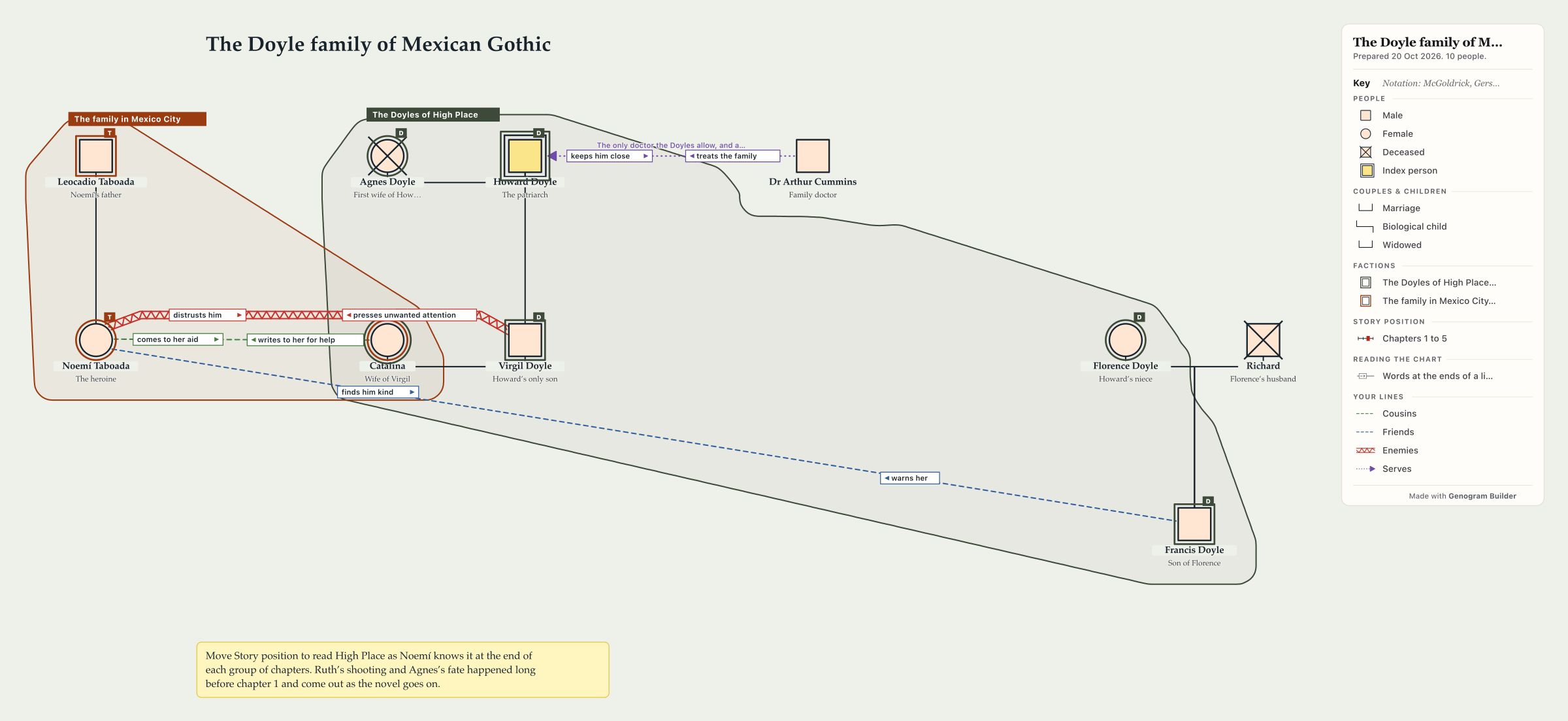
The Mexican Gothic family tree grows from one man. Howard Doyle is the frail patriarch of High Place, an English manor that the family built in the mountains near the village of El Triunfo, where the Doyles ran a silver mine.13 When Noemí meets him he is dying, or seems to be, and he lectures her on race and breeding when he hears that she wants to study anthropology.3
The Slate review reads the family as a picture of colonial rule. The Doyles are fair and blue-eyed, one of them brought soil from England to the mountains, and their silver mine treated the local workers little better than livestock until the mine and the family fortune failed.3 The family’s marriages within itself belong to the same idea of keeping the line apart from the land around it.
Howard married twice. His first wife, Agnes, died in the early sickness that swept High Place, and she had no children of her own.25 He then married her sister Alice in 1895, according to a chapter summary of chapter 12, and Alice bore him two children.5 The elder is Ruth, and the younger is Virgil, born years after his sister.5 LitCharts calls Virgil Howard’s only son.2
Ruth is the first point where the sources part. Wikipedia and the chapter summary both call her Howard’s daughter, and the LitCharts character list calls her his niece.152 The chart follows the two sources that agree and draws her as the daughter of Howard and Alice. The family married within itself so often that both words may be true at once, which is part of what the novel reveals.
Virgil has married twice as well. His first wife was the daughter of Dr Arthur Cummins, the only doctor the Doyles will let near them. She fell ill at High Place and left after miscarriages, a story Noemí hears in chapter 15.25 His second wife is Catalina, Noemí’s cousin, whom he married after a short engagement and brought home to the mountains.2
Leland, Florence and Francis
Howard did not build High Place alone. A summary of chapter 12 says that he and his brother Leland built the house and reopened the mine together.5 Leland married Dorothy, and they had two children, Michael and Florence.5 This branch of the Mexican Gothic family tree rests on that one chapter summary, and the study guides that were checked do not name Leland, Dorothy or Michael.
Florence is the stern woman who runs the household when Noemí arrives. LitCharts calls her Howard’s niece and the mother of Francis, which fits her place as Leland’s daughter.2 She married Richard, who went mad and was found dead in a ravine when their son was a boy.25 By chapter 20 Noemí learns that the house itself drove him mad after he tried to leave.5
Francis is Florence’s son, the young man whom the Slate review calls the decent one of the two.3 LitCharts calls him Noemí’s love interest and also Howard’s nephew, though by the line above he is Howard’s great-nephew and a cousin of Virgil.24 He is the young man whom Howard has chosen for the transfer at the heart of the novel.
Noemí, Catalina and Leocadio
Noemí Taboada is a wealthy young woman of Mexico City in 1950, and the story begins when her industrialist father asks her to look in on her newly married cousin.3 Her father, Leocadio, suspects that Virgil married Catalina for her money.1 Catalina has written a letter that accuses her husband of poisoning her and speaks of the restless dead in the walls.3
The two cousins share grandparents whom the novel does not draw, so the chart joins them with a green cousin line rather than a shared parent. Catalina is a Doyle by marriage, and the chart draws her in the family of Mexico City and in the Doyle household at once.
Ruth’s crime and what Howard is
Long before Noemí arrives, Ruth was engaged to her cousin Michael, a match Howard had arranged.25 She was in love with Benito, an Indigenous miner who later disappeared.25 A week before the wedding she shot Michael, her mother Alice, her aunt and uncle, and Howard, who survived, and then she shot herself.52 Wikipedia sums this up as killing several members of her family before turning the gun on herself.1
The reason comes out in the last third of the book. The house is threaded with a fungus whose network holds memory, and the family calls it the gloom.1 Agnes was used as a sacrifice to grow it, and her body lies at its centre.12 Through the gloom Howard has lived for hundreds of years by taking over the bodies of men of his own family.12 The Doyles married within the family so that their children would carry the bond with the fungus, and Virgil admits in chapter 22 that the inbreeding has brought sterility on the family.15
Howard needs a young man of the family for his next body, and Francis is the one.5 His plan is for Noemí to marry Francis, so that the new body comes with a new wife from outside.1 One chapter summary also reports, in chapter 20, that Agnes and Alice were Howard’s sisters as well as his wives. Since the same summary calls Alice Agnes’s sister in chapter 12, the chart draws only the marriages and leaves this point uncertain.5
The Mexican Gothic family tree chapter by chapter
Each card gives the changes to the chart at the end of a group of chapters. Read each card after its chapters, since the later cards give away the ending.
Chapters 1 to 5
The visit
Spoiler note. Nothing beyond chapter 5.
- Noemí travels to High Place after Catalina’s letter.
- She meets Howard, Virgil, Florence and Francis.
Chapters 6 to 12
Ruth’s story
Spoiler note. The family’s past is told.
- Noemí learns that Ruth shot her family before her wedding.
- The history of Howard, his brother Leland and their wives comes out.
Chapters 13 to 19
Dreams and doctors
Spoiler note. Virgil’s first marriage.
- Noemí hears of Virgil’s first wife, the daughter of Dr Cummins.
- Her dreams of the house grow stronger.
Chapters 20 to 24
The gloom
Spoiler note. Howard’s nature is revealed.
- Noemí learns of the fungus and of Agnes’s body at its heart.
- Howard means to take Francis’s body and to marry him to Noemí.
Chapters 25 to 27
The fire
Spoiler note. The ending is told in full.
- The transfer fails, and Florence is shot.
- Noemí burns Agnes’s remains, and High Place burns as Noemí, Francis and Catalina flee.
How to read this Mexican Gothic family tree
A square is a man and a circle is a woman. A double line is a marriage, and a crossed line is one that ended. The Doyles stand inside a dark green outline, and the family from Mexico City inside a rust outline. Howard has his first wife Agnes to his left and his second wife Alice to his right, and the children of the second marriage drop from that line.
The story positions follow what Noemí learns, not the order of events. Ruth, Michael, Alice, Leland and Dorothy are dead before chapter 1, but they appear on the chart only from the position for chapters 6 to 12, when their story is told. Virgil’s first wife appears with the chapters that name her, and Agnes’s state changes at chapter 20, when Noemí learns what lies at the heart of the house.
The coloured lines carry the story. The purple dashed arrow from Howard to Francis is the plan to take his body, and it appears from chapter 20. The dark red arrow from Ruth to Howard is the shooting he survived, and the red line from Ruth to Michael stands for the killings of that night. The line between Noemí and Francis turns from friendship to love at the fire.
Read in this way, the Mexican Gothic family tree is a short tree folded back on itself, with the same blood on both sides of each marriage. To build a family tree of your own novel, open this chart in the editor or start from the story charts. The symbols are set out in the genogram symbols.
Questions about the Mexican Gothic family tree
Is Ruth Howard’s daughter or niece
Wikipedia and a chapter summary call her Howard’s daughter by his second wife Alice, and LitCharts calls her his niece. The chart follows the first reading.152
How is Francis related to Howard
Francis is the son of Florence, Howard’s niece, which makes him Howard’s great-nephew.25
How is Noemí related to the Doyles
Only through her cousin Catalina, who is married to Virgil Doyle.2
People and sources
A page of its own lists all 16 characters on the chart, each with a short note and the sources for it, and the five numbered sources this article cites. It also gives this page as a reference in the APA, MLA, Chicago and Harvard styles, ready to copy.