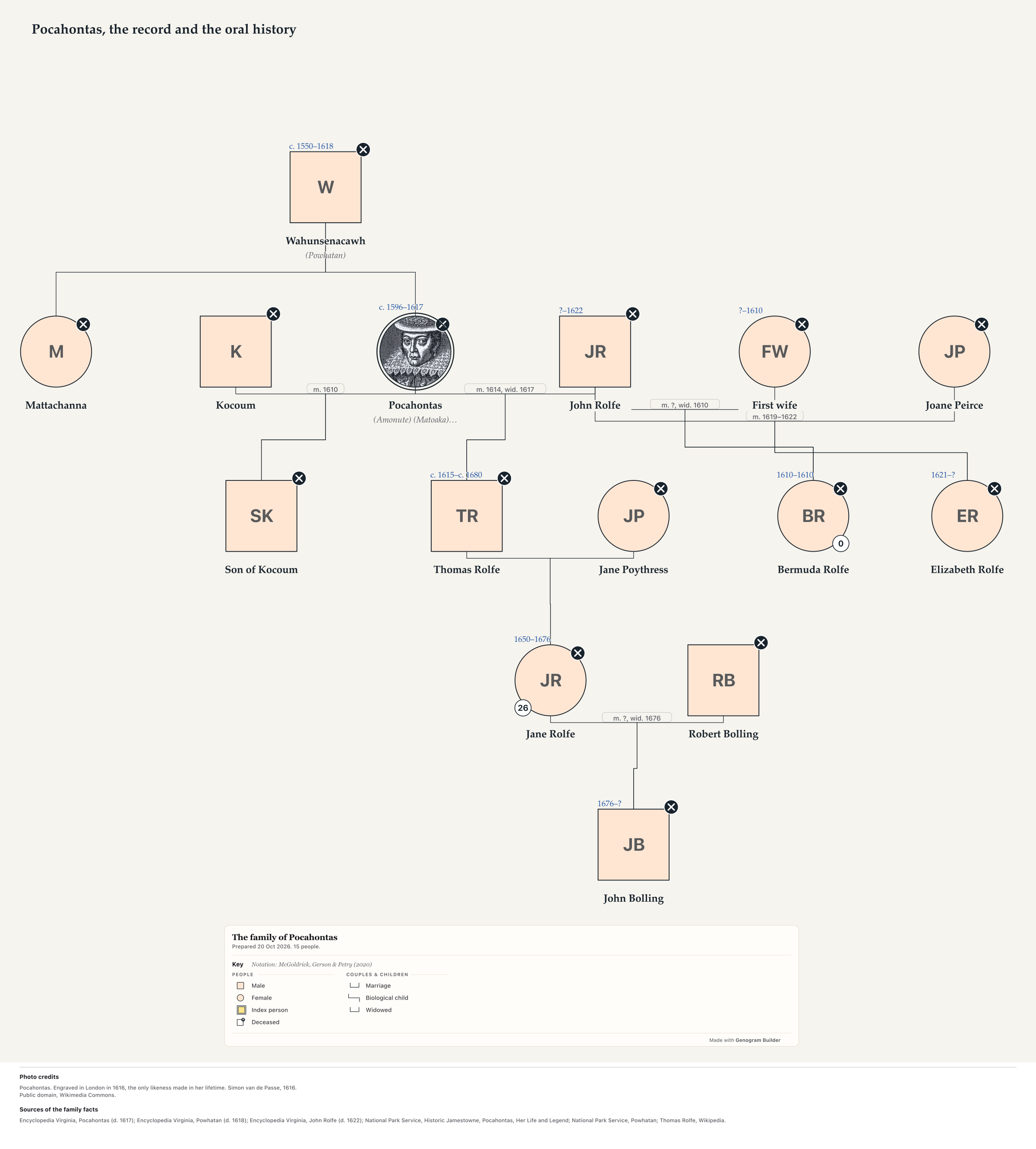
How to read this Pocahontas family tree
Read the Pocahontas family tree from the top down. Pocahontas is the centre, drawn with a double frame and shown in the engraving made in London in 1616. No likeness from life exists of anyone else here, so each has a silhouette rather than a picture imagined later.
The double frame is Pocahontas
Born about 1596 and died at Gravesend in 1617.
A broken line of descent is disputed
It rests on the oral history or on later genealogies, not on the English record.
Two couple lines leave Pocahontas
Kocoum about 1610 and John Rolfe in 1614.
The names of Pocahontas
Pocahontas was born about 1596 and named Amonute, with a private name, Matoaka.4 Pocahontas was a nickname that the Park Service translates as playful one.4 The Mattaponi oral history gives Matoaka as flower between two streams and Pocahontas as laughing and joyous one.4 When she was baptized in 1614 she took the name Rebecca.4
Her father, Wahunsenacawh
Her father's own name was Wahunsenacawh, also written Wahunsenaca. The English called him Powhatan after his home town.24 He was the mamanatowick, the paramount chief of Tsenacomoco, a title that joined spiritual and political power.25 The Park Service dates his birth to about 1550, near present-day Richmond.5 His death was reported to the colonists in April 1618.2
Many wives and children lived with him at Werowocomoco.5 English accounts record nothing of the mother of Pocahontas. The Mattaponi oral history says she was his first wife, chosen out of love, and that she died in childbirth.4 Pocahontas had many older half-brothers and half-sisters.4 Among the Algonquian-speaking peoples rank passed through the female line, so his brothers, not his sons, succeeded him. Encyclopedia Virginia names Opitchapam first and then Opechancanough, and the Park Service writes that in 1617 Wahunsenacawh handed his power to Itoyatan and Opechancanough.25
The first marriage, to Kocoum
About 1610 Pocahontas married Kocoum. The English know of him from one line of William Strachey, who called him a private captain.1 The Park Service suggests he may have been Patawomeck.4
The Mattaponi oral history says more. In it Kocoum was a fine warrior and a brother of the Patawomeck leader Japazaw, and he was killed when Captain Samuel Argall took Pocahontas in 1613. Their son survived.4 The same history names her older sister Mattachanna, who oversaw her coming-of-age ceremony and later sailed to England with her own husband, Uttamattamakin.4 The Pocahontas family tree draws the sister and the son with broken lines.
Captivity and the marriage to John Rolfe
In April 1613 Argall lured Pocahontas aboard his ship with the help of Iopassus, also written Japazaw, and his wife, and held her at Jamestown for ransom.14 In captivity she was taught Christianity and baptized Rebecca. On or about 5 April 1614 she married the colonist John Rolfe, with the approval of her father and of the deputy governor, Sir Thomas Dale.1 The marriage brought the years of calm the English called the Peace of Pocahontas.4
Rolfe had married before. His first wife, whose name is not recorded, sailed with him on the Sea Venture, wrecked on Bermuda in 1609. Their daughter Bermuda was christened there on 11 February 1610 and died soon after, and the mother died about the time the survivors reached Virginia in May 1610.3 After the death of Pocahontas he married Joane Peirce, daughter of William Peirce, in 1619 or 1620, and their daughter Elizabeth was born in 1621.3 Rolfe signed his will on 10 March 1622 and died soon after, probably of natural causes, not in the attack of that month as is often said.3
The Rolfes sailed for England in the spring of 1616. Pocahontas died at Gravesend in March 1617, and was buried in the chancel of St George's Church on 21 March.14 Encyclopedia Virginia thinks the bloody flux the likely cause. The oral history says she fell ill after dining with Argall, and that her family suspected poison.14
Thomas Rolfe and the Bolling line
Thomas Rolfe is first recorded at his mother's death, so Encyclopedia Virginia says the date and place of his birth are unknown, between 1615 and 1617.1 Wikipedia gives January 1615.6 The oral history holds that he was born before the marriage.4 He was left ill in England in 1617 with Sir Lewis Stukley, to be raised by his uncle Henry Rolfe.3 He came back to Virginia in 1635 and died about 1680 or 1681.16
His family is the weakest part of the Pocahontas family tree. Later genealogies give him a wife, Jane Poythress, and a daughter, Jane Rolfe, born on 10 October 1650, who married Robert Bolling and died soon after the birth of their son John Bolling on 27 January 1676.6 Wikipedia notes that one nineteenth-century writer called Jane Poythress a non-existent personage, and concludes that the identity of his wife remains an unanswered question.6 Encyclopedia Virginia says he left an unknown number of children, if any, and calls claims of descent from Pocahontas tenuous.1 The Pocahontas family tree draws the Bolling line, which most genealogies follow, and marks the link from Thomas as disputed.
Where the English record and the oral history differ
| Event | English written record | Mattaponi oral history |
|---|---|---|
| Her mother | Not recorded | His first wife, who died in childbirth |
| John Smith in 1607 | She saves his life | A ceremony she could not attend, with Smith never in danger |
| Kocoum | A husband, about 1610 | Killed at her capture, with a son who lived |
| The marriage of 1614 | A peace between two peoples | Made in captivity, with consent given in fear |
| Her death in 1617 | Illness | Illness after dining with Argall, and suspicion of poison |
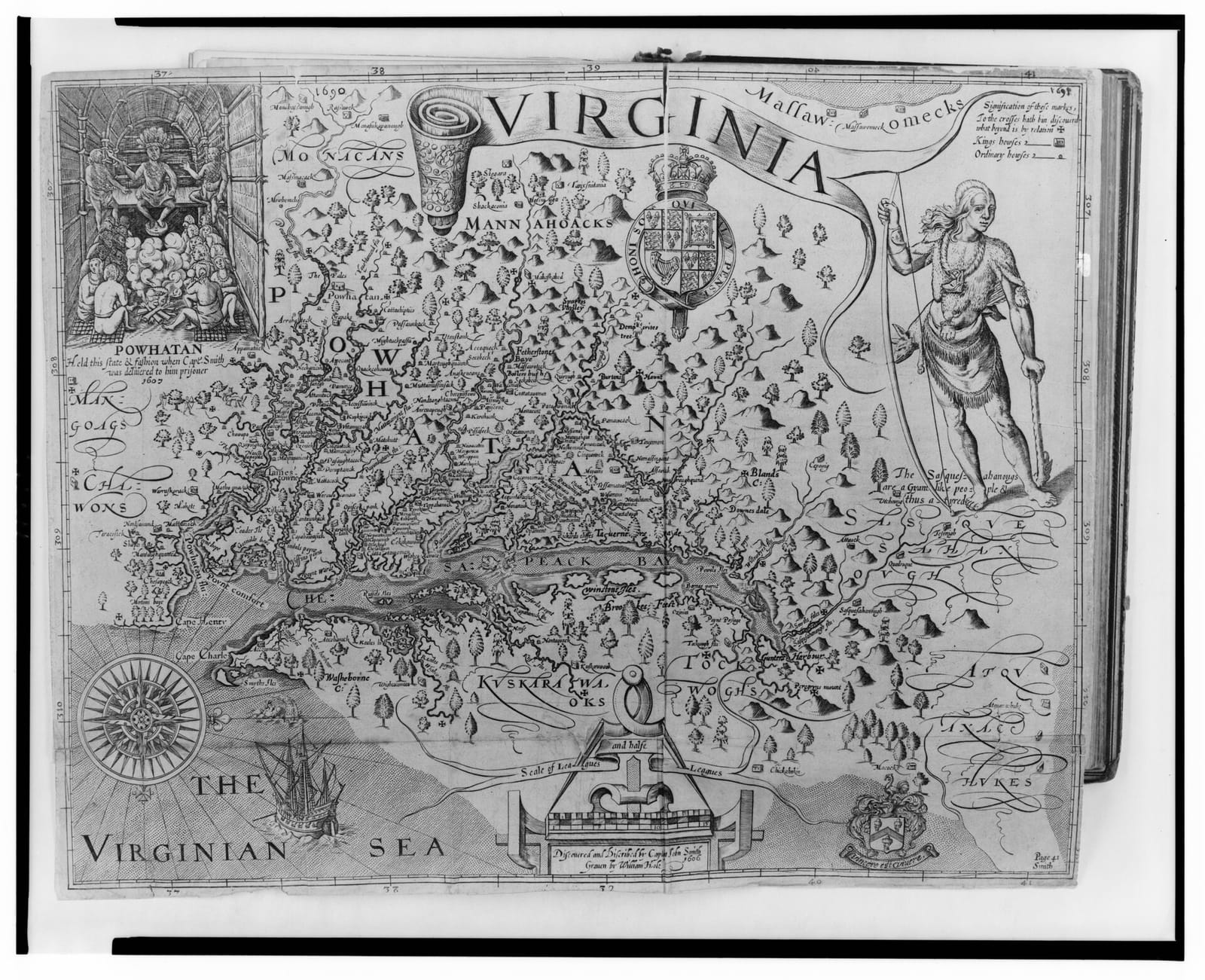
Tsenacomoco on the English map of 1612
Questions about the Pocahontas family tree
Who the father of Pocahontas was
Her father was Wahunsenacawh, the paramount chief of Tsenacomoco, whom the English called Powhatan. English accounts do not record her mother.
Whether Pocahontas has living descendants
Many people trace themselves onto the Pocahontas family tree through Thomas Rolfe and the Bolling line. Encyclopedia Virginia calls those claims tenuous, because no record proves that Thomas had children.
People and sources
A page of its own lists all 15 people on the chart, each with a short note and the sources for it, and the six numbered sources this article cites. It also gives the credits of the portraits and this page as a reference in the APA, MLA, Chicago and Harvard styles, ready to copy.