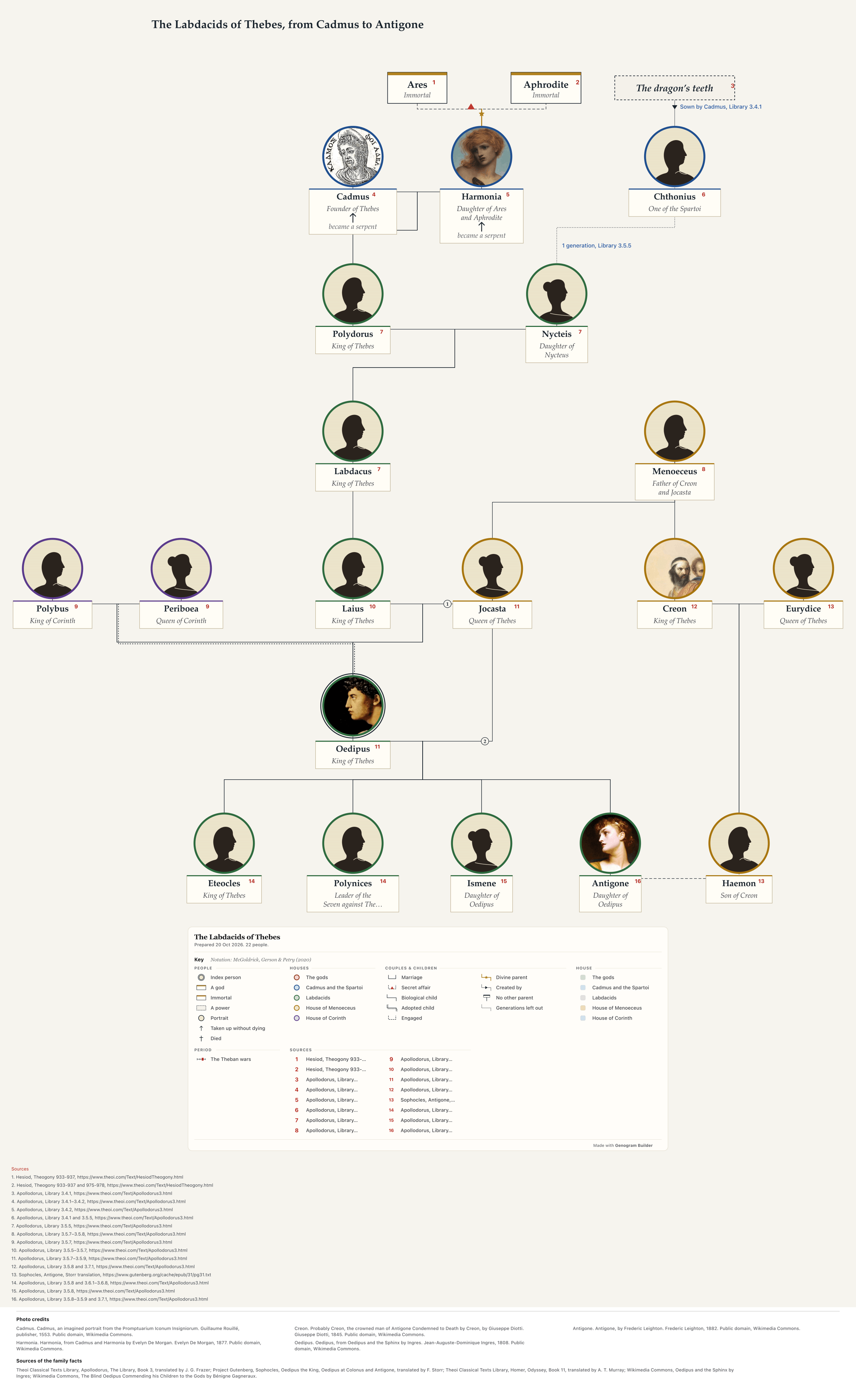
How to read this Antigone family tree
Read this Antigone family tree from the top down, one generation to a row. The figures of myth have no dates, so each plate gives a title in place of years. The colour of each plate shows the house.
A picture is a figure
Each is a detail of an old painting or print, named in the credits.
A double ring is the centre
Oedipus is the centre, the son and the husband of Jocasta.
A solid line is a marriage
Jocasta has two, the first to Laius and the second to Oedipus.
From Cadmus to Laius
The Antigone family tree begins with a stranger to Thebes. Cadmus was one of the three sons of Agenor, and he killed a dragon by a spring of Ares and sowed its teeth on the advice of Athena. Armed men rose from the ground, and five of them survived, among them Echion and Chthonius.1 To atone for the dragon, Cadmus served Ares for “an eternal year,” and then Zeus gave him Harmonia, the daughter of Aphrodite and Ares.1 The parents of Harmonia belong to the Greek mythology family tree.
Harmonia bore four daughters, Autonoe, Ino, Semele and Agave, and a son, Polydorus.1 Semele became the mother of Dionysus by Zeus, and Agave bore Pentheus, who ruled Thebes after Cadmus.1 The chart follows the son. Polydorus married Nycteis, a granddaughter of Chthonius, so the line of kings descends from one of the men sown from the dragon’s teeth.1
Labdacus gave the house its name and died leaving a son a year old, Laius.1 As a young man Laius fell in love with Chrysippus, a son of Pelops, and carried him off.1 He then married a daughter of Menoeceus, whom “some say” was Jocasta and others Epicasta.1
Oedipus, the son who became a husband
An oracle had warned Laius “not to beget a son,” since that son would kill his father. When a son was born, Laius pierced the child’s ankles and gave him to a herdsman to expose.1 Herdsmen of Corinth brought the baby to Periboea, wife of King Polybus, who raised him as her own and named him Oedipus for his swollen feet.1
Grown up, Oedipus met Laius on a narrow road and killed him in a quarrel, without knowing who he was.1 At Thebes the Sphinx was asking “What is that which has one voice and yet becomes four-footed and two-footed and three-footed,” and Creon had promised the kingdom and the widow of Laius to whoever could answer.1 Oedipus solved the riddle and “unwittingly married his mother.”1
This marriage is why the Antigone family tree folds back on itself. Jocasta is both mother and wife of Oedipus, so her four children by him are also his half brothers and half sisters. Antigone is his daughter and his sister at once.
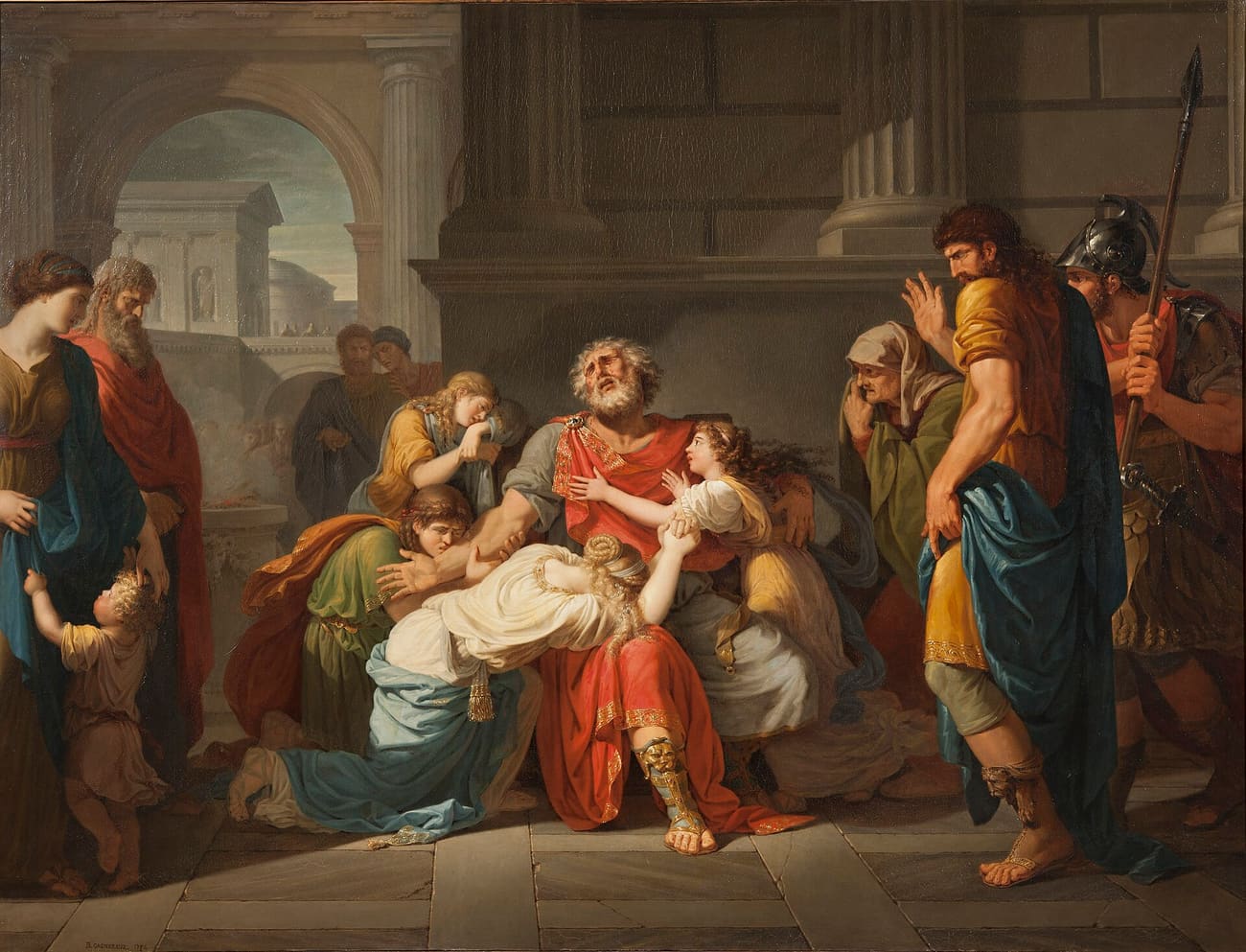
When the secret came out, “Jocasta hanged herself in a noose,” and Oedipus put out his eyes, cursed his sons and was driven from Thebes.1 In Sophocles a messenger tells how he tore the golden brooches from her robe and struck his own eyes.2 He went with Antigone to Colonus in Attica, where Theseus received him kindly and where he died.1
Eteocles, Polynices, Ismene and Antigone
Apollodorus names the four children of Oedipus and Jocasta, the sons Polynices and Eteocles and the daughters Ismene and Antigone.1 The brothers agreed to rule Thebes in turn, a year each. When Eteocles kept the throne, Polynices went to Argos and married Argia, a daughter of King Adrastus.1
Adrastus raised an army “with seven leaders” and marched on Thebes. At the gates the two brothers “fought a single combat for the kingdom, and slew each other.”1 So the curse that Oedipus laid on his sons was fulfilled, and both lines of male descent from Laius ended in one day.
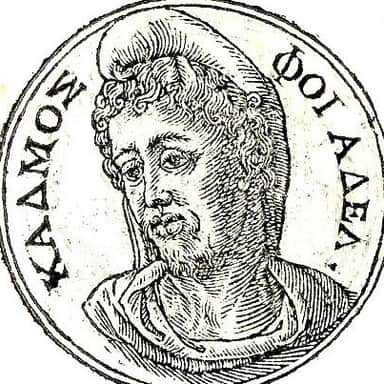 Cadmus
 Oedipus
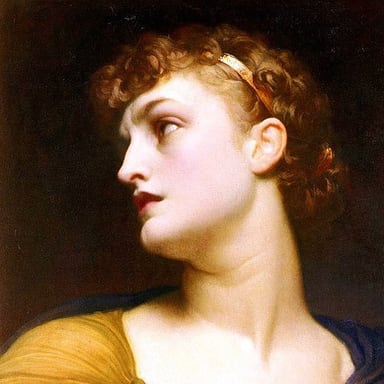 Antigone

Creon, Haemon and the burial of Polynices
After the deaths of the brothers, Creon, “son of Menoeceus,” held Thebes.1 He is the brother of Jocasta, and in Sophocles he calls her “my royal sister.”2 That makes him the great-uncle of Antigone through her father and the uncle through her mother, the second loop on this Antigone family tree.
Creon left the Argive dead unburied and “issued a proclamation that none should bury them.”1 Antigone “stole the body of Polynices, and secretly buried it,” and for this she was put alive into a tomb.1 In Sophocles the Chorus asks Creon whether he will rob his own son of his bride, since Haemon was betrothed to Antigone.2
The play ends in three deaths. Antigone hangs herself in the tomb, Haemon falls on his sword beside her, and his mother Eurydice stabs herself, mourning her other son Megareus as well.2
Where Homer, Apollodorus and Sophocles differ
This Antigone family tree follows Apollodorus and Sophocles, who agree on the main line. The texts part on the points below, and the chart notes each one on the figure it concerns.
| Question | Homer, Odyssey 11 | Apollodorus, Library 3 | Sophocles |
|---|---|---|---|
| The name of the queen | Epicaste | Jocasta, or Epicasta in some accounts | Jocasta |
| What became of Oedipus | He went on ruling Thebes in sorrow | He was blinded and driven out, and died at Colonus | He blinded himself and left Thebes with Antigone |
| The mother of the four children | Not stated | Jocasta, or in some accounts Eurygania, daughter of Hyperphas | Jocasta |
| The death of Haemon | Not told | Carried off by the Sphinx | He kills himself beside Antigone |
The second marriage that Apollodorus reports matters most to the chart. If the four children were born to Eurygania, they are not the children of their father’s mother, and the double tie between Antigone and Oedipus falls away.1 Homer says that the gods made the marriage known “straightway,” which leaves no time for four children at all.3 The tragedians keep Jocasta, and so does this Antigone family tree. The house of Atreus family tree draws the other cursed family of Greek tragedy.
Questions about the Antigone family tree
How Antigone is related to Oedipus
She is his daughter and his half sister. On the Antigone family tree Jocasta is the mother of Oedipus and also the mother of his four children, so Antigone shares a mother with her own father.
How Antigone is related to Creon
Creon is her uncle, the brother of her mother Jocasta. Since Jocasta is also the mother of Oedipus, Creon is the uncle of her father as well.
How Antigone and Haemon are related
They are first cousins, since Haemon is the son of Creon and Antigone the daughter of Jocasta, his sister. In Sophocles the two are betrothed.
Who the Labdacids are
The royal house of Thebes named after Labdacus, the grandson of Cadmus. Laius, Oedipus and the two sons of Oedipus are his descendants on this chart.
People and sources
A page of its own lists all 22 people on the chart, each with a short note and the sources for it, and the three numbered sources this article cites. It also gives the credits of the portraits and this page as a reference in the APA, MLA, Chicago and Harvard styles, ready to copy.