How to read this Geronimo family tree
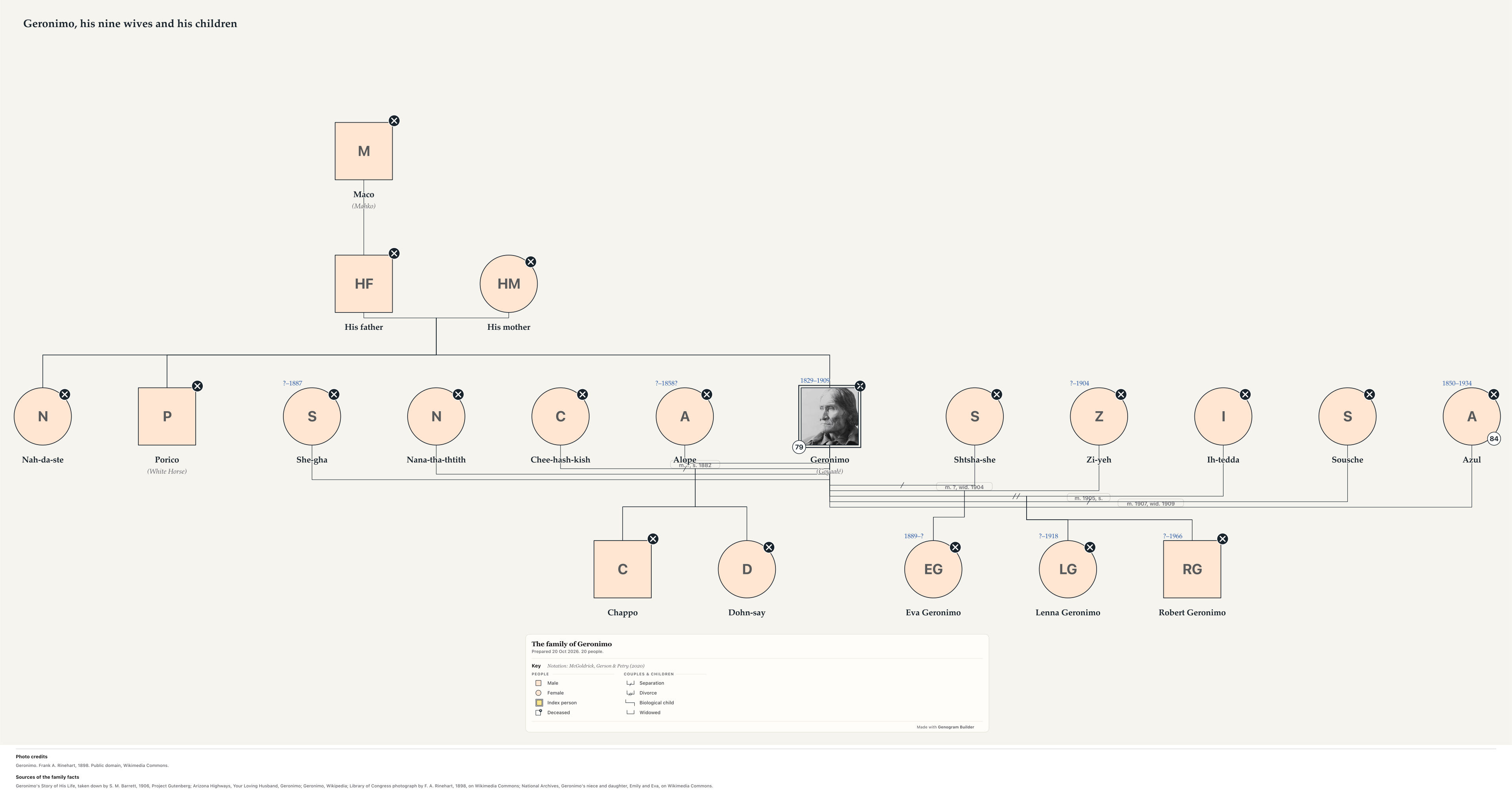
Read the Geronimo family tree from the top down, one generation to a row. Geronimo is the centre, drawn with a double frame and a photograph of 1898. Squares are men and circles are women. Everyone else has a silhouette, because no photograph on Commons can be matched to them with confidence.
The double frame is Geronimo
Born in June 1829 and died at Fort Sill in 1909.
Nine couple lines leave Geronimo
They run in the order of marriage, from Alope to Azul.
A child hangs from its mother's marriage
Chappo and Dohn-say from Chee-hash-kish, Eva from Zi-yeh, Lenna and Robert from Ih-tedda.
The family in Geronimo's own words
Geronimo told the story of his life to S. M. Barrett, who published it in 1906.1 It is the only account of the family in his own words, and the Geronimo family tree takes from it every relative he names. Wikipedia gives his own name as Goyaałé, the one who yawns, and his birth as 16 June 1829, near Turkey Creek, a tributary of the Gila River, then in Mexico and now in New Mexico.3
He was the fourth of eight children, four boys and four girls. By 1906 only he, his brother Porico, called White Horse, and his sister Nah-da-ste were living.1 He does not name the other five, so the chart draws only these two beside him.
A grandfather and two parents without names
Geronimo names his grandfather, Maco, and says that he had been their chief.1 Barrett's note calls Maco a chief of the Nedni Apaches, while Wikipedia writes Mahko and calls him chief of the Bedonkohe.13 The chart writes the name as Geronimo gives it.
He names neither parent. His father died when he was a small boy, and Barrett's note says the father had married a Bedonkohe woman and joined her people.1 His mother was killed by Mexican troops in the same attack that killed his first wife and children.1 Genealogy websites give both parents names, but no source read here does, so the Geronimo family tree draws them as his father and his mother.
Alope and the attack at Kas-ki-yeh
After the council of warriors admitted him in 1846, Geronimo went to No-po-so to ask for his daughter Alope. The father asked many ponies for her, and Geronimo brought them.1 Arizona Highways quotes his words that the greatest joy was that he could now marry the fair Alope.2 Three children were born to them.1
While the men were away trading, Mexican troops attacked their camp. Geronimo said that his aged mother, his young wife and his three small children were among the slain.1 He dates the attack at Kas-ki-yeh to 1858. Arizona Highways dates the killing to 1851, and Wikipedia places his mother's death at Janos in that year.23 The Geronimo family tree writes 1858 with a question mark and does not draw the three children one by one, because no source read names them.
The nine wives of Geronimo
Barrett's note says Geronimo had four wives who were full Bedonkohe and four who were part Bedonkohe.1 With Azul, whom he married after 1906, Wikipedia counts nine.3 Arizona Highways tells each marriage in turn, and the Geronimo family tree follows its order.2
| Wife | Married | How the marriage ended |
|---|---|---|
| Alope | About 1846 | Killed by Mexican troops with their three children |
| Chee-hash-kish | After Alope's death | Captured by Mexicans in 1882, after about thirty years |
| Nana-tha-thtith | About the same time | Killed by Mexican troops with their child |
| She-gha | 1860s or early 1870s | Died of tuberculosis in 1887 |
| Shtsha-she | Not recorded | Lost to him in 1884 |
| Zi-yeh | Not recorded | Died in 1904 |
| Ih-tedda | Not recorded | Sent home to Mescalero, a divorce by Apache custom |
| Sousche | Christmas Day 1905 | Separated soon after |
| Azul | About 1907 | Widowed in 1909 |
She-gha was a relative of Cochise. After her capture in 1885 Geronimo took her back from Fort Apache, and she died in 1887 after the prisoners left Fort Marion. She is buried at Barrancas National Cemetery.2 Little is known of Shtsha-she.2 Ih-tedda was a Mescalero woman, and Geronimo said that sending her home was equal to what white people call divorce.1 Sousche was also called Mrs. Mary Loto, and Geronimo said they could not live happily.21 Azul nursed him in his last illness.2
The children who lived
Barrett's note says that four of Geronimo's children were killed by Mexicans and four were held as prisoners by the United States government.1 Arizona Highways names the five whose lives can be followed, and the Geronimo family tree draws them.2
Chee-hash-kish was the mother of Chappo and Dohn-say. Chappo was sent home from the Carlisle Indian School with tuberculosis and died soon after.2 Wikipedia says that a daughter, probably Dohn-say, married Zebina Streeter.3 Zi-yeh bore Eva in 1889, and in 1906 Eva was the one child living with her father.21 He held a dance for her coming of age near Fort Sill in September 1905.1
Ih-tedda gave birth to Lenna at Fort Marion and to Robert after she went home. In 1906 Geronimo said both were living at Mescalero, New Mexico, and that Lenna was married.12 Lenna died in 1918 and Robert in 1966, and both left descendants.2 Zi-yeh also had a son, Fenton, who stayed in captivity, and Nana-tha-thtith and She-gha each had a child who died young. Those three are named in the text only.2
Geronimo's life in dated records
Birth
Born among the Bedonkohe Apache.
Marriage
Admitted to the council of warriors, he marries Alope.
Kas-ki-yeh
Mexican troops kill his mother, wife and children. Other sources give Janos in 1851.
Chee-hash-kish
Mexicans capture his wife of about thirty years.
Surrender
He surrenders and becomes a prisoner of war.
Eva
His youngest daughter is born.
Death
He dies of pneumonia at the Fort Sill hospital, still a prisoner.
Questions about the Geronimo family tree
How many wives Geronimo had
Wikipedia and Arizona Highways count nine, from Alope to Azul. In 1906 Barrett counted eight, before the marriage to Azul.
Who the parents of Geronimo were
His own account does not name them. It says his father died when he was a small boy and his mother was killed by Mexican troops.
People and sources
A page of its own lists all 20 people on the chart, each with a short note and the sources for it, and the three numbered sources this article cites. It also gives the credits of the portraits and this page as a reference in the APA, MLA, Chicago and Harvard styles, ready to copy.