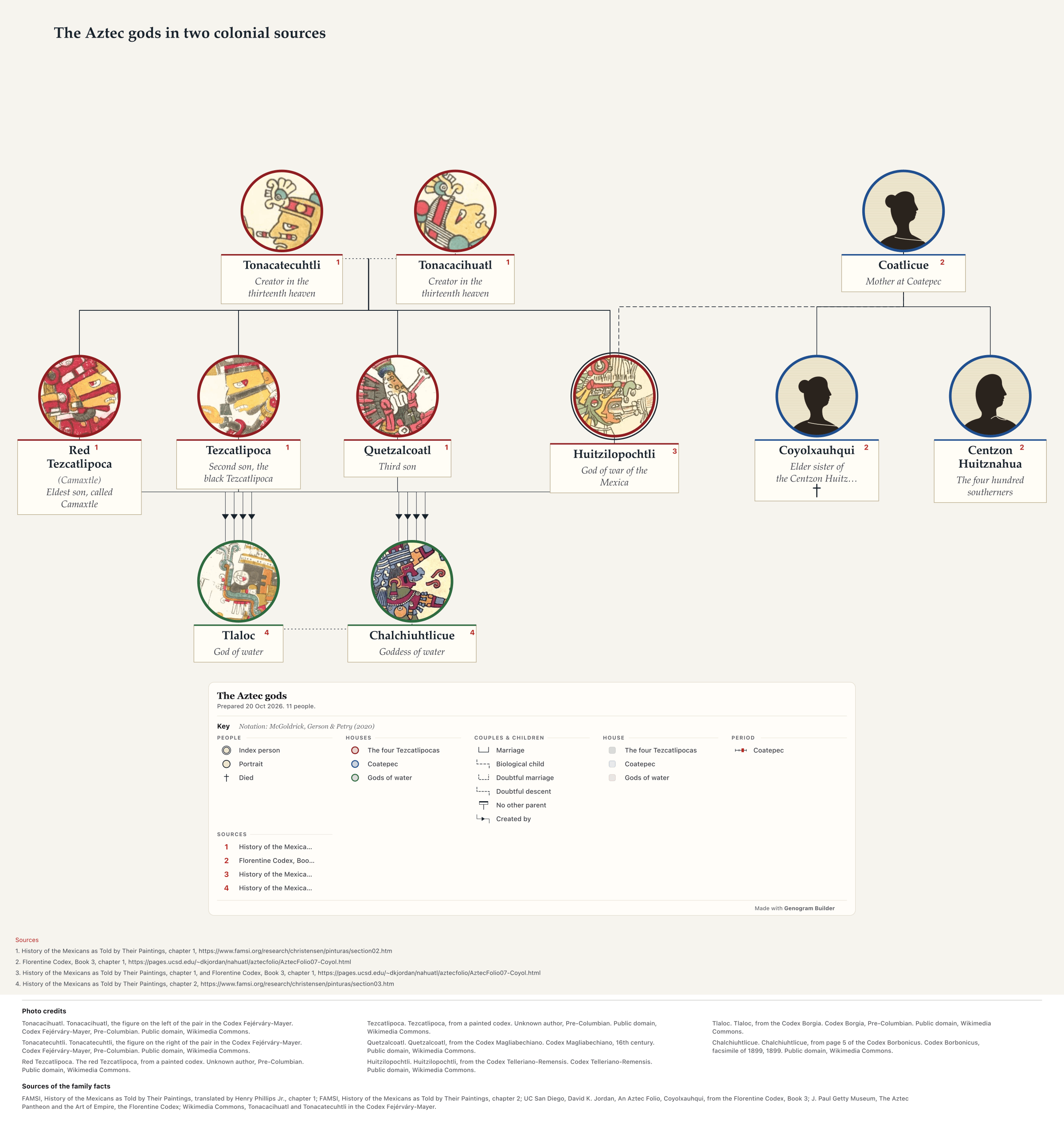
How to read this Aztec god family tree
Read this Aztec god family tree from the top down. The gods have no dates, so each plate gives a title in place of years. The pictures are details of painted codices. They show each god with its dress and signs, while the family lines come from the two written sources quoted below.
A double ring is the centre
Huitzilopochtli, the god of war of the Mexica.
A solid line is a pair
Tonacatecuhtli and Tonacacihuatl, and Tlaloc and Chalchiuhtlicue.
A red line is a killing
Huitzilopochtli killed his sister Coyolxauhqui at Coatepec.
Two colonial sources and how far to trust them
The two texts that this Aztec god family tree follows were both made after the Spanish conquest, by or for Spanish churchmen, from what Nahua painters, lords and elders told them. Neither is a sacred book of the Aztecs themselves.
The first source is the History of the Mexicans as Told by Their Paintings. Its translator, Henry Phillips, explains that it “was prepared shortly after the Conquest” by the orders of Ramírez de Fuenleal, Bishop of Cuenca and President of the Chancelleria.4 Its author says he worked from the narrations of the lords and from books “anointed with human blood,” and adds that each community called the gods by different names.1
The second source is the Florentine Codex, the work of the Franciscan friar Bernardino de Sahagún, who spent thirty years recording Aztec life “in Spanish as well as Nahuatl” with his students and native elders. It is kept in the Biblioteca Medicea Laurenziana in Florence.6 Book 3 tells the birth of Huitzilopochtli, and its translators note several places where the Nahuatl can be read more than one way.5
The creator pair and their four sons
The History begins with “one god named Tonacatecli, who took for wife Tonacaçiguatl.” The pair “created themselves, and were perpetual inhabitants of the thirteenth heaven.”1 This Aztec god family tree spells them in the modern way, Tonacatecuhtli and Tonacacihuatl.
Four sons were born to them. The eldest, the red Tezcatlipoca, was “born of a ruddy color all over,” and the people of Huexotzinco and Tlaxcala worshipped him as Camaxtle. The second, Tezcatlipoca, was “the greatest and the worst,” and “totally black at birth.” The third was Quetzalcoatl.1
The fourth and smallest was called Omitecuhtli and Maquizcoatl, “whom the Mexicans termed” Huitzilopochtli, and whom they took as their chief god and god of war. He “was born without flesh, but only bones,” and so lived for six hundred years, while the gods did nothing.1 The four sons then made the fire, a half sun, the first man and woman and the days of the calendar.2
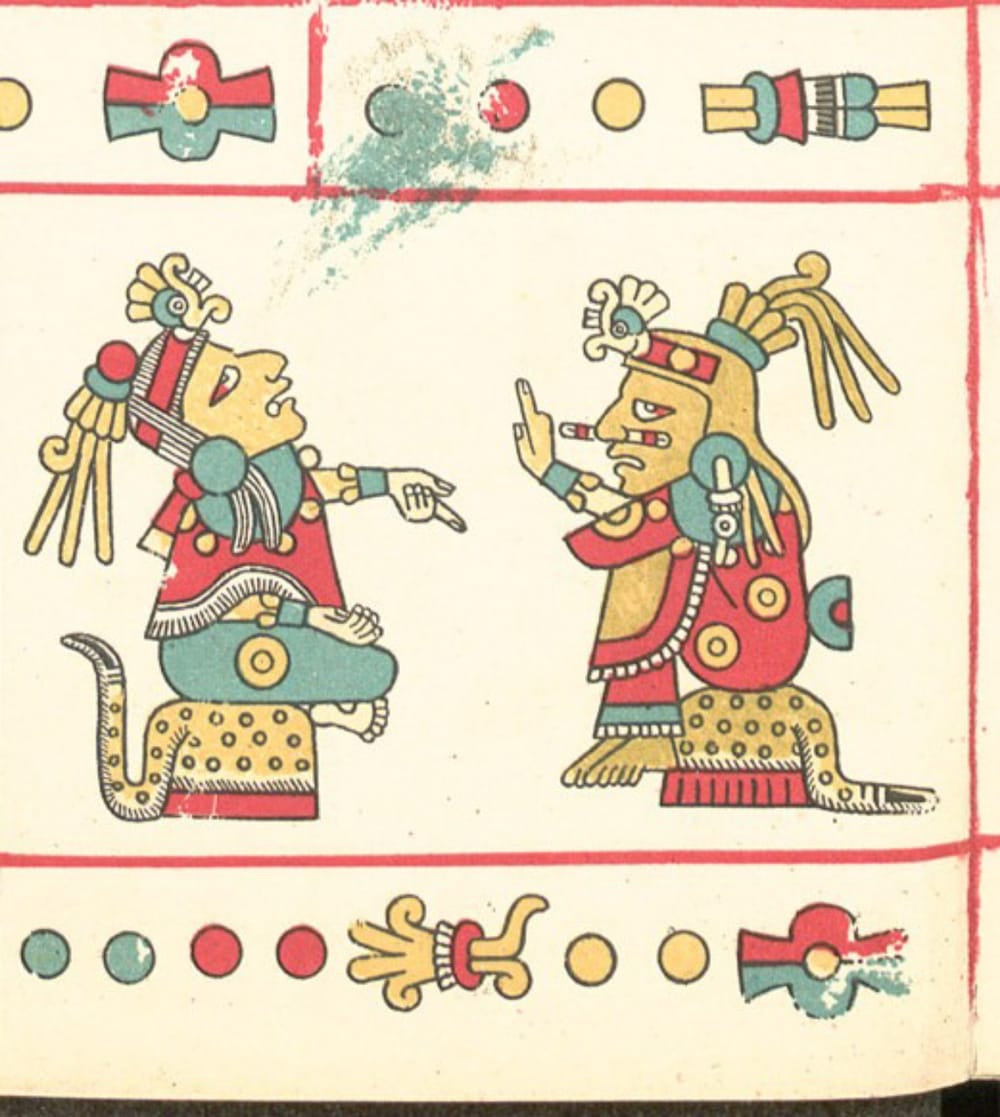

Coatlicue, Coyolxauhqui and the birth of Huitzilopochtli
The Florentine Codex tells another birth. At Coatepec there lived a woman named Coatlicue, “mother of the Centzon Huitznahua,” whose elder sister was Coyolxauhqui.5 While she swept, a ball of feathers fell, and “Coatlicue snatched it up and placed it in her bosom.” Then “Coatlicue conceived.”5
Her children took the pregnancy as a disgrace. Coyolxauhqui told the Centzon Huitznahua, the four hundred brothers, “we must slay our mother, the wicked one who is already with child.”5 As they came, Huitzilopochtli was born, and the translators note that he “appears to have been born filthy but fully armed,” with his shield, darts and dart thrower.5
He “pierced Coyolxauhqui, and then he quickly struck off her head,” and her body “went crashing in pieces” below the hill. Then “Huitzilopochtli then arose and pursued the Centzon Huitznahua.”5 Jordan notes that scholars disagree whether she was cut apart or broke in the fall, and whether the places of the story are the hills around or parts of the Great Temple of Tenochtitlan.5
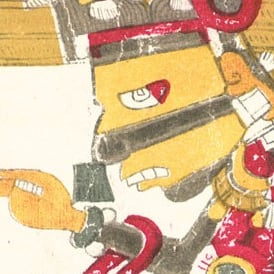 TezcatlipocaThe black Tezcatlipoca.
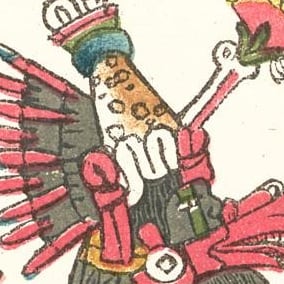 QuetzalcoatlFrom the Codex Magliabechiano.
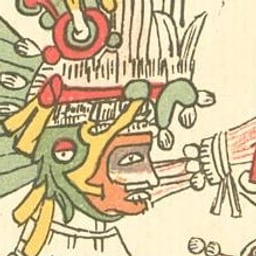 HuitzilopochtliFrom the Codex Telleriano-Remensis.
Tlaloc and Chalchiuhtlicue, made and not born
Not every god in the History has parents. “To create the god and goddess of water, all the four divinities joined themselves together, and made Tlalocatecli, and his wife Chalchiutlique.”2 On this Aztec god family tree Tlaloc and Chalchiuhtlicue therefore hang from the four sons by thin lines of Created by, not by lines of birth.
The same chapter has the four sons make the lords of the underworld, Mictlantecuhtli and his wife, and a first man and woman, Oxomoco and Cipactonal.2 Their son Piltzintecuhtli was given a wife made from the hair of Xochiquetzal.3 They are left off the chart, which keeps to the gods with a family line.
Where the History and the Florentine Codex differ
The two sources were made for different readers, and on the main point they cannot both be right.
| Question | History of the Mexicans | Florentine Codex, Book 3 |
|---|---|---|
| The parents of Huitzilopochtli | Tonacatecuhtli and Tonacacihuatl | Coatlicue, by a ball of feathers |
| His brothers and sisters | Tezcatlipoca, the red Tezcatlipoca and Quetzalcoatl | Coyolxauhqui and the four hundred Centzon Huitznahua |
| How he was born | Without flesh, only bones | Fully armed, as his brothers attacked |
| The names used | Many, by community and dialect | Nahuatl names, with readings in doubt |
The chart keeps both mothers and marks the line from Coatlicue as disputed, since neither text can be preferred on the evidence of the other. The gods of Greece and Egypt, whose sources agree more often, are drawn on the Greek mythology family tree and the Osiris family tree.
Questions about the Aztec god family tree
Who the parents of Huitzilopochtli were
The sources disagree. The History of the Mexicans makes him the youngest son of Tonacatecuhtli and Tonacacihuatl. The Florentine Codex makes him the son of Coatlicue, so the Aztec god family tree draws both.
How Tezcatlipoca and Quetzalcoatl are related
In the History of the Mexicans they are brothers, the second and third of the four sons of the creator pair.
How Coyolxauhqui is related to Huitzilopochtli
She is his elder sister in the Florentine Codex, a daughter of Coatlicue, and he killed her at Coatepec.
Why there is no single Aztec family of gods
The family was written down only after the conquest, by different authors from different towns, and each community called the gods by different names.
People and sources
A page of its own lists all 11 people on the chart, each with a short note and the sources for it, and the six numbered sources this article cites. It also gives the credits of the portraits and this page as a reference in the APA, MLA, Chicago and Harvard styles, ready to copy.