A financial genogram records money events, sayings and support
A financial genogram, also called a money genogram, is an ordinary genogram with one more layer. Beside the names and the dates it records the money events of each generation, such as a business that failed, an inheritance, a move abroad to find work or a debt that was paid off. It records what the family says about money, often in the words of a parent or a grandparent, and who gives money to whom.
The money genogram is described in the family therapy literature, for example by Mumford and Weeks in the Journal of Family Psychotherapy in 2003. Counsellors and financial therapists can use it to help a person or a couple see where their habits with money came from before they talk about what to change.
Genogram Builder
Draw money as its own line
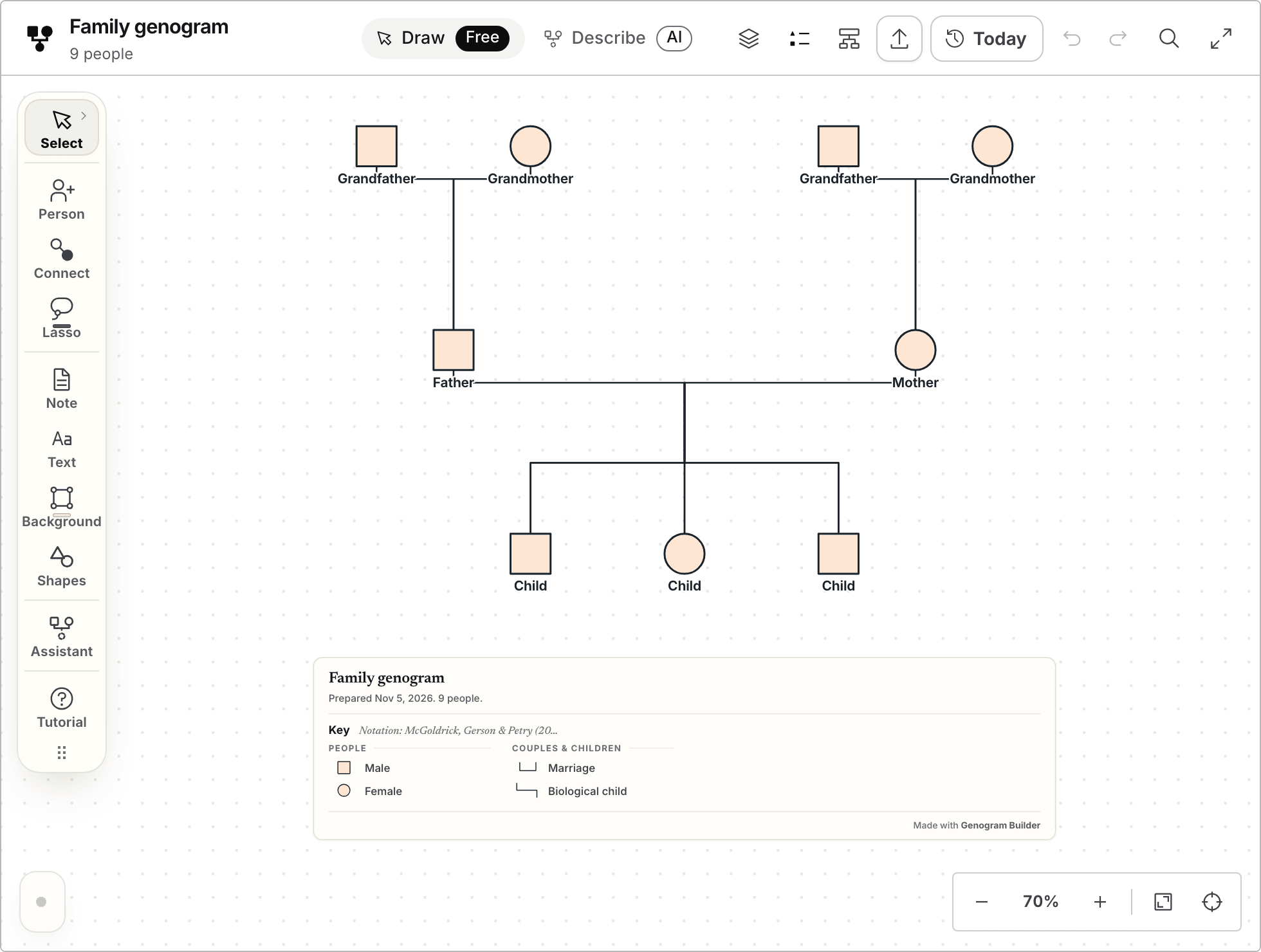
Start from the blank three generation sheet, name the family, then add a custom line such as financial support with an arrow toward whoever receives the money.
- Opens without an account
- Custom lines are named in the key
- PNG and PDF export with a free account, with a watermark
Record the same fields for every person on the chart
Keep the record even from one person to the next, and write each answer in the words the person used. Amounts are rarely needed. A range or a plain description such as covers the rent is enough, and it is easier for the family to agree to.
| Field | What to write | A fictional example |
|---|---|---|
| Work and income | The main work and whether income was steady | Shift work at a mill, laid off in 1982 |
| Money events | Each event with its year | Inherited a house in 1995 and sold it |
| Family sayings | What the person heard about money, in quotation marks | We do not borrow |
| Support given or received | Who pays for whom, since when | Pays a daughter’s rent since 2023 |
| Shared obligations | Loans, guarantees and joint accounts | Co-signed a sister’s lease |
| Open questions | What is not known and whom to ask | Why the farm was sold, ask an aunt |
A fictional family shows support and a shared debt as lines
The Reyes and Ortiz family in the template library is fictional and is drawn here by the editor. Rachel Ortiz is the index person. She married Daniel Ortiz in 2012 and they divorced in 2023, and the chart records their relationship as hostile. Their son Leo is close to his mother, and Daniel pays child support, drawn as a financial support line to Leo.
Since 2023 Rachel’s father Manuel has given her monthly support that covers her rent and Leo’s after-school care, drawn as a second financial support line. Her brother Andrés co-signed her lease in 2023, drawn as a line of its own. Manuel and Carmen, her parents, are recorded as close but in conflict, and the template notes that they argue about whether the money keeps Rachel from standing on her own. The chart records the arrangements and leaves the judgement to the people in it.
Neutral questions open a financial genogram interview
Ask about what happened and what was said before asking how anyone felt about it. The questions below can be copied as a list. Skip any that the person does not want to answer, and leave the field empty rather than guess.
Money in the family you grew up in
- Who earned the money in your family, and who decided how it was spent?
- Was money talked about openly, or was it kept private?
- What did your parents or grandparents say about saving, borrowing and giving?
- Were there years when money was short, and what changed in the family then?
Events across the generations
- Which money events does the family still talk about, such as a loss, an inheritance or a move for work?
- Did anyone start a business, lose a business or leave one to someone else?
- Has anyone been in serious debt, and how was it resolved?
Support and obligations today
- Who in the family gives money to whom, and since when?
- Have you signed for a loan, a lease or a debt for a relative?
- Which money arrangement would you most like to change?
Draw each money line in the editor as a custom line
The standard relationship lines describe how close or strained a relationship is, so money needs a line of its own. A custom line takes a name, a colour and an arrow, and the key lists it under Your lines.
Open the blank sheet, select each person and type the name and the year of birth into the details.
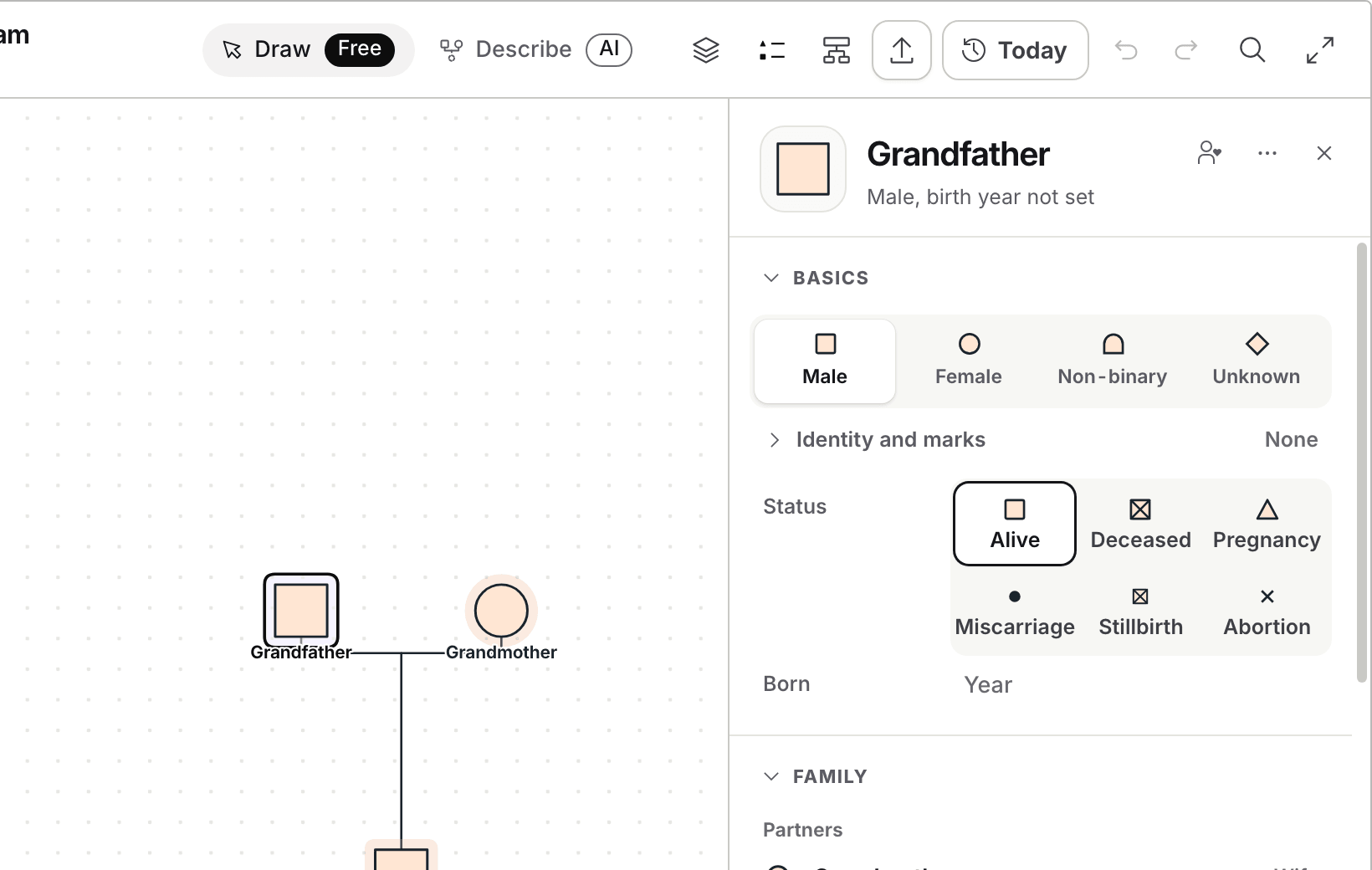
Hover over the person who gives the money, click Emotional relationship on the ring, click the person who receives it, and click New custom line.
Type Financial support in Name in the key, choose a colour and the arrow at the second person, and click Create.
The chart describes money and gives no financial advice
A financial genogram helps a person see a pattern. It does not say whether a loan was wise, whether a parent should stop paying or how anyone should invest, and it makes no judgement about the people on it. Decisions about money belong with the family and, where needed, with a qualified adviser. Where the family owns a company, the roles and shares in it are covered by the family business genogram, and the wider interview is in the genogram interview questions.
Common questions
The difference between a financial genogram and a money genogram
There is none in practice. Both names describe a genogram that adds money events, sayings and support to the family structure.
Whether to write amounts on the chart
Usually not. A range or a description is enough to show the pattern, and the chart may be seen by people who should not see exact figures.
How to show money on the chart
Draw it as a custom line with a name in the key, such as financial support, and an arrow to the person who receives it. Write the year it began on the line.
Who uses a financial genogram
Counsellors, financial therapists, couples who want to talk about money and students who are set the exercise in a course. It is drawn with the person whose family it shows.
Sources and methodology
We make Genogram Builder. We used the references below for this guide. Last checked on 5 November 2026.
Put the family on a blank sheet, then draw each kind of support as a line of its own. No account is needed to begin.
Start a financial genogram