The notation shades the lower half of a symbol for substance misuse
The notation of McGoldrick, Gerson and Petry (2020) uses the lower half of a symbol for alcohol or drug misuse and the left half for a physical or psychological problem. A filled lower half records misuse. A hatched lower half records misuse that is suspected. Recovery fills only the lower-left quarter, with the dividing line drawn across the full width of the symbol. When a person has both a problem and substance misuse, three quarters are filled.
The words under the name say which substance it is and when it began, because the shading alone does not say whether it was alcohol or a drug.
Alcohol or drug abuse
Suspected alcohol or drug abuse
In recovery from substance abuse
Problem and substance abuse
Genogram Builder
Open a family that records alcohol misuse
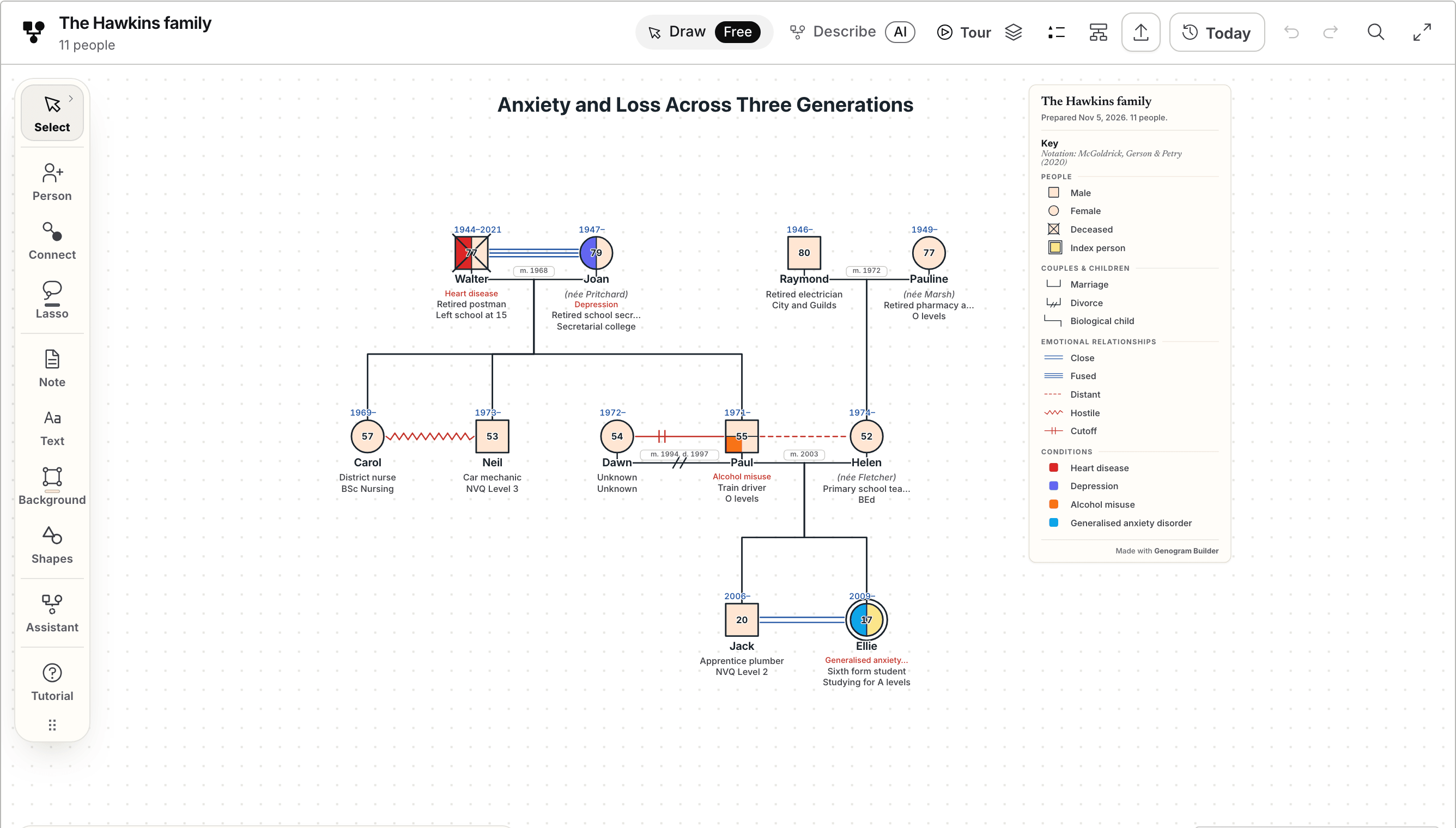
The fictional Hawkins family opens in the editor with alcohol misuse, a cutoff and four conditions shaded, so you can see how each mark is set.
- Opens without an account
- Each condition has a status, such as suspected or in recovery
- PNG and PDF export with a free account, with a watermark
Each fact on the chart carries a date and a source
Substance use is a subject on which relatives disagree, remember differently or repeat what they heard from someone else. An addiction genogram stays useful when every fact on it says when it applied and who said so. The record below is fictional and belongs to no real family. It shows the four kinds of fact a worker meets and how each one is written down.
| Fact as recorded | When | Who said so | How it is marked |
|---|---|---|---|
| Grandfather drank every day until he died | Until 1990 | His daughter Ruth, at interview | Hatched lower half, marked as suspected, with the source in the notes |
| Father in recovery from alcohol | Since 2016 | The father himself | Lower-left quarter, with the year |
| Father completed a treatment programme | 2016 | A discharge letter, seen with his consent | A note under his name |
| An uncle may drink heavily | Not dated | One cousin, second hand | Hatched lower half, marked as suspected |
| The client says drinking became a problem at fifteen | 2009 | The client | Filled lower half, with the age of onset |
| Cause of an aunt’s death | Not known | Nobody present knew | Left blank, with whom to ask |
A fictional family shows recovery, suspicion and a cutoff
The Herrera family in the template library is fictional and is drawn here by the editor. Ernesto Herrera, 1944 to 2008, is recorded with alcohol use disorder from the age of twenty and with alcohol-related cirrhosis as his cause of death. His son Miguel is recorded in remission, sober since 2012, with Alcoholics Anonymous drawn as an institution beside him. Miguel’s brother Javier is recorded with alcohol use disorder that is still present, and the two brothers have been cut off from each other since 2015.
Mateo, Miguel’s son, is the index person. His alcohol use disorder is recorded as suspected, not confirmed, after a screening score of 19, and he shares a household with his father. Carmen, who does not drink, is drawn as the caretaker of her mother Dolores. Sofia, Mateo’s older sister, is recorded as drinking rarely. Karen, Miguel’s former wife, divorced him in 2010, which the notes place during his heaviest drinking. The chart records these facts and says nothing about why they are there.
An addiction genogram records reports and draws no conclusions
A pattern across generations is a question to ask, not a finding. Three relatives with the same shading show that the subject comes up in this family. They do not show that one person’s drinking caused another’s, or that a child will follow a parent. Write what each person said, mark what is suspected as suspected, and leave a rumour in the notes rather than on a symbol.
Ask before writing anything about a relative who is not in the room, and keep the chart as confidential as any other health record. The genogram interview questions include a group on health and habits, and the guide to genograms in nursing and medicine covers health histories more widely.
Fill in the same fields for each person on the chart
A blank layout keeps the record even from one person to the next. Use these fields for each person, and leave a field empty rather than guess. In the editor, open the person’s side panel, click Add a condition, choose the condition, and set Kind to Substance use and Status to Active, Suspected or Recovery.
Update the record when something changes. A year of recovery, a relapse or a new programme is added with its own date, and the earlier entry stays in the notes, so the chart shows a history rather than one moment.
| Field | What to write |
|---|---|
| Substance or behaviour | Alcohol or a named drug in the words used, and any other behaviour as a note, since the notation has no mark for it |
| Status | Present, suspected, or in recovery since a given year |
| Onset | The age or the year it began, marked as approximate where it is |
| Treatment and support | Programmes, groups and services, with years |
| Source and date | Who said it, when, and whether a record confirms it |
| Consent | Whether the person agreed to have it written down |
Common questions
Which symbols an addiction genogram uses
The standard notation fills the lower half of a symbol for alcohol or drug misuse, hatches it when misuse is suspected and fills only a quarter for recovery. The genogram symbols guide shows each mark with its definition.
Whether to record a relative who was never diagnosed
Record what was reported, say who reported it and mark it as suspected unless a record or the person confirms it. The chart is a record of what the family said, not a diagnosis.
Where to find an addiction genogram template
The medical family history sheet on the templates page prints with a key for substance misuse, remission and recovery. The editor draws the same marks on screen without an account.
Who draws an addiction genogram
Counsellors, addiction workers, nurses and social workers draw them with a client, and some families draw one to talk about a pattern they have noticed. It is the client’s story, so it is drawn with the client.
See how substance use, recovery and a cutoff are recorded on a fictional family, then change it into your own. No account is needed to begin.
Open the Hawkins family