Each person can belong to the family, the business or the ownership
Renato Tagiuri and John Davis described the family business as three overlapping groups, the family, the business and the ownership, in a model they developed at Harvard Business School in 1978. Because the groups overlap, a person can be a relative only, an employee only, an owner only, or any combination, which the model counts as seven interest groups. A family business genogram puts all three on the chart, so the overlaps can be seen at once.
| Role | Where it goes on the chart | In the fictional Brandt family |
|---|---|---|
| Family | The standard symbols, couple lines and children | Three generations from Walter and Ingrid |
| Business | The job title under the name, with the years | Karl as chief executive since 2015 |
| Ownership | A custom line or a note, with the year | Shares given to Karl and Heidi in 2015 |
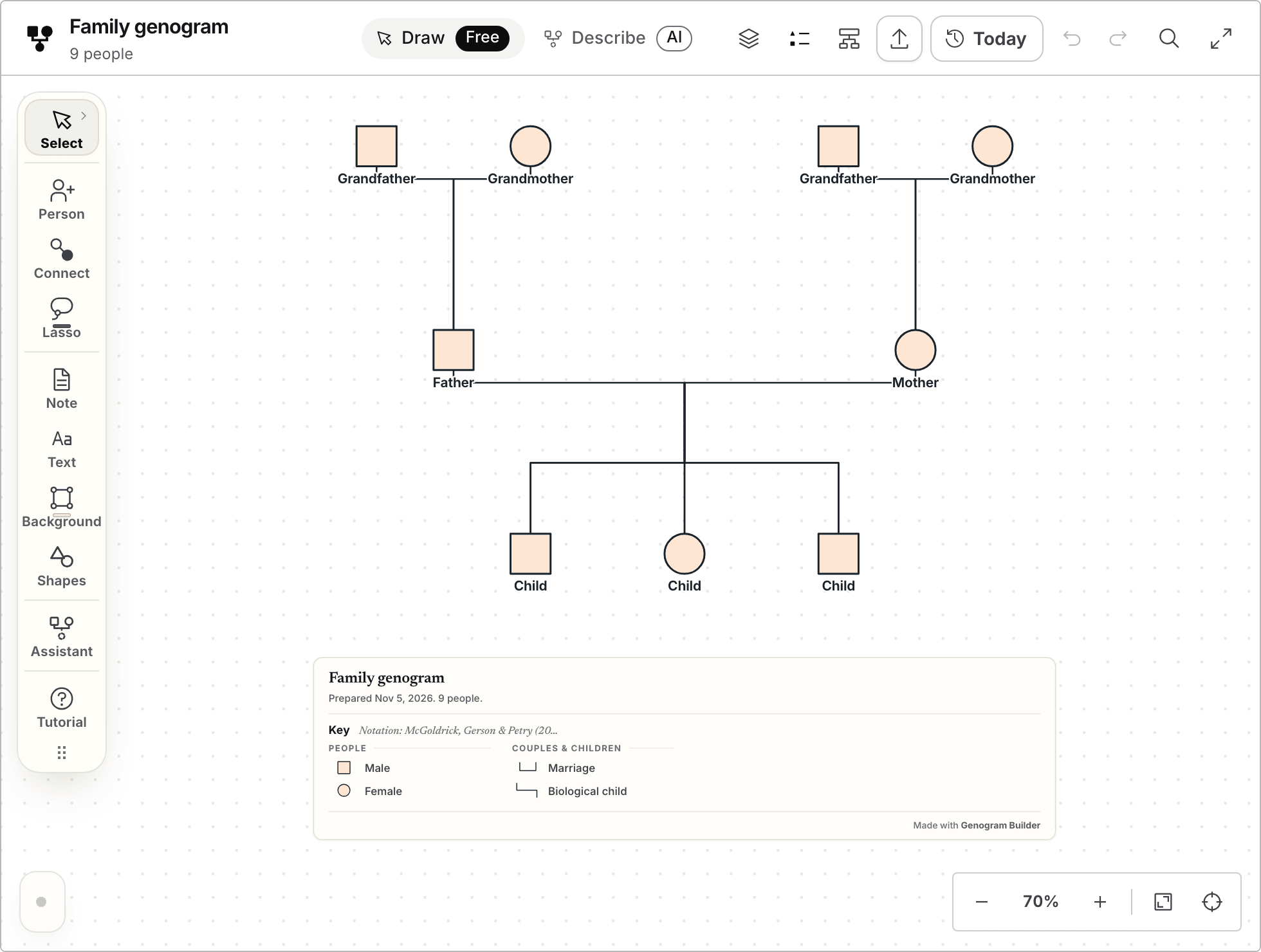
Genogram Builder
Draw your family and its firm
Start from the blank three generation sheet, write each job under the name, and add lines of your own for shares and employment.
- Opens without an account
- Custom lines are named in the key
- PNG and PDF export with a free account, with a watermark
Write the job under the name and draw ownership as a line
Draw the family first, in the standard notation, with the founders on the top row and each generation below. Then write each person’s role in the firm under the name, such as founder, chief executive or finance director, and the year it began. Someone who works elsewhere gets their own occupation, because who stayed out of the firm matters as much as who joined it.
Ownership and employment are not emotional relationships, so they need lines of their own. In the editor a custom line takes a name in the key, such as owns shares or employs, a colour, one or two strands, and an arrow at the second person where the line has a direction. Write the year on each line and leave percentages off unless the people on the chart have agreed to show them.
A fictional firm shows shares, jobs and a rivalry
The Brandt family in the template library is fictional and is drawn here by the editor. Walter Brandt founded Brandt Precision Tooling and is still its chairman. After a heart attack in 2015 he stepped back and gave shares to his two children, Karl and Heidi, while keeping the controlling block. His wife Ingrid kept the firm’s books for its first thirty years.
Karl has been chief executive since 2015 and employs his son Lukas, who joined in 2020. Heidi is the chief financial officer, and the chart records the rivalry between her and Karl over who should lead the company after Walter as hostile. Heidi’s husband Paul is a teacher who stays out of the business. Her daughter Emma works for another manufacturer, and Walter is drawn as her mentor.
Draw the firm in the editor with custom lines
The editor draws the family in the standard notation and lets you add the business as lines of your own, each named in the key.
Open the blank sheet, select each person and type the name, the years and the role in the firm into the details.
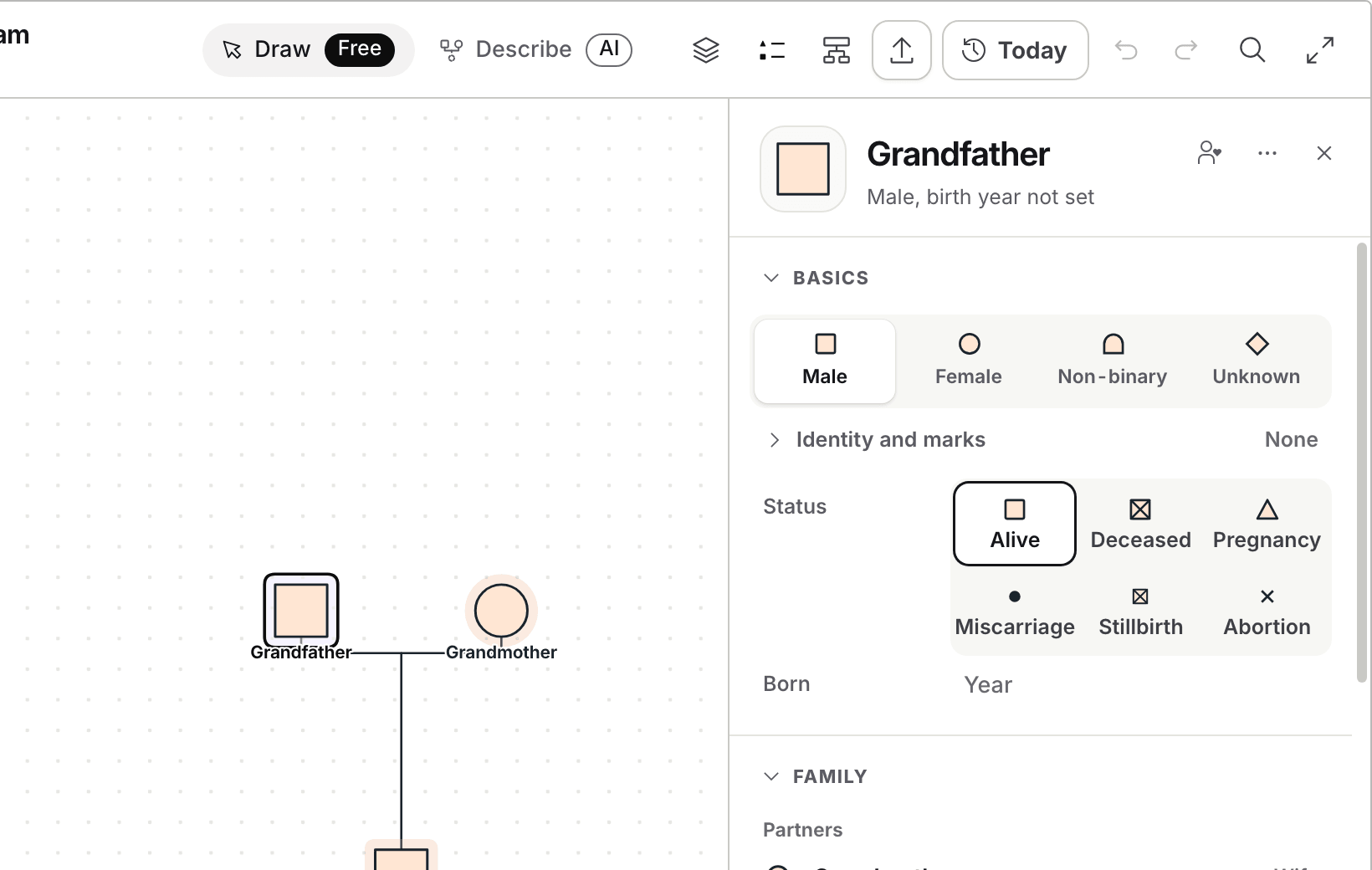
Hover over the founder, click Emotional relationship on the ring, click a child who holds shares, and click New custom line.
Type Owns shares in Name in the key, choose a colour and two strands, and click Create. For Employs, also choose the arrow at the second person.
Questions that fill in a family business genogram
Ask the same questions of each generation, and write the answers with their years. The list can be copied and used in a meeting with the family.
Ownership
- Who founded the firm, and when?
- Who holds shares today, and how did they come to hold them?
- Has ownership ever passed outside the bloodline, for example to an in-law?
Work in the firm
- Who works in the firm, in which role, and since when?
- Who chose to work elsewhere, and what did the family say about it?
- Who trained or mentored whom inside the business?
Decisions and the future
- How are decisions about the firm made, and who takes part?
- Which disagreements about the firm have affected relationships in the family?
Read the chart for overlaps rather than for a successor
A family business genogram shows what a list of shareholders or an organisation chart does not. It shows who owns part of the firm but has no job in it, who works in it but owns nothing, which in-laws are drawn in and which stand outside, and where a rivalry between siblings runs along the same line as a question of ownership.
The chart does not choose a successor, value a share or settle a dispute. Those decisions belong with the family, the board and their advisers. Family business advisers use genograms to open that conversation, and the book Family Business on the Couch, by Manfred Kets de Vries, Randel Carlock and Elizabeth Florent-Treacy, includes an appendix on developing a business family genogram.
To record one person’s working life rather than a shared firm, the career genogram template gives each relative a line for their occupation and education.
Common questions
Who draws a family business genogram
Family business advisers, consultants and family therapists draw them with the family, and members of a family firm sometimes draw one before a meeting about the future of the company.
Whether to include in-laws and partners
Yes, when they hold shares, work in the firm or take part in its decisions. A partner who stays outside the firm is drawn as well, since the family includes them.
How to show shares without the figures
Draw a custom line named owns shares between the person who gave the shares and the person who holds them, as the Brandt chart does with a double line, or write shareholder under the name. Add percentages only when everyone on the chart has agreed.
How it differs from a career genogram
A career genogram records the work of each relative separately. A family business genogram follows one firm through the family, with ownership and employment drawn between people.
Sources and methodology
We make Genogram Builder. We used the references below for this guide. Last checked on 5 November 2026.
Put the family on the blank sheet, write each role under the name and draw shares and jobs as lines of their own. No account is needed to begin.
Start a family business genogram