A supervision genogram maps a lineage of supervision
A family genogram follows the people a person descends from. A supervision genogram, as this guide draws it, follows the people who supervised and trained a practitioner and the people who supervised them, so that a trainee can see where their ideas about supervision came from.
Aten, Madson and Kruse published their article in the journal Psychotherapy. According to its abstract, the tool is meant to build the self-awareness of supervisors in training and their understanding of the supervisory process. The article explains how to develop and process the genogram, gives an overview of its symbols and a completed example, and discusses ethical, professional and developmental issues. It adds that trainers of supervisors can use the chart to assess what a supervisor in training needs.
The article’s own symbols are in the full text, available through the publisher and university libraries, and are not reproduced here. The charts on this page use three lines of their own, marked in the key as conventions of this guide. If your course uses the article’s symbols, follow those.
Genogram Builder
Print the blank chart or draw it in the editor
Draw your own network in the editor with three named custom lines.
- A printable landscape chart with four rows
- Custom lines are named in the key
- PNG and PDF export with a free account, with a watermark
Dana’s chart shows one supervisor’s influence arriving twice
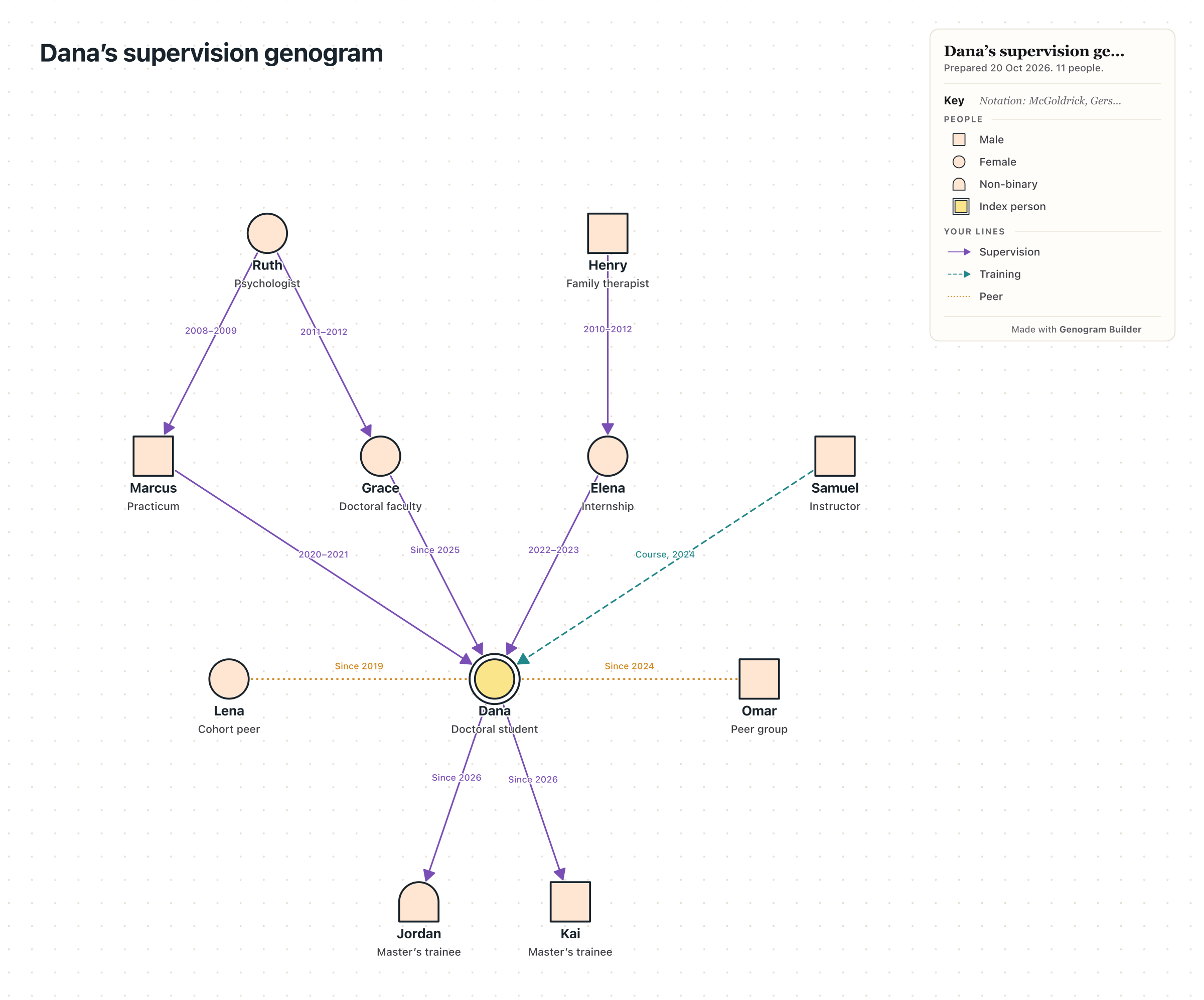
Dana Whitfield is a fictional doctoral student in counselling psychology who began supervising two master’s trainees in 2026. Her second row holds Marcus Bell, her practicum supervisor from 2020 to 2021, Elena Ortiz, her internship supervisor from 2022 to 2023, and Grace Kim, a faculty member who has supervised Dana’s own supervision since 2025. Samuel Price taught her supervision course in 2024.
Dana sits between two peers, Lena from her cohort and Omar from a consultation group, above Jordan and Kai, the trainees she supervises.
The top row makes a pattern visible. Marcus and Grace were both supervised by Ruth Abbott, so two of the supervisors who shaped Dana learnt from one person. Dana can ask which of Ruth’s habits reached her twice and whether she is passing them on.
Supervision, training and peer connections need different lines
Supervision is an ongoing relationship in which a more experienced practitioner oversees a trainee’s work with clients and usually evaluates it. Training is teaching, such as a course or a workshop, without responsibility for particular clients. A peer connection joins colleagues at a similar stage who consult one another without evaluating each other.
A supervisor who also taught you a course is joined by two lines, one of each kind.
| Connection | How this guide draws it | Who it joins | What to write on it |
|---|---|---|---|
| Supervision | A solid violet line with an arrow at the person supervised | A supervisor and a supervisee, including your own supervisees | The years, the setting and whether it was individual or in a group |
| Training | A dashed teal line with an arrow at the learner | A teacher or trainer and you | The course or workshop and the year |
| Peer | A dotted amber line without an arrow | You and a colleague at a similar stage | The cohort or group and the years |
Fill in the blank chart one row at a time
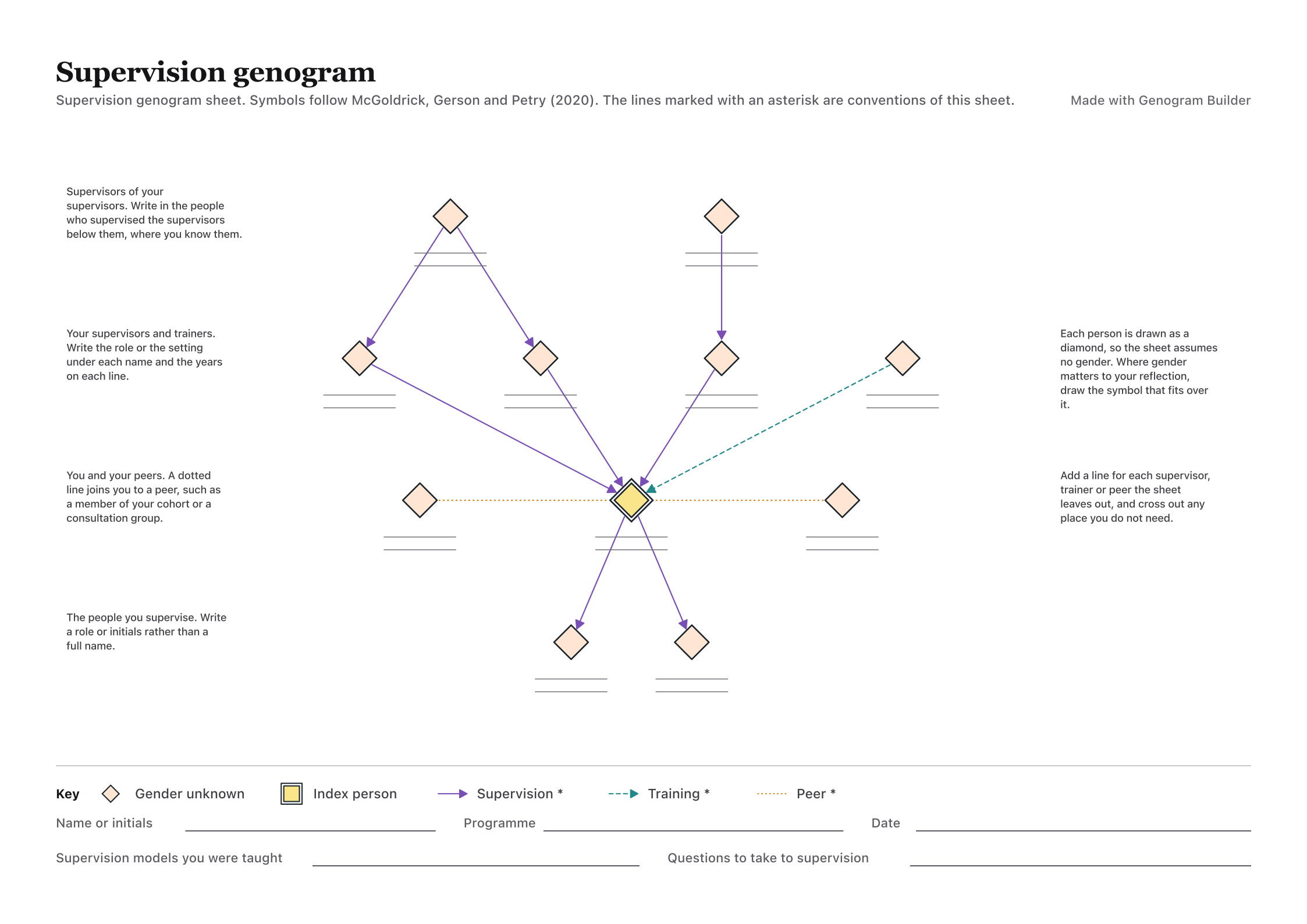
The printable chart has four rows of diamonds, the symbol for a gender not recorded, so that it assumes nothing about who fills it in. Write a role or initials on the first line under each symbol and the setting on the second.
Start with yourself and your supervisors, add the trainers and peers who influenced you, then ask your supervisors who supervised them. Cross out any place you do not need, and leave the bottom row empty until you have supervisees.
Reflective questions turn the chart into material for supervision
The questions below were written for this guide. Choose the few that matter to you and take them to your supervisor or your course.
Your supervisors
- Which supervisor do you most want to resemble as a supervisor, and which least?
- What did each supervisor do when you made a mistake with a client?
- How did differences of culture, gender or age between you and a supervisor shape the relationship?
Across the generations
- Which approaches or habits appear in more than one line of your chart?
- What did your supervisors learn from the people who supervised them?
You as a supervisor
- Which of your supervisors’ habits do you notice in your own supervision?
- What would you like your supervisees to take from you, and what would you rather not pass on?
- How will you talk about evaluation with someone you supervise?
- What support do you need from your own supervisor while you learn to supervise?
Protect the people on the chart before you share it
A supervision genogram describes real colleagues, some of whom may still assess or employ you. Use roles or initials on any copy that leaves your hands, leave out the names of clinics that would identify someone, and keep clients off the chart.
Write your reading of a relationship in your own notes rather than on the chart, because a judgement about a named supervisor can do harm if the chart is shared. Show the full chart only to people you choose, and say in an assignment that names have been changed.
A supervisor usually evaluates the trainee, so showing them the chart crosses a difference in power. Decide beforehand what you will discuss, and a course that sets the exercise should let a trainee keep parts of it private.
Draw the same chart in the editor with custom lines
Genogram Builder can draw this chart, although it was made for families. Follow Start a new genogram, add each person with the Person tool and type the role where the occupation goes. Draw an emotional relationship from a supervisor to you and turn it into a custom line, as Make your own kind of line explains.
Name the first line Supervision, with Violet, a solid line and the mark Arrow at the second person. Name the second Training, with Teal, a dashed line and the same mark, and the third Peer, with Amber, a dotted line and a plain mark. The key lists them under Your lines, and Label writes the years beside a line.
Common questions
Who introduced the supervision genogram
Jamie D. Aten, Michael B. Madson and Sandra Johnston Kruse published it in 2008 in the journal Psychotherapy. Check a citation against the PubMed record, number 22122369, or the DOI 10.1037/0033-3204.45.1.111.
How it differs from a family of origin genogram
A family of origin genogram maps relatives. A supervision genogram maps professional relationships, from the supervisors of your supervisors to the people you supervise. The family of origin genogram guide covers the family assignment.
Sources and methodology
We make Genogram Builder. We used the references below for this guide. Last checked on 9 November 2026.
- PubMed, Aten, Madson and Kruse, The supervision genogram, a tool for preparing supervisors-in-training, 2008
- DOI record of the article, Psychotherapy, volume 45, pages 111 to 116
- The University of Southern Mississippi, Aquila repository record of the article
- Genogram Builder documentation, Make your own kind of line
Add the people who supervised and trained you, and name three custom lines. No account is needed to begin.
Open the editor