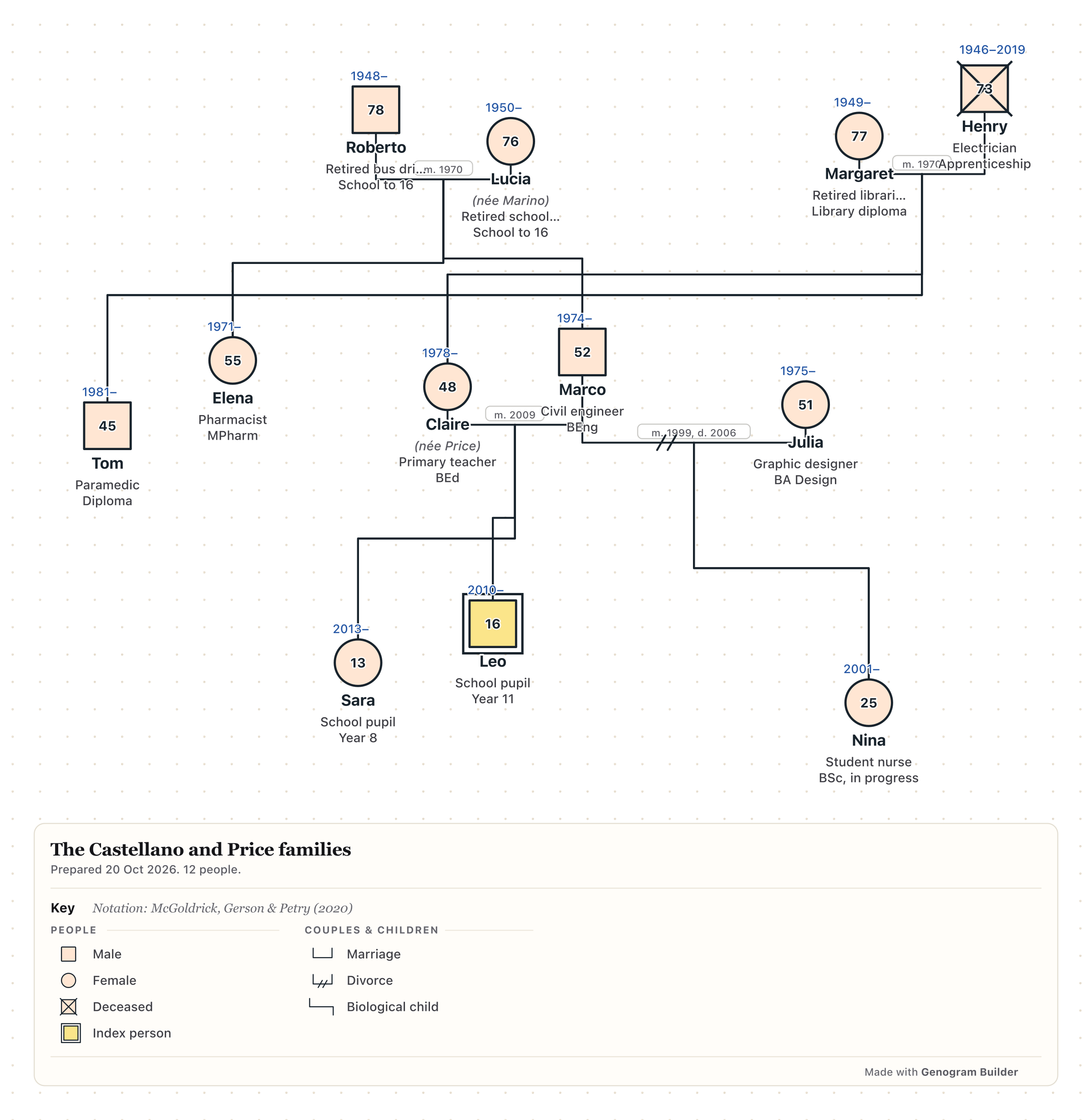
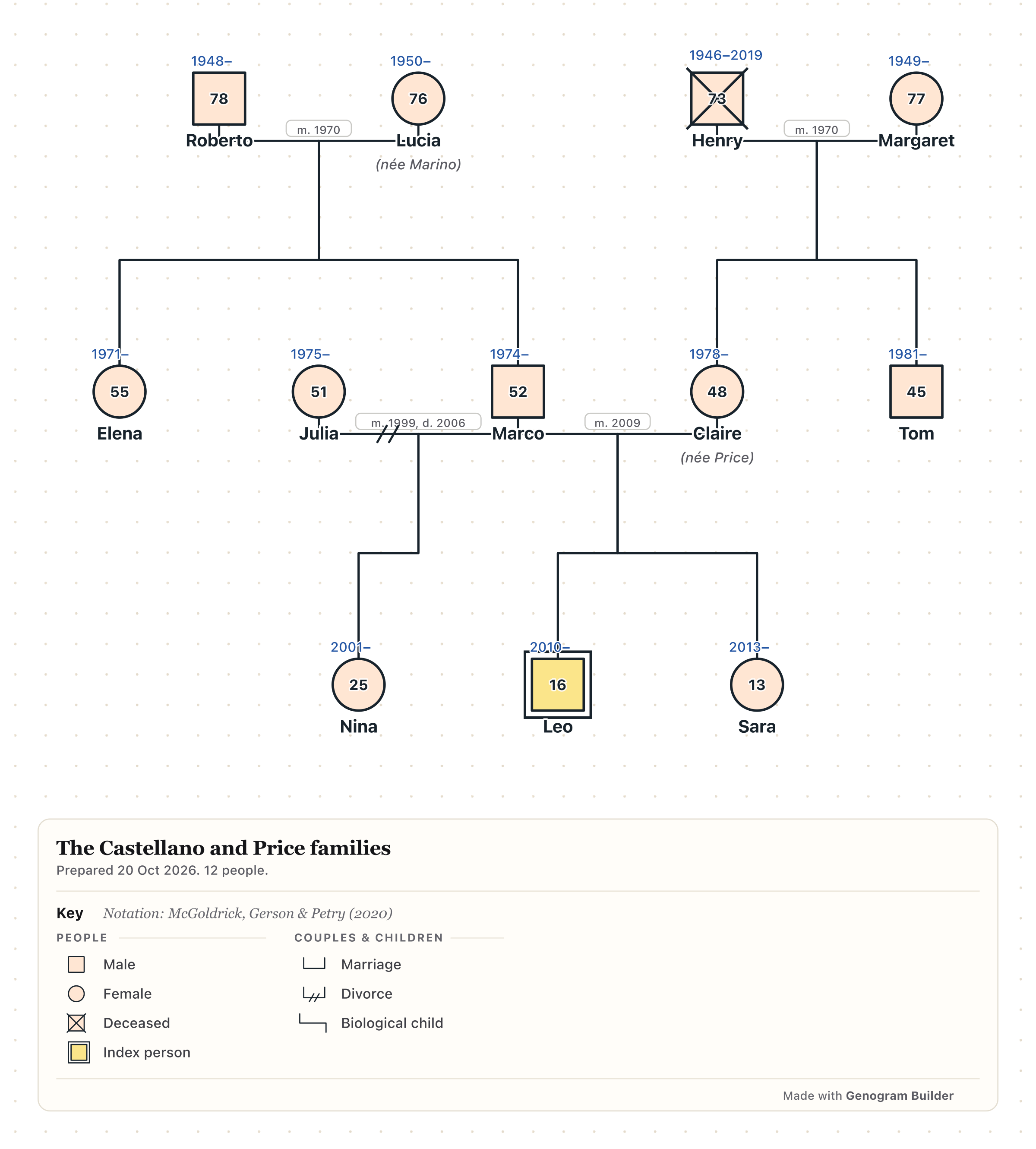
The same family reads better once four things change
Both drawings hold the same twelve people, four couples and four sets of children. In the first, the rows drift up and down, so it is hard to tell who belongs to which generation. Claire stands on the far side of Marco from her own parents, so her parents’ line crosses his. Sara is drawn before her older brother, and two lines of occupation and education crowd every name.
The second drawing changes four things and nothing else. Each generation sits on one level row. Marco stands between his former wife Julia and his present wife Claire, so each couple line is short. The children hang from their own parents in birth order, oldest on the left. Each symbol has its name below and its years above, and nothing more.
Genogram Builder
Try the layout on a blank family
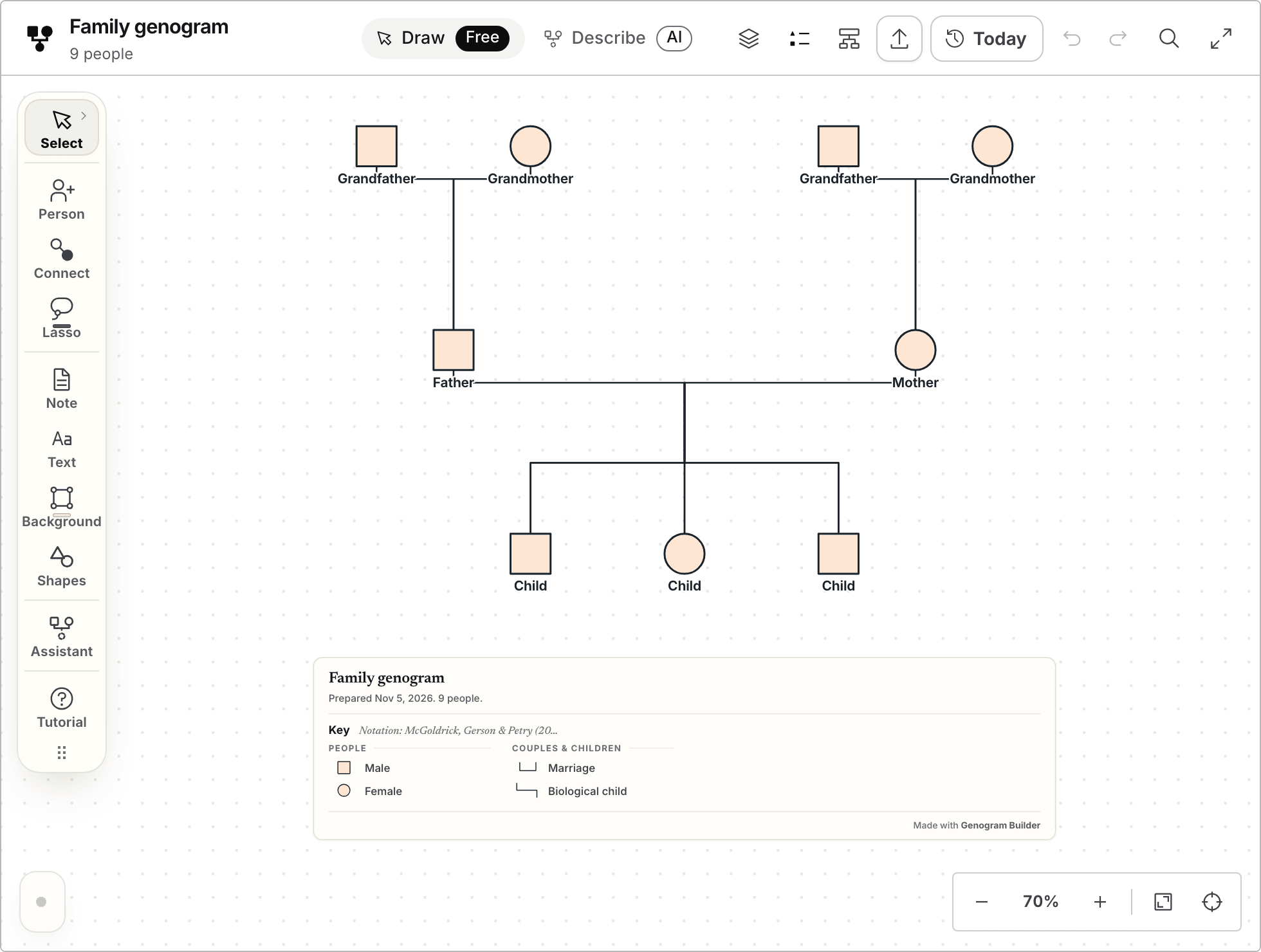
The blank three generation sheet opens with level rows and a key, and Arrange tidies the rows again after you add people.
- Opens without an account
- The key is drawn from what you use
- PNG and PDF export with a free account, with a watermark
Give each generation one row and keep the gaps even
A reader finds a generation by its height on the page, so a person drawn half a row too high looks like a different generation. Keep the gaps between people even within a row, and leave more room where a couple line or a sibling line needs to pass. White space between branches does the work that boxes and colours often try to do.
- Level the rows
Put everyone of one generation at the same height, and keep the distance between rows the same down the page.
- Keep partners together
Draw partners side by side, with a former partner further out, so that no couple line passes behind another person.
- Seat children in birth order
Hang each set of children from their own parents, from the oldest on the left to the youngest on the right.
- Leave room between branches
Give each side of the family its own space, so a sibling line never runs under the wrong couple.
Fewer words under each symbol make the chart easier to read
Every line of text under a symbol pushes the next person further away or into the text of a neighbour. Write the name and the years on the chart, and add an occupation, a condition or a place only when the question the chart answers depends on it. A longer note belongs in a list beside the chart, or in the person’s own notes in the editor.
The key should list only what the chart uses and sit where the reader looks for it, under the drawing or beside it. In the editor, the What is written tab of View clears the label rows the reader does not need, and Arrange with Tidy straightens the rows and evens out the spacing in one step.
Match the genogram design to where it will be read
The best genogram design ideas depend on where the chart ends up. A class assignment is often printed in black and white, so a pattern that relies on two shades of red disappears. Use the shading of the notation, which still reads in grey, and put the key on the same page as the chart.
A clinical record is read in a hurry by someone who did not draw it. Keep it plain, date it, and leave out anything the reader does not need. The Clinical mode of the editor replaces names with numbers when the chart has to be shared without them.
A slide is read from across a room. Show three generations at most, raise the text size and cut the labels to names alone. The What is written tab sets the text size and can wrap long text, so the same chart can serve the page and the screen.
Creative genogram ideas still keep the standard symbols
A creative family genogram can use colour, hand lettering or a larger sheet of paper, and it still reads as a genogram as long as the squares, circles and lines keep their standard meaning. The table sets out ideas that work and the one rule each of them has to keep.
| Idea | When it helps | What has to stay standard |
|---|---|---|
| Colour by household or heritage | Two families joined by a second marriage | Every colour named in the key |
| One accent colour | A single pattern the reader should follow | All other symbols left plain |
| Hand lettering on a large sheet | A class poster or a family reunion | Names under the symbols and years above them |
| A timeline strip under the chart | Moves, losses and events in the same years | Dates written the same way as on the chart |
| A dark background | A slide shown in a dim room | Lines thick enough to read from the back |
Eight case genograms apply the same choices to larger families
Large and well-known families test these ideas hardest, because they have remarriages, many children and branches that drift apart. The case guides draw each one in the same notation and explain the choices made. They cover the Madrigal family of Encanto, the Kennedy family, the families of Harry Potter, the Simpsons and Star Wars, the households of Modern Family, the houses of Game of Thrones and the Hoover family of Little Miss Sunshine.
For clinical and medical families drawn in the same calm style, browse the genogram examples and the templates.
Common questions
What makes a genogram design readable
Level rows, partners side by side, children in birth order and a short label under each symbol. A reader should be able to trace any child up to a grandparent without guessing which line to follow.
Whether colour belongs on a genogram
Yes, when each colour means one thing and the key says what it means. The editor can fill people by a field such as generation or heritage and lists each colour in the key.
How to fit a large family on one page
Draw only the people who bear on the question, keep labels short and give each branch its own space. The PDF export prints it on one sheet from A4 to A0, or across several pages to join.
Genogram design ideas that suit a class assignment
Keep the standard symbols, print in black and white with shading rather than colour, and include the key so that the marker can read every symbol. Check the brief before adding anything creative.
Open the blank sheet, put each person on their row and let Arrange keep the spacing even. No account is needed to begin.
Start a tidy genogram