The chart covers the family up to season 19
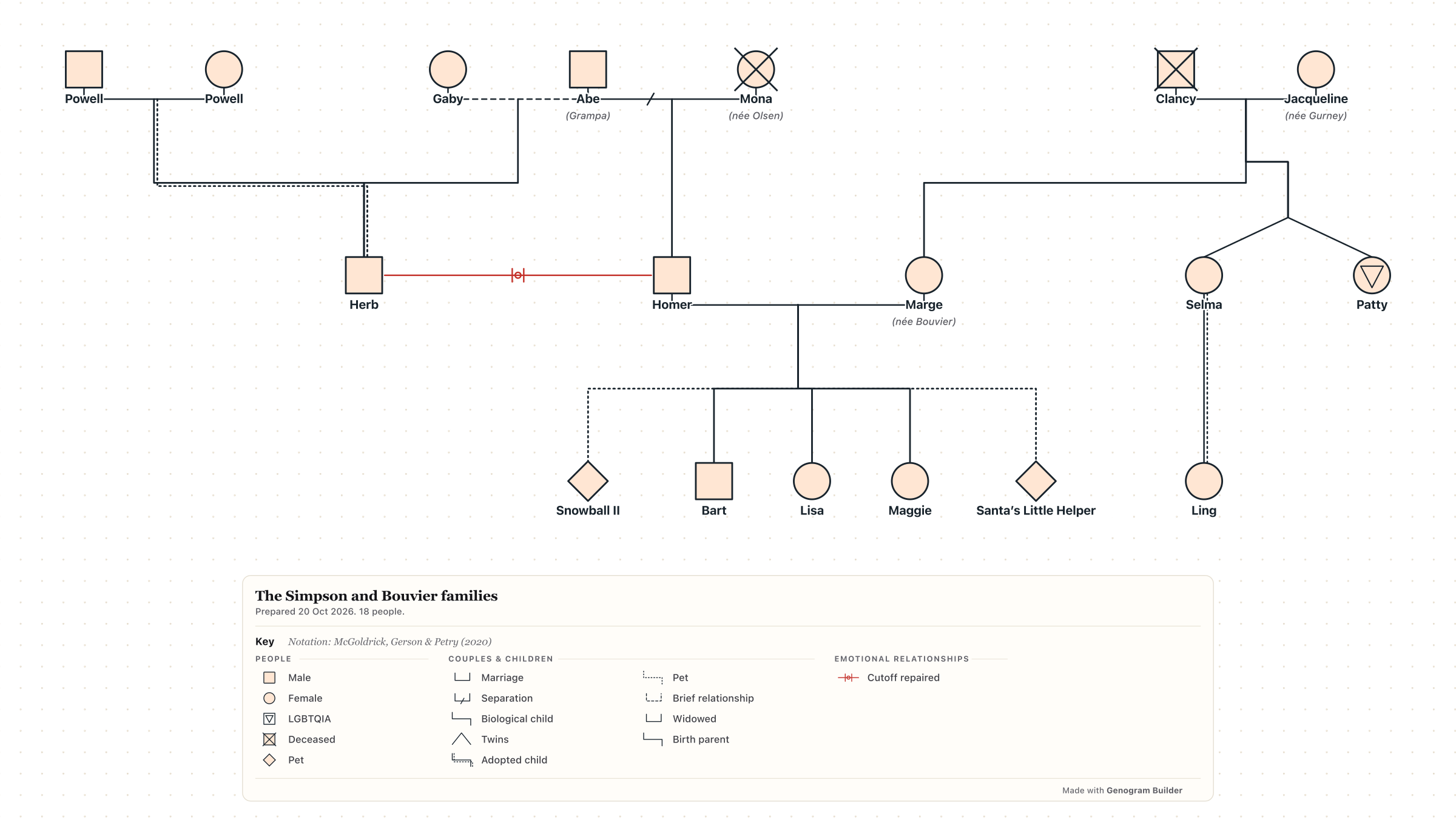
The Simpsons began on Fox in December 1989. The chart gives no birth years, because a year on the chart becomes an age counted to today, which would not match the characters on screen. It stops at season 19, the season in which Homer’s mother Mona dies. Everything drawn here appears in an episode, and the Simpson family article on Wikipedia, which names those episodes, was used to check each person and line.
Three generations are shown in this Simpsons genogram. Abe Simpson and the Bouviers sit on the top row, Homer, Marge, Herb and the twin aunts in the middle, and the children, the pets and Ling at the bottom. The Powells, who adopted Herb, stand at the far left.
Genogram Builder
Draw a family the same way
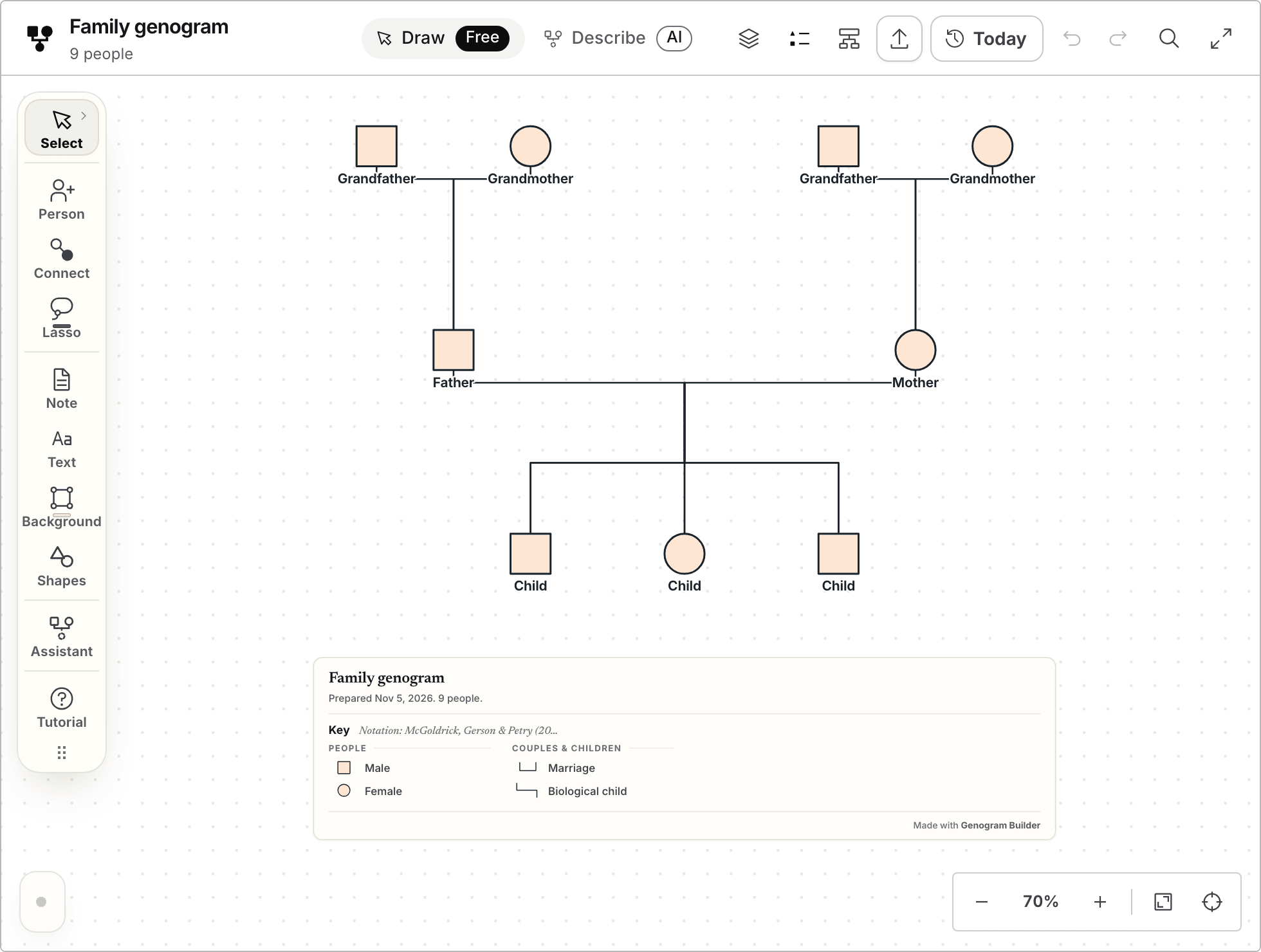
The blank three generation sheet opens in the editor. Each relative becomes a person, each marriage a line, and the key is drawn for you.
- Opens without an account
- Continue in the full editor to keep the chart
- PNG and PDF export with a free account, with a watermark
Every line on the chart comes from an episode
The table lists the relationships that need explaining and the episodes that establish them. A relationship that the series has only hinted at is left off the chart.
| Relationship | How the chart draws it | Where the series shows it |
|---|---|---|
| Abe and Mona | A marriage line with one slash, for a separation | “Mother Simpson”, season 7, in which Mona is revealed to have left the family |
| Abe and Gaby | A dashed line for a brief relationship | “Oh Brother, Where Art Thou?”, season 2 |
| Herb and his parents | A solid line to Abe and Gaby, a dotted line to the Powells | The same episode, in which Abe tells Homer that he gave a son up for adoption |
| Herb and Homer | A cutoff that has been repaired | Seasons 2 and 3, from the failed car to “Brother, Can You Spare Two Dimes?” |
| Patty and Selma | Twin lines from one point on the Bouvier line | The twins are older than Marge, and Selma is older by two minutes |
| Selma and Ling | A dotted adoption line from a single parent | “Goo Goo Gai Pan”, season 16 |
| The two pets | Diamonds on the dotted pet line | Santa’s Little Helper joins the family in the first episode |
The notation records adoption, twins and pets
Herb is the clearest lesson in the chart. He is Homer’s paternal half-brother, born to Abe and a woman named Gaby a year before Abe married Mona, and raised by his adoptive parents, the Powells. The genogram symbols draw a birth parent with a solid line and an adoptive parent with a dotted one, so both families stay on the page and neither replaces the other.
Patty and Selma hang from a single point on the Bouvier line, which is how the notation marks twins. Patty carries the inverted triangle inside her circle, because she comes out as a lesbian in “There’s Something About Marrying”, season 16. Ling hangs from Selma alone, since Selma adopts her as a single parent. Santa’s Little Helper and Snowball II are drawn as diamonds on the dotted line that the notation uses for pets.
What the chart leaves out and why
By season 19 Selma has married five times, once to Abe in season 18, and none of the marriages lasts. Drawn in full, those marriages would make Abe both Homer’s father and his brother-in-law, and the five partners would crowd the chart. They are left out, and this note says so. Abe’s daughter Abbey, born in England during the Second World War, is also left out.
Only one emotional line is drawn. The article describes the twins’ strong dislike of their brother-in-law, but a line from either twin to Homer would cross Marge, so it is told here rather than drawn. The chart records relationships as the episodes present them. It does not diagnose any character or explain why the family behaves as it does.
Use a fictional family to practise the notation
A television family makes a good first exercise, because everyone in a class can check the chart against the same episodes. Start from the household, add one generation at a time, and write down the episode for each fact you add. When a relationship changes over the seasons, choose a cut-off point, as this chart does with season 19, and say so in the caption.
Draw it in the editor from a blank sheet, and compare it with the Star Wars genogram, where adoption and fostering split a pair of twins, and the Modern Family genogram, where remarriage joins three households. The genogram examples show clinical and historical families drawn the same way.
Rebuild this Simpsons genogram from a blank sheet
To practise, rebuild the Simpsons genogram from a blank sheet rather than copying the picture. The blank three generation sheet starts with two sets of grandparents, two parents and three children, which is the shape of the Simpson household before any extra relatives are added.
Select the grandfather on the left and type Abe Simpson into the details, then name Mona, Clancy and Jacqueline and set Clancy and Mona as deceased.
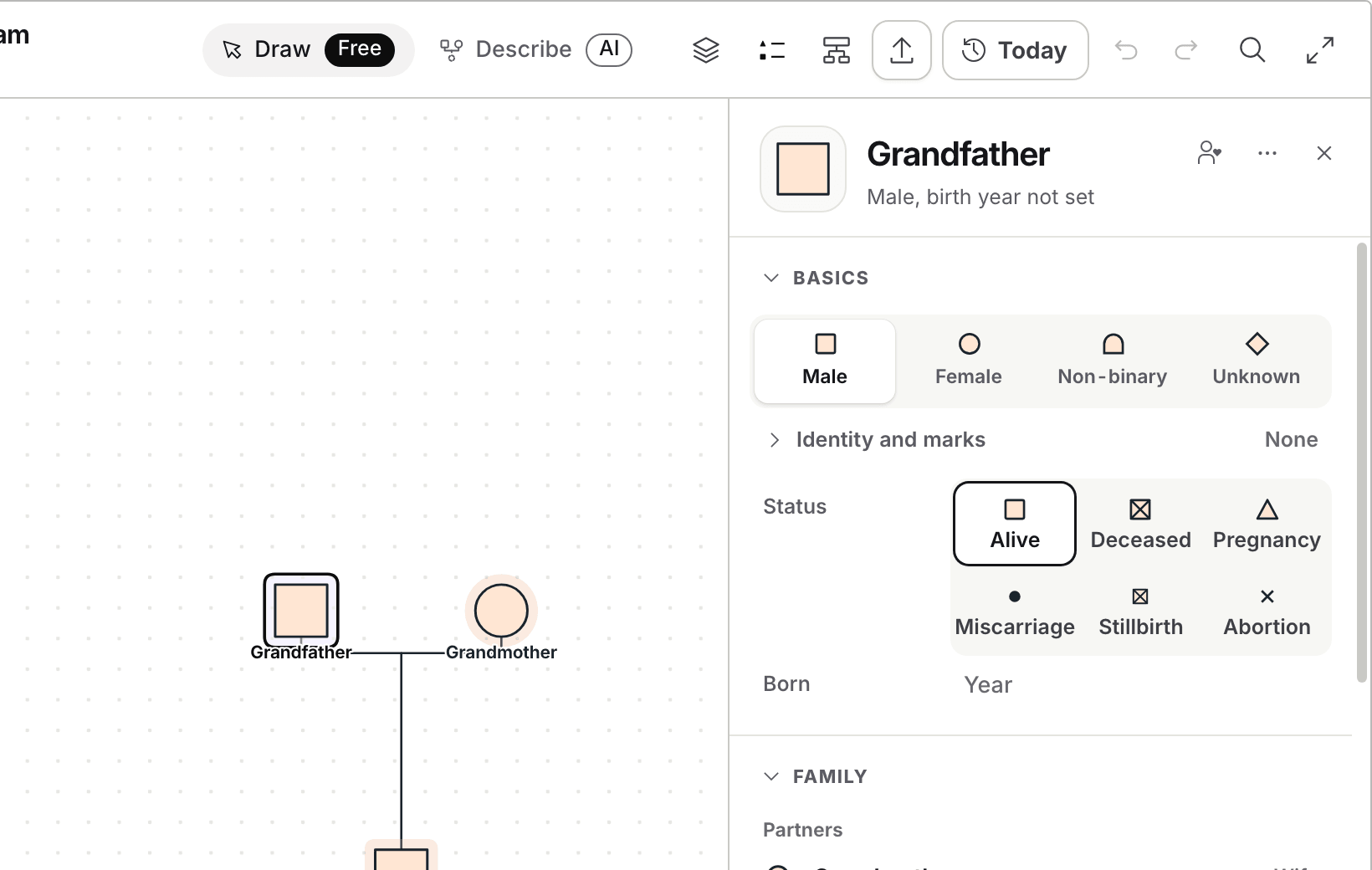
Name the parents and the three children, then add Herb and Ling with the Person tool and Selma with Add a sibling on Marge. Join each one with Connect and choose the parent type, such as birth parent or adoptive parent. Add Patty with Add a twin on Selma, then click their shared line to choose identical or fraternal.
When the chart matches the episodes, choose Export. A free account saves it as a PNG or a PDF with a watermark.

Common questions
Whether Herb is Homer’s brother or half-brother
Half-brother. They share their father Abe, while Herb’s mother is Gaby and Homer’s is Mona, so the chart hangs them from two different couple lines.
Why Mona is drawn as separated from Abe
She left the family when Homer was a boy and lived in hiding, and the article calls her Abe’s estranged first wife. A slash on the couple line records a separation without claiming a divorce that the series never shows.
Using a Simpsons genogram for a class assignment
Draw your own version and name the episode behind each fact, since a tutor can check those against the series. Copying this picture teaches less than rebuilding it, and the choices about what to leave out are part of the exercise.
Whether the pets belong on a genogram
They can. The notation draws a pet as a diamond on a dotted line from the household, and some families count their animals as members. Leave them out when the chart is about something else.
Sources and methodology
We make Genogram Builder. We used the references below for this guide. Last checked on 5 November 2026.
Draw any family the way this chart is drawn, one generation at a time. No account is needed to begin.
Start a family from a blank sheet