At a glance
A structural map shows how a routine works
Family map is a broad phrase. In structural family therapy it usually means a drawing of the way family members organize themselves around a task or a recurring situation. A map can show who makes decisions, which people work together, and what happens at the boundary between groups.
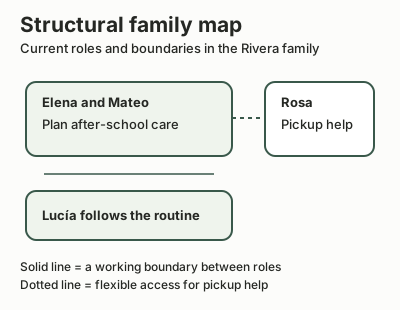
In the Rivera example, Elena and Mateo decide the after-school routine, Lucía follows it and Rosa helps with pickup. The map makes Rosa’s current role visible. Each line is explained in the key, and the roles are recorded as an observation to discuss with the family.
A genogram gives those roles family history
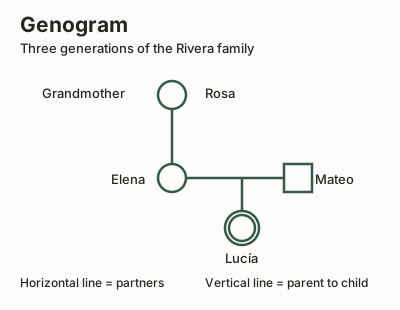
The genogram shows Rosa as Elena’s mother and Lucía’s grandmother. It also shows Elena and Mateo as Lucía’s parents. Those links give the reader a family context for the pickup arrangement. You can add dated events, other relatives and relevant emotional ties as you learn about them.
Use a genogram if you need to record how a relationship changed over time, who is related through a previous partnership, or where a known health condition appears in several generations. Keep unknown relationships and dates marked as unknown.
The question determines which diagram to draw
For a question about current caregiving, map who makes decisions and who provides help. Date the map, because the arrangement can change. For a question about family history, start with a genogram and place each person in their generation.
The drawings can sit side by side in an assignment or assessment. Reuse the same names across both and give each drawing its own key. If the task is about services, school, work and other outside connections, use an ecomap to give that network room.
Start with a question about the routine
Ask what happens when school ends on a day when both parents are still at work. In the Rivera family map, Elena and Mateo agree on the plan and Rosa collects Lucía. Draw the adults who make the decision close enough that the reader can see them working together. Place the regular pickup role beside Rosa. A label for the handoff explains why Rosa appears in the current routine even though she lives in a separate household.
A structural family map can make an arrangement easy to discuss. Mark which interactions you actually observed or heard about and note when the information was collected. If the family describes two different versions of a routine, record them separately until you can ask about the difference. A line indicating a role is a description of that arrangement. Use a brief key so a reader can tell the difference between help, responsibility and a family connection.
Try drawing the same routine at two points in time. If Rosa is away and Mateo changes his work hours, update the map to show who now handles pickup. The new drawing tells you what changed in the arrangement. The birth and parent-child details in the genogram can stay as they were. Adding the date to both diagrams makes it easier to see why the two pictures may change at different times.
Build the history from the same people
Use the same four names on the genogram. Put Rosa on the oldest row, place Elena and Mateo on the adult row, and put Lucía below their partnership. Trace Lucía upward to her parents and Elena upward to Rosa. If there is information about a previous partnership, a half-sibling or a dated event, add it where it belongs on that family branch. You can leave an unconfirmed date blank and put a short note beside the person.
Choose relationship or health details according to the question the chart must answer. A family history chart can follow a condition through the generations. A counseling chart can use emotional lines to show ties that matter to the discussion. Explain the notation in the key and indicate which facts still need to be confirmed. Keep the diagram readable enough that a second reader can follow it without asking where the family story begins.
The same person can be important in both diagrams for different reasons. Rosa appears in the genogram because she is Elena’s mother. She appears in the map because her pickup role affects how this household functions now. Showing both diagrams in a report lets the reader find the part of the story they need, with the generation structure in one view and the current responsibility in the other.
Review the two diagrams before sharing
Ask a reader to explain both pictures using the keys alone. For the family map, ask who sets the routine and who helps carry it out. For the genogram, ask who Lucía’s grandmother is and which side of the family she belongs to. If the reader gives a relationship answer when you asked about the routine, make the map labels clearer. If the reader misses a parent connection, check the line joins and generation rows on the genogram.
When an assignment asks for a family map, look at the course definition before starting. Some courses use that term for a broad family diagram. Others use it for the structural map shown here. The instruction may also ask for an ecomap when the question concerns school, services, work or wider support. Use the names in the assignment’s own key to label your finished diagram.
Keep personal information limited to the task. For a practice case, use fictional names and record the parts of the story needed to explain the example. When you share a real chart, remove details the recipient does not need and keep the working copy separately. Review the two diagrams again if the routine changes or if someone confirms a relationship you had previously left open.
Before you decide
Whether family map always means a structural map
The phrase is also used for informal family diagrams. Here it means the structural family therapy drawing of current organization and boundaries.
Whether a family can use both diagrams
Yes. A genogram can establish relationships across generations while a separate structural map explains how people work together around a current routine.
Sources and methodology
We make Genogram Builder. We used the references below for this comparison. Last checked on 4 November 2026.
Start with the person the chart is about, then add their family and mark what you know about the relationships.
Draw a genogram